Food services up 5.9%, farm and fishery products up 9.7%; home appliances and clothing decline
Overseas direct purchases fall 6.3% in Q3 while reverse cross-border sales jump 40.7%

South Korea's online shopping transactions nearly reached 25 trillion won in September.
Vehicle and auto-parts sales rose more than 30 percent from a year earlier, while food delivery services and farm and fishery products also posted gains. Home appliances and electronics, along with clothing, declined.
Reverse cross-border sales — domestic online transactions targeting overseas consumers — surged more than 40 percent in the third quarter. Direct overseas purchases by South Korean consumers fell, led by declines in buying from China and the United States.
The Ministry of Statistics released the September 2026 online shopping trend report Monday, showing total online shopping transactions reached 24.97 trillion won ($18.7 billion), up 975.8 billion won, or 4.1 percent, from the same month last year. The figure was also 2.7 percent higher than the previous month.
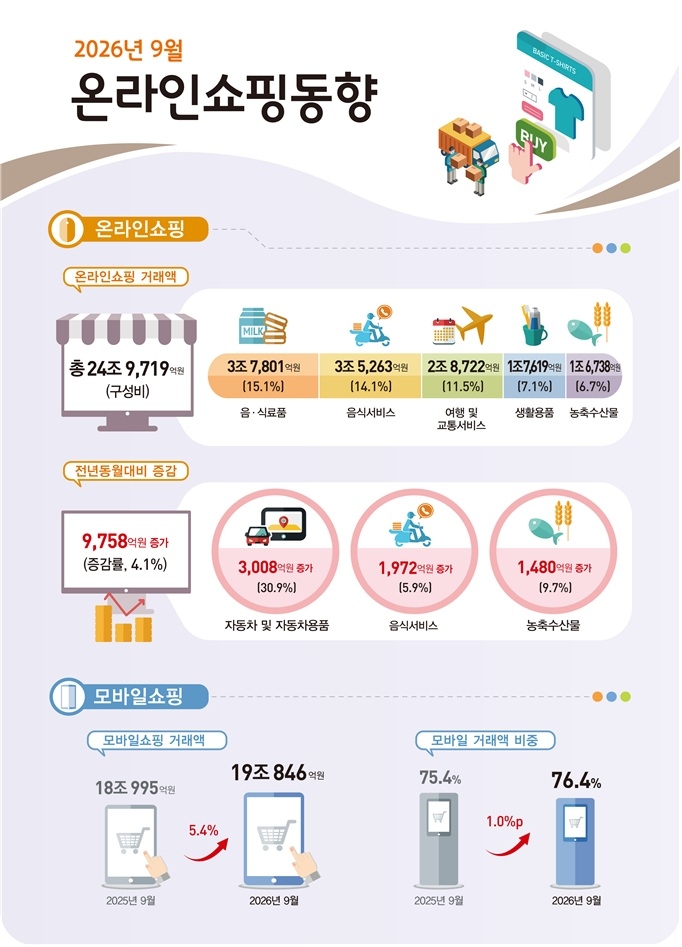
Vehicles and auto parts led overall transaction growth. Sales in the category reached 1.27 trillion won, up 300.8 billion won, or 30.9 percent, from the same month a year ago — accounting for roughly 31 percent of the total increase in online shopping transactions. The figure also rose 44 percent from the previous month.
Food-related categories continued to expand. Food service transactions reached 3.53 trillion won, up 197.2 billion won, or 5.9 percent, from a year earlier. Farm and fishery products rose 148 billion won, or 9.7 percent, to 1.67 trillion won, while food and grocery products climbed 143.7 billion won, or 4 percent, to 3.78 trillion won. Combined food transactions — groceries and farm and fishery products — totaled 5.45 trillion won, a 5.7 percent increase.
Cosmetics transactions reached 1.29 trillion won, up 12.2 percent from the same month a year ago. Cultural and leisure services rose 25.1 percent to 315.2 billion won, and e-coupon services gained 19.4 percent to 625.5 billion won.
Home appliances and electronics, however, fell 7 percent year-on-year to 1.22 trillion won. Clothing slipped 4.8 percent to 1.67 trillion won, and fashion goods and accessories dropped 8.3 percent to 349.4 billion won. Travel and transportation services edged up just 0.6 percent to 2.87 trillion won.
Compared with the previous month, food service transactions fell 11.2 percent and travel and transportation services declined 14.6 percent. Clothing rose 25.1 percent from the prior month but still fell short of the level recorded in the same month last year.
Among all online shopping categories, food and grocery products held the largest share at 15.1 percent of total transactions, followed by food services at 14.1 percent and travel and transportation services at 11.5 percent.
Mobile shopping transactions reached 19.08 trillion won, up 985.1 billion won, or 5.4 percent, from the same month a year earlier. Mobile's share of total online shopping rose 1 percentage point year-on-year to 76.4 percent. By category, mobile accounted for 99.1 percent of food service transactions, 92.2 percent of e-coupon services and 84.3 percent of pet supply purchases.
Online product transactions — excluding travel, food services and similar categories — totaled 17.41 trillion won, representing 29.7 percent of total retail sales.
Third-quarter online overseas direct sales reached 1.09 trillion won, up 40.7 percent from the same period last year. Cosmetics led the category with 636.3 billion won in sales, a 47.1 percent increase, accounting for roughly 58 percent of all reverse cross-border transactions. By destination, China topped the list at 432 billion won, followed by the United States at 278.7 billion won and Japan at 200.2 billion won. Sales to China and the United States rose 62.3 percent and 30.4 percent, respectively.
Third-quarter direct overseas purchases by South Korean consumers, meanwhile, fell 6.3 percent year-on-year to 1.99 trillion won. Purchases from China dropped 9.1 percent to 1.29 trillion won, and those from the United States declined 11.1 percent to 309.4 billion won. Purchases from Japan bucked the trend, rising 32.4 percent to 198.9 billion won.
By product category, clothing and fashion-related goods accounted for the largest share of overseas direct purchases at 753.9 billion won, though that figure was down 15.5 percent from a year earlier. Cosmetics and home appliances and electronics also declined, falling 13.3 percent and 11.1 percent, respectively.
fact0514@heraldcorp.com