Rare tail-drag traces confirmed at site; findings announced by Korea National University of Cultural Heritage
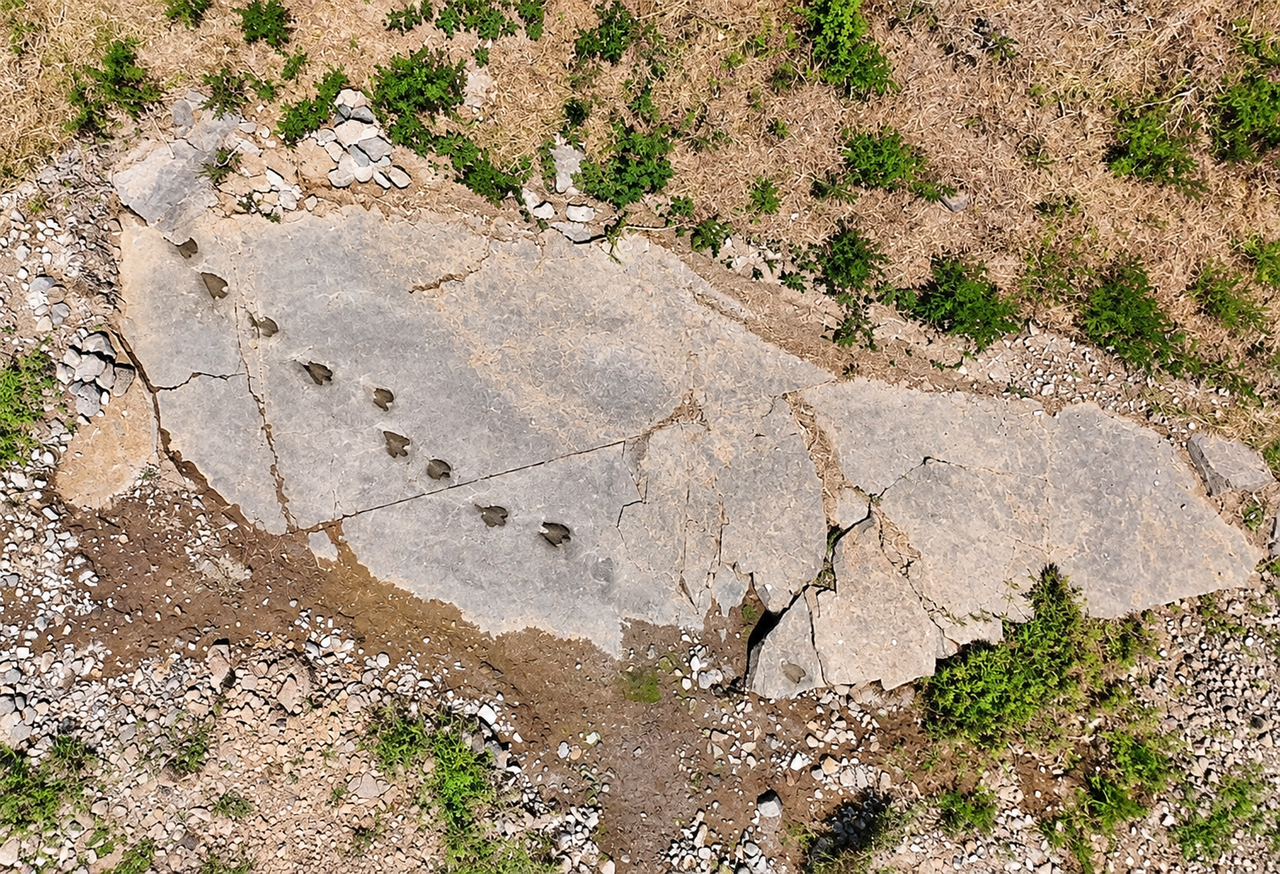
The bank of the Taehwa River in Ibam-ri, Beomeo-eup, Ulju-gun, Ulsan, has been confirmed as a lakeside habitat where dinosaurs roamed about 100 million years ago, drawing attention from the academic community.
The city of Ulsan on Tuesday announced the final results of an academic study titled "Research on the Paleontological Value of the Ibam-ri Fossil Site in Ulju-gun," conducted over six months beginning in May by the Korea National University of Cultural Heritage's Industry-Academic Cooperation Foundation under the supervision of Professor Kong Dal-yong.
The investigation confirmed that the fossil site around Ibam-ri 1141-128 contains sedimentary layers formed during the Cretaceous period of the Mesozoic era, approximately 100 million years ago. Dinosaur footprints were identified across at least seven stratigraphic levels, establishing the area as a major activity zone for dinosaurs.
The sedimentary layers also revealed a variety of depositional structures, including ripple marks, raindrop impressions, paleosol layers, irregular polygonal cracks and gas structures. Researchers said these features indicate the site was a lake margin that was submerged during wet seasons and partially exposed during dry seasons.
At the location first identified in 2012 (Site A), researchers confirmed a quadrupedal trackway belonging to a large ornithopod dinosaur. Analysis of the trackway estimated the ornithopod's hip height at approximately 1.16 meters and its walking speed at about 2.3 kilometers per hour.
At a nearby location (Site C), a quadrupedal trackway stretching about 8.2 meters was found alongside tail-drag traces running along the center of the trackway. The forefootprints were notably smaller and shallower than the hindfoot prints — a pattern distinct from typical terrestrial locomotion. The research team proposed a behavioral hypothesis that the dinosaur may have been moving through shallow water with part of its body submerged, influenced by buoyancy and the soft substrate.
Tail-drag traces are far rarer in the fossil record than footprints alone, with only about 50 cases reported across nine countries, including France, the United States, China and South Korea. Within South Korea, the only previously known site — in Yeongdong, North Chungcheong Province, reported in 2011 — was lost to a slope collapse, making Ibam-ri the country's sole remaining fossil site with dinosaur tail-drag traces.
The study used three-dimensional scanning and drone photogrammetry to precisely document the site's major dinosaur footprints and trackways. Taking into account academic significance, representativeness, rarity, preservation condition and educational value, the research team concluded that the Ibam-ri fossil site holds high geological heritage value.
"Although the Ibam-ri fossil site is not large in scale, it preserves dinosaur footprints and trackways from multiple stratigraphic levels, rare tail-drag traces, and diverse sedimentary structures all within a single geological context," said Kong Dal-yong, a professor at the Korea National University of Cultural Heritage. "It holds significant academic value in that it allows comprehensive research into the behavior of Cretaceous dinosaurs, the environment of the time, and the processes by which the footprints were formed and preserved."
cityblue@heraldcorp.com