Exhibition booth at COEX's AI Expo MARS 2026
Demonstrations span daily care to medical referrals
Three clinical algorithms power personalized lifestyle management
Proof-of-concept underway with health center and regional hospital in Hwaseong's Dongtan
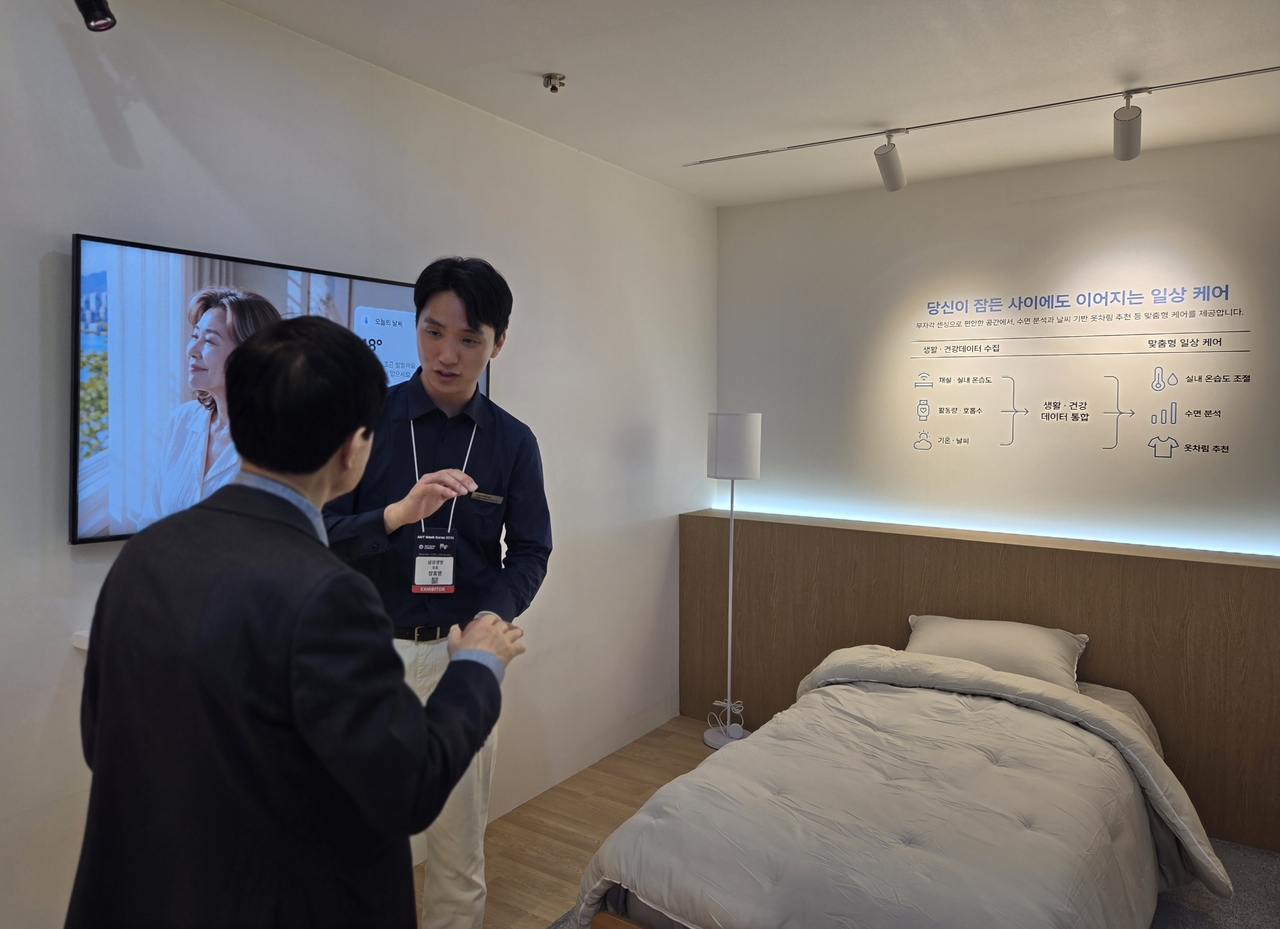
Samsung Life Insurance is launching a community-based integrated care model called "Senior Connected Care," covering everything from daily lifestyle management and safety monitoring to referrals to local medical institutions. The rollout comes as South Korea's population aged 65 and older has surpassed 20 percent, officially entering super-aged society status, and insurers are moving in earnest to capture the senior care market.
Samsung Life announced Wednesday that it is showcasing Senior Connected Care at AI Expo MARS 2026, held at COEX in Seoul from Tuesday through Thursday. The expo is an AI fair hosted by Hwaseong Special City, and Samsung Life is participating in the "Real Life AI" category covering healthcare and smart-home technology. The exhibition booth is designed as a senior residential space, an integrated monitoring center and a local government consultation area, and demonstrates the full care process from daily lifestyle support to medical institution referrals.
Samsung Life has adopted the slogan "Connect technology, embrace daily life, protect life," centering the model on what it calls "five connections" — data, clinical medicine, daily living, life and public policy. The concept is built around Aging in Place (AIP), supporting seniors in continuing to live in their own homes and communities. While conventional care monitoring has focused on safety checks and emergency response, this model goes further by applying clinically grounded algorithms to provide personalized management of everyday life.
At the core are three algorithms covering disease prediction, vitality management and anomaly detection. The system analyzes lifestyle data gathered from residential sensors and wearable devices to deliver personalized missions and guidance tailored to each individual's living patterns, with activity levels adjusted as those patterns change. The service is a non-medical lifestyle management offering, not a diagnostic or treatment service.
When an unusual change in a senior's daily routine is detected, a monitoring coordinator follows established procedures to verify the information and relay it to a guardian or local care worker. If medical attention appears necessary, the system connects the senior to a regional hospital or other medical institution. Samsung Life has also proposed an operational model for local governments, under which municipalities identify local care needs and coordinate health centers, medical institutions and welfare agencies to track service outcomes. The company said the model can be expanded to include a range of lifestyle support services tailored to each region's demographic profile and welfare conditions.
Samsung Life and Hwaseong Special City are conducting a proof-of-concept project in the Dongtan area through December. The pilot will verify whether key operational procedures — lifestyle management missions, monitoring based on daily living data, safety checks and follow-up responses, and linkages to regional hospitals and municipal services — work effectively in the field.
"Integrated care in a super-aged society must evolve beyond simply confirming seniors' safety to actively supporting their everyday lives and connecting them to medical and community care when needed," a Samsung Life official said. "We will work with regional hospitals and local governments to build an integrated care model that allows seniors to live with peace of mind in the places they call home."
won@heraldcorp.com