Kim's apology over Shincheonji remarks called 'an act of courage'
Party adviser urges caution on merger with Rebuilding Korea Party
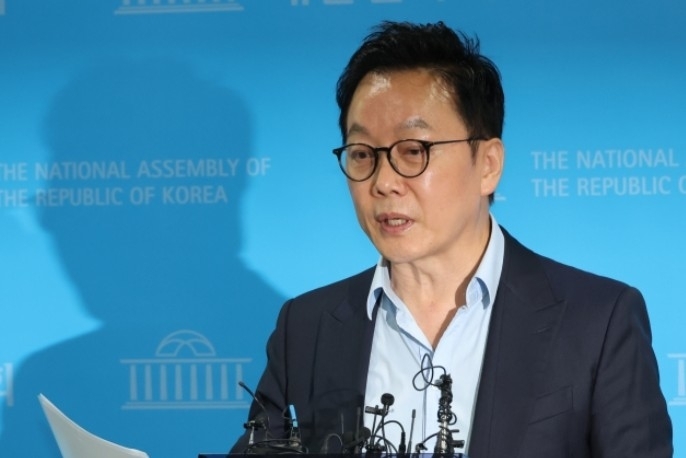
Jung Bong-ju, special adviser on planning to the Democratic Party of Korea leader, said Wednesday that internal party conflict is the primary cause of the Democratic Party's sliding approval rating, and called on party members to stop undermining leader Kim Min-seok. Jung also praised Kim for apologizing Tuesday over remarks related to the Shincheonji Church of Jesus allegations, calling the move "an act of courage."
Appearing on YTN Radio's "Jang Seong-cheol's News Myeongdang," Jung pushed back against calls for Kim to take responsibility as the party leader approaches his 100th day in office. "He promised to raise the approval rating by 10 percentage points — he did not promise to resign if he failed to do so," Jung said.
Jung went on to say that some within the party were continuing to destabilize Kim for political gain. "The fundamental reason the Democratic Party's approval rating has fallen starts with internal division," Jung said.
"He is trying to raise the numbers and reach out, but if people say, 'I don't need to join hands with you — I'm going to keep shaking things up,' how can the approval rating possibly go up?" Jung added.
On the broader state of intraparty tensions, Jung said internal conflict is a two-way problem. "One side is trying to extend a hand, but the other keeps pushing it away — that has to stop," Jung said.
"I personally meet with these people behind the scenes to try to build bridges, and we smile and get along just fine — but the moment a microphone appears, the sharp criticism comes back. How is internal conflict supposed to be resolved that way?" Jung said.
Jung also argued that younger voters have changed the way they see the Democratic Party. The party has been the largest in the National Assembly since 2016, held a commanding majority in 2020 and retained its top position in 2024, Jung noted. "For voters in their 20s and 30s who started paying attention to politics in 2016, the Democratic Party has been the establishment for more than a decade," Jung said.
"Young Koreans have always rallied behind the underdog, never the one on top. We have been on top for about 10 years. But if instead of pooling strength for the country, the people and people's livelihoods, they just fight among themselves every day — that is simply a turf war. Who is going to vote for a party that is fighting over turf?" Jung said.
Jung was positive about Kim's apology over his earlier remarks on Shincheonji. "It is a very significant thing for a political leader to apologize," Jung said. "Anyone who has watched politics for a long time knows they rarely apologize — not just rarely, but almost never." Jung added that "an apology takes great courage and resolve."
Jung struck a cautious note on the question of merging with the Rebuilding Korea Party. "A merger is an enormous undertaking," Jung said, adding that if the current electoral system remains in place, the need for a proportional-representation party could arise again at the 2028 general election. "The time has come to discuss whether a party dedicated to proportional representation should have a permanent place in South Korean political history," Jung said. "It may well be meaningful for the Rebuilding Korea Party, which was launched as a proportional-representation party, to continue playing that role."
raining@heraldcorp.com