Record 419,432 recipients last year as payouts rise 4.86%; disability benefits drive three-quarters of increase; construction sector and gig workers see notable gains
Workers' compensation insurance payouts in South Korea surpassed 8 trillion won for the first time last year, with the number of recipients approaching 420,000 — a record high — and more than half of them aged 60 or older. Disability benefits accounted for nearly three-quarters of the overall increase, while the construction sector and gig workers such as delivery riders and designated drivers also saw rising recipient numbers.
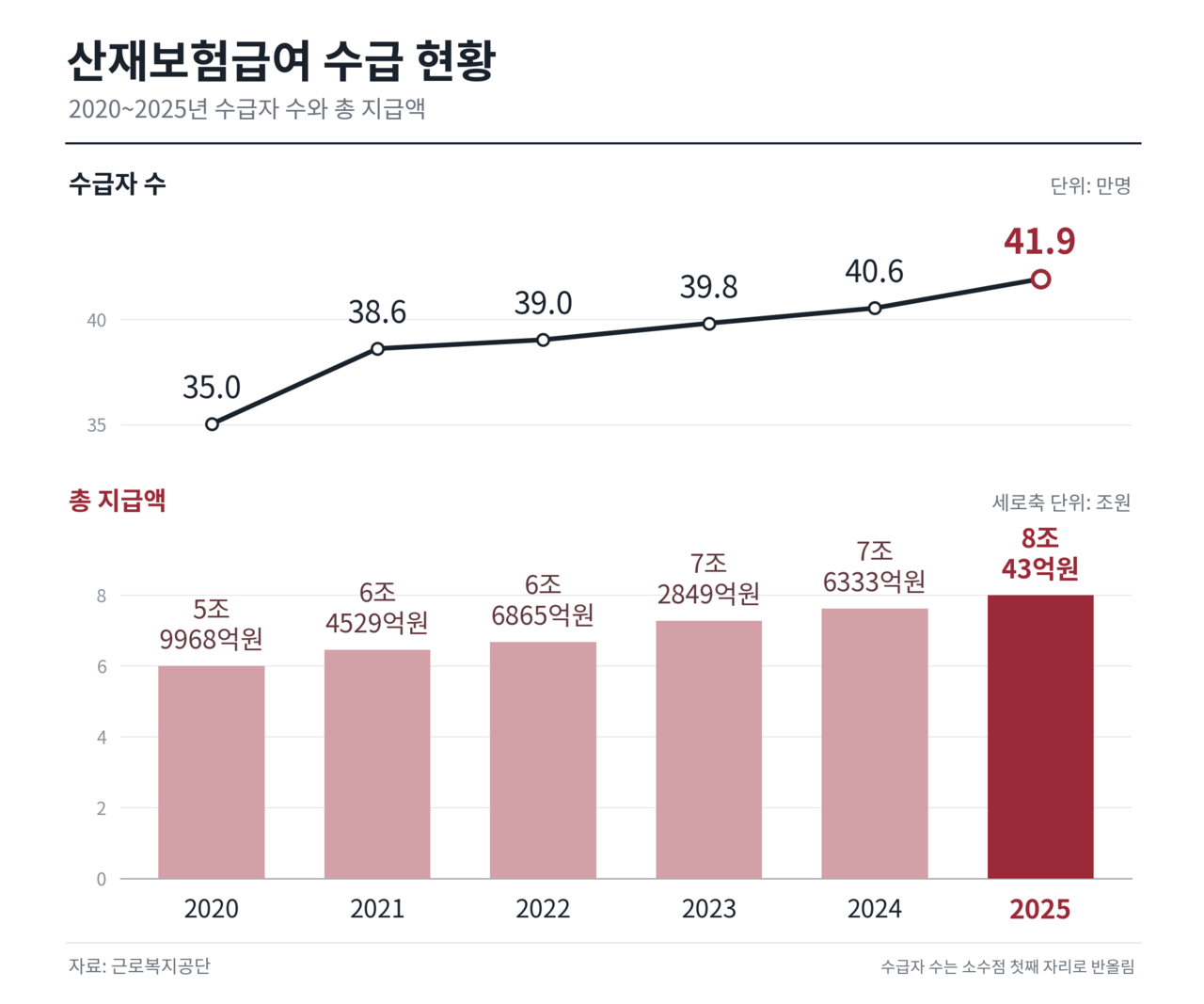
According to the 2025 Korea Workers' Compensation and Welfare Service statistical yearbook released Wednesday, the number of people who received workers' compensation benefits last year reached 419,432, up 13,893, or 3.43 percent, from 405,539 the previous year. Total payouts rose from 7.63 trillion won to 8 trillion won ($5.96 billion), an increase of 371 billion won, or 4.86 percent. Both figures were the highest recorded in the yearbook's annual data.
By age group, recipients aged 60 or older numbered 222,666, accounting for 53.1 percent of the total. Broadening the range to those 50 and older, the figure reached 315,581, or 75.2 percent — meaning roughly three in four recipients were at least 50 years old. The 60-to-69 age bracket was the largest at 132,313, followed by the 50-to-59 group at 92,915 and the 70-to-79 group at 67,790.
Disability benefits were the primary driver of the overall payout increase. Last year's disability benefit payouts reached 3.24 trillion won, up 272.5 billion won, or 9.17 percent, from the previous year — representing 73.5 percent of the total 371 billion won increase in workers' compensation payouts. The number of disability benefit recipients also rose by 5,668, or 4.63 percent, to 128,110.
Survivor benefit payouts came to 1.11 trillion won, up 86.8 billion won, or 8.45 percent. The number of temporary disability benefit recipients fell by 426, or 0.24 percent, to 174,233, but total payouts edged up 31.2 billion won, or 1.62 percent, to 1.96 trillion won. Medical care benefit recipients, meanwhile, increased by 8,914, or 2.96 percent, to 309,939, while payouts dipped 5 billion won, or 0.34 percent, to 1.46 trillion won.
By industry, the construction sector posted the sharpest rise in recipients. Construction sector recipients totaled 107,017 last year, up 6,392, or 6.35 percent, from the previous year. Manufacturing sector recipients rose 1,007, or 0.90 percent, to 112,404, while other industries gained 5,899, or 4.69 percent, to 131,678. Together, these three sectors accounted for 83.71 percent of all recipients.
Recipients in the transportation, warehousing and communications sector also increased by 1,955, or 5.50 percent, to 37,509. The mining sector saw a decline of 1,049, or 3.91 percent, to 25,773.
Among workplaces excluding the construction sector, those with 5 to 29 employees had the highest number of recipients at 87,349 and also recorded the largest payouts at 1.37 trillion won. Workplaces with fewer than five employees followed with 83,643 recipients and 1.18 trillion won in payouts. Particularly notable was the 4,870-person, or 6.18 percent, increase in recipients at sub-five-employee workplaces — far outpacing the 0.50 percent growth rate at the 5-to-29-employee tier.
Recipients and payouts also rose among gig workers, including delivery riders, designated drivers and freight truck owner-operators. Last year's recipient count reached 23,835, up 1,912, or 8.7 percent, from the previous year, while payouts climbed 32.5 billion won, or 14.0 percent, from 232.6 billion won to 265.1 billion won.
By occupation, freight truck owner-operators saw their recipient count rise from 3,860 to 4,899, an increase of 1,039. Designated drivers increased from 1,361 to 1,717, and parcel delivery workers from 1,913 to 2,343.
Foreign worker recipients numbered 19,482, up 1,395, or 7.7 percent, from the previous year, with payouts rising 12.6 billion won, or 3.9 percent, to 336.4 billion won. By nationality, Chinese nationals were the largest group at 12,626, of whom 10,743 were ethnic Koreans. Vietnam followed with 1,022 recipients, Uzbekistan with 863 and Nepal with 716.
Both the number of recipients and total payouts have trended upward for years. Recipients grew from 350,363 in 2020 to 419,432 last year, while payouts increased over the same period from 5.9968 trillion won to 8.00 trillion won. Last year's average payout per recipient was 19.08 million won, up about 260,000 won, or 1.3 percent, from the previous year.
fact0514@heraldcorp.com