Total 'resting' population reaches 2.55 million, down from last year's record; share of inactive population seeking work falls to 8-year low; economically inactive population rises to 16.29 million
About 2.55 million people in South Korea are neither working nor looking for work — a group the government classifies as "resting" — with 680,000 of them in their 20s and 30s, the age groups considered the core of the workforce.
The share of economically inactive people who hope to find a job or start a business in the near future has also dropped to its lowest level in eight years.
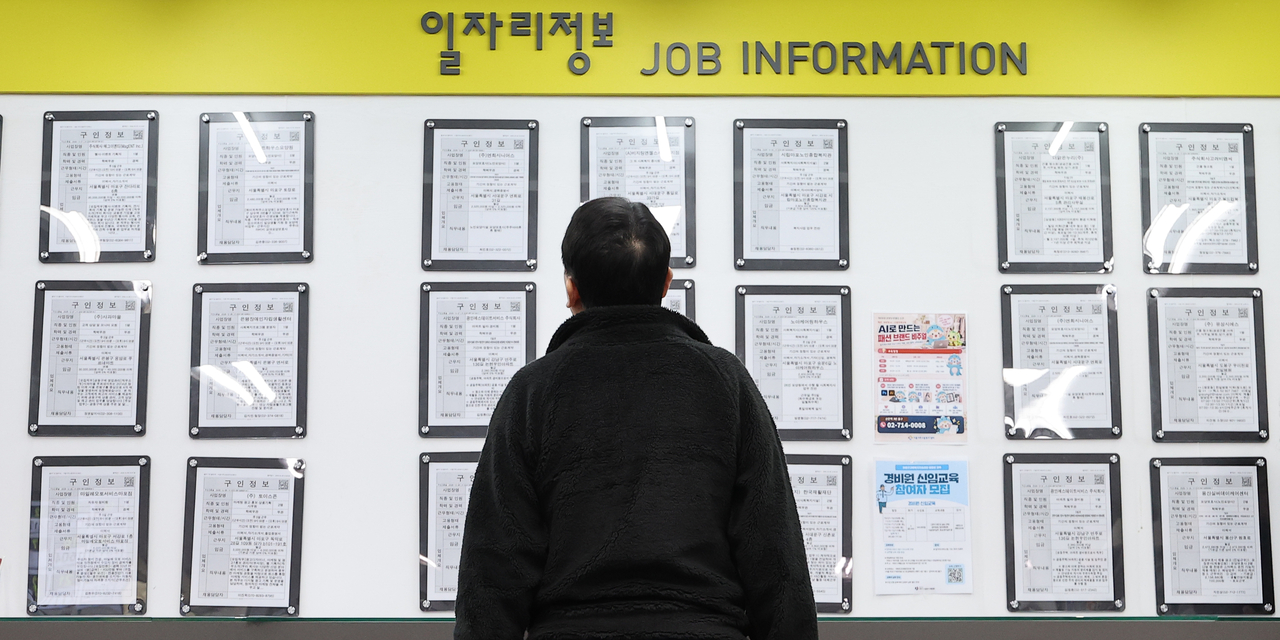
According to the supplementary survey on the economically inactive population released Wednesday by the Ministry of Statistics, the economically inactive population stood at about 16.297 million as of August, up 77,000 from a year earlier. They accounted for 35.4 percent of the population aged 15 and older, unchanged from last year.
The economically inactive population refers to people who are neither employed nor actively seeking work. Women made up 61.5 percent of the group and men 38.5 percent. By age, those 70 and older accounted for the largest share at 29.4 percent, followed by people in their 60s at 19.0 percent and those aged 15 to 19 at 13.1 percent.
Compared with last year, the 70-and-older group grew by 232,000, the 60s group by 53,000, and the 15-to-19 group by 30,000. By contrast, the population in their 50s fell by 115,000, those in their 40s by 71,000, and those in their 20s by 43,000.
Among the main activities reported by the economically inactive, housework was the most common at 37.0 percent, followed by schooling or coursework at 20.6 percent. Those who said they were simply resting without any particular activity accounted for 15.7 percent.
The "resting" population totaled about 2.551 million, down 89,000 from last year's record high of about 2.641 million.
By age, people in their 60s made up the largest group at 966,000, followed by those in their 20s at 377,000, those in their 50s at 366,000, and those in their 30s at 303,000. People in their 40s numbered 264,000 and those aged 70 and older 257,000. Combined, those in their 20s and 30s totaled 680,000.
The 60s age group's share of the total "resting" population rose 1.9 percentage points from last year to 37.9 percent, while those aged 70 and older climbed 1.8 percentage points to 10.1 percent. The shares of people in their 20s and 50s fell 1.7 and 1.6 percentage points to 14.8 percent and 14.4 percent, respectively, while those in their 30s slipped 0.5 percentage points to 11.9 percent.
Reasons for resting varied by age. Overall, poor health was the most common answer at 34.4 percent, followed by continuing to rest after leaving a job or reaching mandatory retirement age at 19.9 percent. Some 18.9 percent said they could not find the kind of work they wanted.
Among younger respondents, difficulty finding desirable work was the top reason. Some 35.2 percent of the "resting" population aged 15 to 29 said they were not working because they could not find jobs they wanted, and the same response was the most common among those in their 30s at 32.3 percent.
Those figures rose 1.1 percentage points for the 15-to-29 age group and 5.0 percentage points for those in their 30s compared with last year. In all other age groups, health problems were cited most frequently.
About 3.24 million economically inactive people said they hoped to find employment or start a business within the next year, representing 19.9 percent of the total economically inactive population — down 0.5 percentage points from last year and the lowest level since 16.7 percent was recorded in 2018.
Among those who wanted to work or start a business, 76.1 percent said their motivation was to earn living expenses or spending money. In terms of preferred employment type, 92.9 percent wanted to be wage workers and 7.1 percent sought non-wage work. More specifically, 67.0 percent preferred full-time positions, 25.9 percent part-time, and 6.9 percent self-employment.
Among those who preferred part-time work, health concerns were the most common reason at 36.2 percent, followed by a desire to balance work with other activities or commitments at 24.2 percent, and childcare or child education at 15.5 percent.
The most commonly desired monthly wage range was 2 million to 3 million won ($2,240) at 42.8 percent. Some 30.4 percent wanted 3 million won or more, while 19.6 percent sought between 1 million and 2 million won.
For those planning to start a business within a year, the most important considerations were income and profitability at 46.7 percent, personal aptitude and field of study at 24.1 percent, and startup capital and growth potential at 18.0 percent.
Among those who did not want to find work or start a business, housework was the most common reason at 24.6 percent, followed by academic study or college preparation at 22.9 percent and old age at 21.7 percent. Men most often cited academic study or college preparation at 33.5 percent, while women most frequently pointed to housework at 37.7 percent.
y2k@heraldcorp.com