Korea Labor Institute analyzes workers born 1955–1961; rehired at same firm see 13.5% wage drop
90.2% of surveyed firms assign rehired workers same duties as before retirement
Among 79 firms with wage-peak systems, 53.2% cut pay further upon rehiring
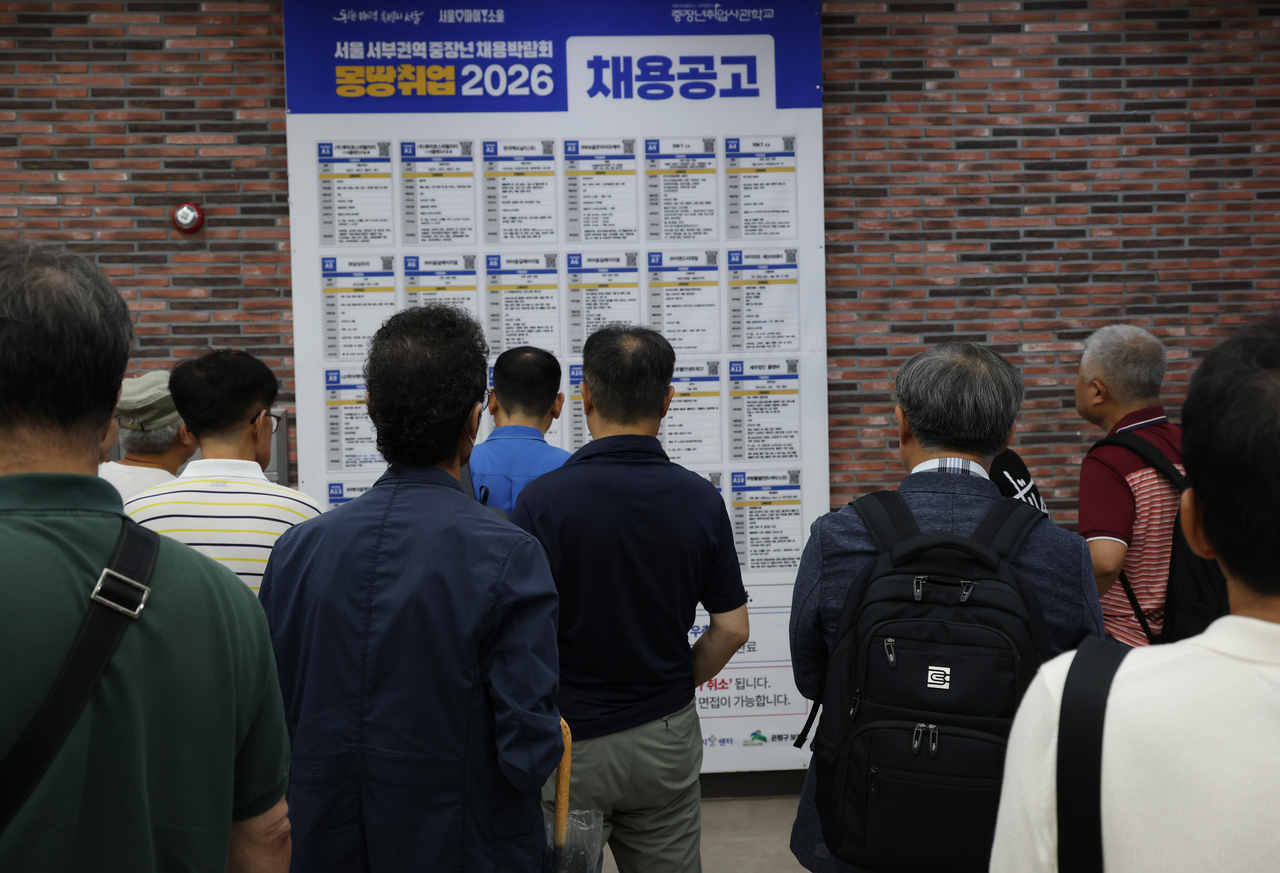
Workers rehired by the same employer after retiring near the mandatory retirement age saw their average monthly wages fall by 395,000 won ($295) compared with what they earned before leaving, according to new research. A separate survey of businesses found that nine out of 10 firms assigned rehired workers the same duties they had performed before retirement.
More than half of firms operating wage-peak systems cut pay a second time upon rehiring workers whose wages had already been reduced before the mandatory retirement age. As discussions over extending continued employment to age 65 gain momentum, the criteria for setting wages after the retirement age are emerging as a central issue.
Rehired at same firm: 13.5% wage drop; job changers or self-employed: 33.3% drop
According to the October issue of the Korea Labor Institute's Labor Review, released Thursday, senior research fellow Lee Seung-ho compared the pre- and post-retirement incomes of workers born between 1955 and 1961 who had held full-time positions until age 59, drawing on data from the Korea Labor Panel Survey. Workers who returned to the same employer as non-regular staff after retiring were classified as "rehired," while those who found work at a different firm or started their own business were classified as "re-employed."
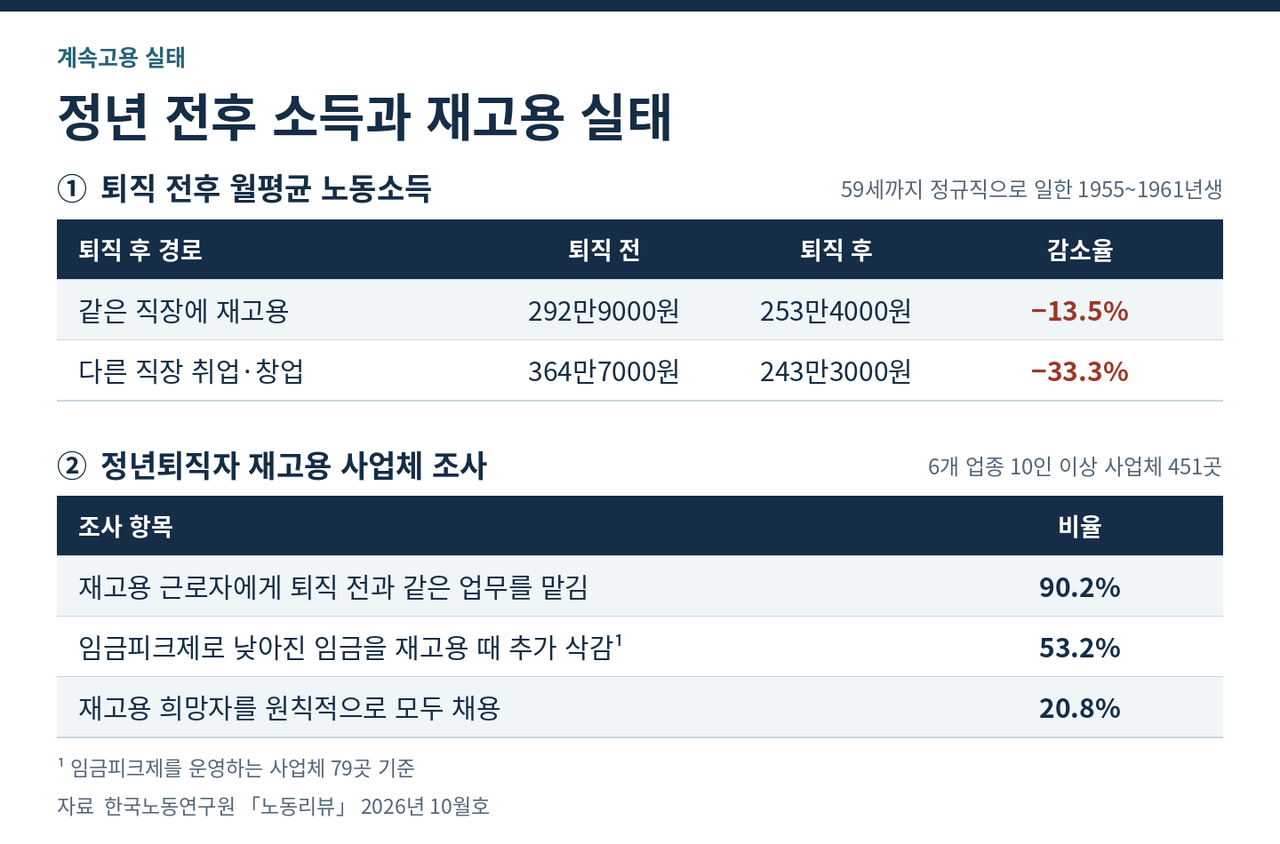
The rehired group saw average monthly wages fall 13.5%, from 2.93 million won before retirement to 2.53 million won after. The re-employed group experienced a steeper 33.3% decline in average monthly labor income over the same period, dropping from 3.65 million won to 2.43 million won. Before retirement, the re-employed group earned 718,000 won more per month than the rehired group; after retirement, the rehired group earned 101,000 won more.
Among those studied, 54.6% maintained their existing full-time positions until they became eligible for the national pension. Another 20.8% continued earning labor income through rehiring or re-employment, while 24.7% experienced a gap in labor income before their pension payments began.
The share who experienced an income gap was 12.5% among those born in 1955 and 1956, who begin receiving the national pension at age 61, and 33.7% among those born in 1961, who must wait until age 63. Workers born in 1966, who turn 60 this year, will not begin receiving their national pension until age 64.
Lee said that where a full-scale extension of the mandatory retirement age is not feasible, rehiring could serve as a transitional measure — one that extends the period workers can remain in their primary jobs and softens the drop in labor income after retirement.
90.2% of rehiring firms assign same duties; only 20.8% accept all applicants
Senior research fellow Noh Se-ri of the Korea Labor Institute separately surveyed 451 firms with 10 or more employees across six industries — including manufacturing and wholesale and retail trade — that had rehired workers who reached mandatory retirement age within the past five years, as well as 167 of those rehired workers. The survey was conducted last year.
Among the firms surveyed, 90.2% assigned rehired workers the same duties as before retirement, and 78.7% said the workers' productivity was comparable to their pre-retirement level. The most commonly cited reason for rehiring was the desire to retain skilled and experienced staff, at 63.9%.
Wage outcomes varied depending on whether firms operated a wage-peak system. Among the 79 firms with such a system, 53.2% reduced wages further upon rehiring, on top of cuts already made before the mandatory retirement age. Some 7.6% paid less than half of what the worker had earned just before retirement. Among firms without a wage-peak system, 77.6% maintained the worker's pre-retirement wage level upon rehiring.
Only 20.8% of firms said they accepted in principle all workers who wished to be rehired. Another 41.2% screened candidates selectively, while 37.9% used a combination of both approaches.
Labor groups are calling for the statutory retirement age to be raised to 65, in line with the national pension eligibility age. Business groups, citing concerns over labor costs, prefer a system that allows companies to rehire retirees on terms suited to their individual circumstances.
"In some firms, wages were cut even when job duties and working hours remained unchanged," Noh said. "Pay should be determined based on actual duties, roles, working hours, workload and responsibilities — not on age or whether a worker has reached the retirement age — and the criteria and calculation method should be clearly explained to workers."
fact0514@heraldcorp.com