
Ministry of Employment and Labor, related ministries and labor groups hold joint awards ceremony
Doosan Bobcat pays colleagues 500,000 won for covering parental leave duties
Nepes Ark lets office workers choose start times to the minute between 6 a.m. and 1 p.m.
Honorees receive exemptions from routine labor inspections and tax audit deferrals
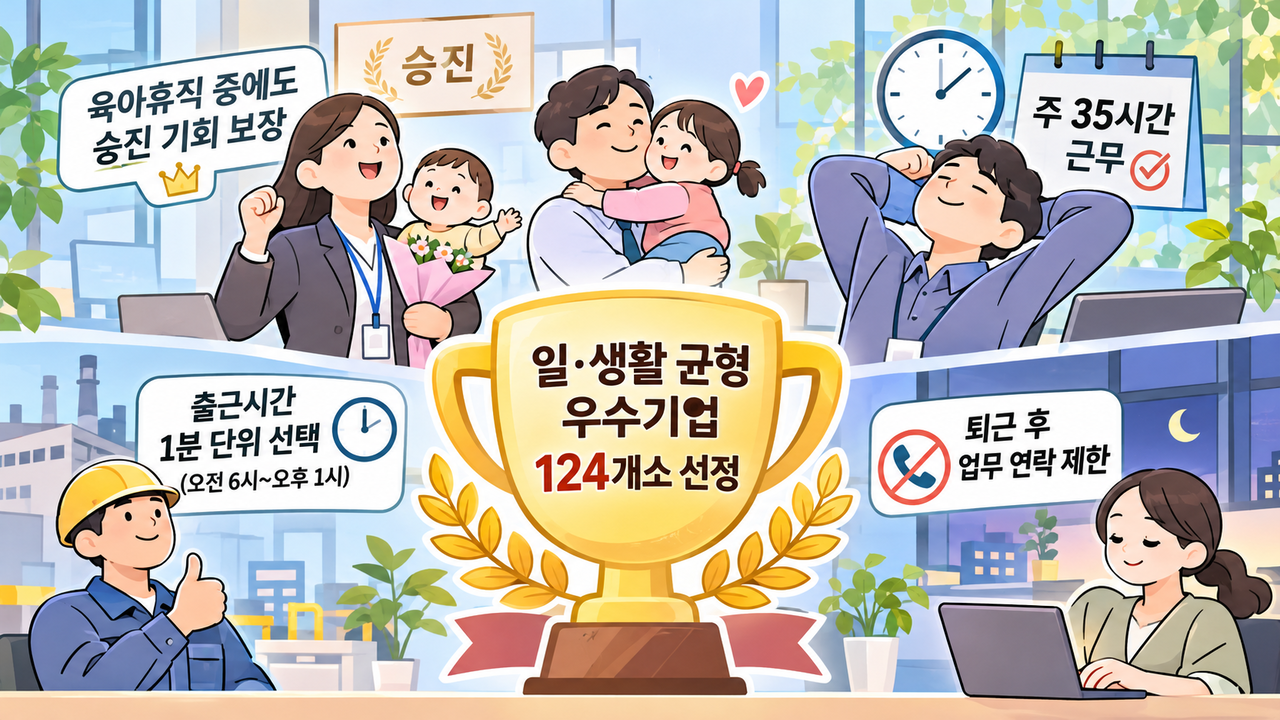
Employees on parental leave can still be considered for promotion, and colleagues who cover their workload receive a separate allowance. One manufacturer lets workers choose their start time to the minute, while a small business has introduced a 35-hour workweek and restricted after-hours contact. The government on Wednesday named 124 companies leading the way on balancing work with childcare and reducing working hours, designating them top work-life balance employers.
The Ministry of Employment and Labor held the "2026 Korea Work-Life Balance Excellence Awards" ceremony at Olympic Parktel in Seoul on Wednesday, joined by the Ministry of Trade, Industry and Resources, the Ministry of SMEs and Startups, the Korean Confederation of Trade Unions, the Korea Enterprises Federation, the Korea Chamber of Commerce and Industry, and the Korea Federation of SMEs.
The designation recognizes companies that have demonstrated exemplary practices in combining work with childcare, flexible working arrangements, reduced working hours and leave usage. This year, 295 companies applied, and after written reviews and on-site inspections, 17 large companies, 24 mid-sized companies and 83 small and medium-sized enterprises were selected. Honorees receive benefits including exemptions from routine labor inspections, bonus points in public procurement, deferrals of tax and customs audits, and preferential terms on financing and guarantees.
Tricycle, a mid-sized online commerce company, guarantees employees on parental leave the opportunity to be considered for promotion. The company allows workers to apply for maternity and parental leave together in a single request, and conducts pre-return interviews to place employees in roles that suit their childcare situation and preferred department. Its return-to-work rate after parental leave exceeds 90 percent.
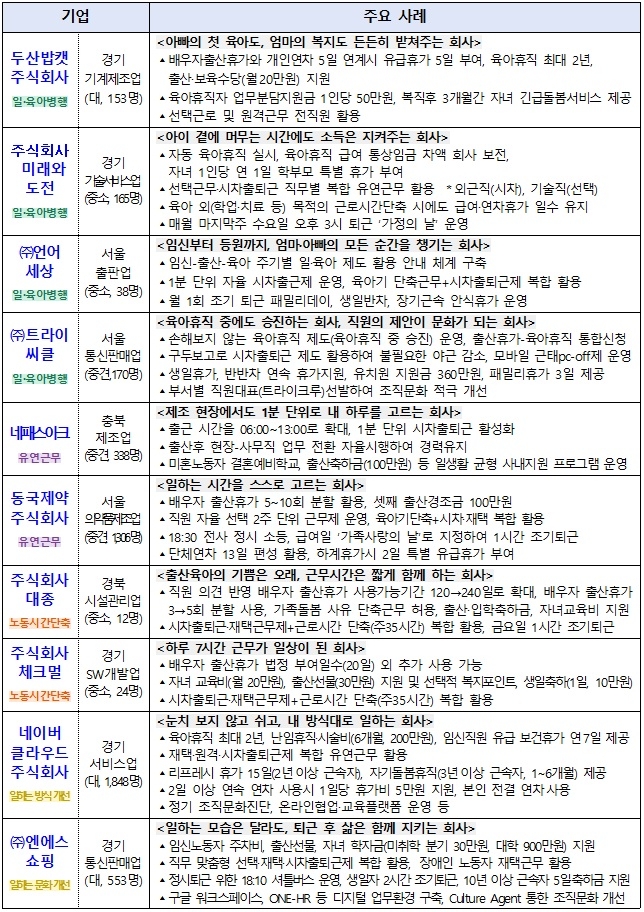
Doosan Bobcat guarantees parental leave of up to two years and covers the gap between the government's parental leave benefit and an employee's regular monthly salary during the first month of leave. The company also pays 500,000 won ($372) per person to colleagues who take on the absent employee's duties. For three months after an employee returns to work, the company provides a childcare referral service for parents who need emergency help with their children.
Small and medium-sized enterprise Mirae and Challenge covers the difference between the government parental leave benefit and employees' regular wages. Workers who reduce their hours for reasons beyond childcare — such as pursuing education or undergoing medical treatment — retain their full pay and annual leave entitlement. Every last Wednesday of the month, the company holds a "Family Day," with employees leaving at 3 p.m.
The manufacturing sector has also seen moves to expand workers' control over their schedules. Nepes Ark, a semiconductor component testing company, allows office workers to choose their start time to the minute anywhere between 6 a.m. and 1 p.m. Production-floor workers receive an additional hour of break time, and those who find floor work difficult after childbirth are offered the opportunity to transfer to office roles.
Daejong, a small business with 12 employees, operates a 35-hour workweek and lets staff leave an hour early every Friday. The company has cut unnecessary meetings and waiting time by sharing meeting agendas in advance and using mobile approval systems. Group chat notifications are blocked after 6 p.m., and non-urgent work messages after hours are also restricted.
Naver Cloud guarantees parental leave of up to two years and offers employees with at least two years of service 15 days of refresh leave. Those with three or more years of service can take up to six months of self-care leave. Employees who take two or more consecutive days of annual leave also receive 50,000 won per day as a vacation allowance.
To spread these practices more widely, the government plans to strengthen support for small and medium-sized enterprises hiring replacement workers and for colleagues sharing workloads, while also backing flexible working arrangements and shorter working hours. The government also intends to introduce a new childcare allowance for special-type workers, freelancers and sole proprietors who fall outside the employment insurance system, and to expand employer support for paternity leave.
"Women should not have to give up their careers because of childbirth and childcare, and men should be able to participate in caregiving without hesitation," Employment and Labor Minister Kim Young-hoon said. "The government will strengthen its support so that workers who use these policies can continue their careers, and so that the burden on their colleagues is also eased." Kim added that advances in AI technology must translate into more rest and family time for workers, and that achieving this requires changing the way people work.
fact0514@heraldcorp.com





