Napa cabbage, radish prices plunge ahead of kimjang season
Households less inclined to make kimchi as imports rise
Farmers call for preemptive market intervention
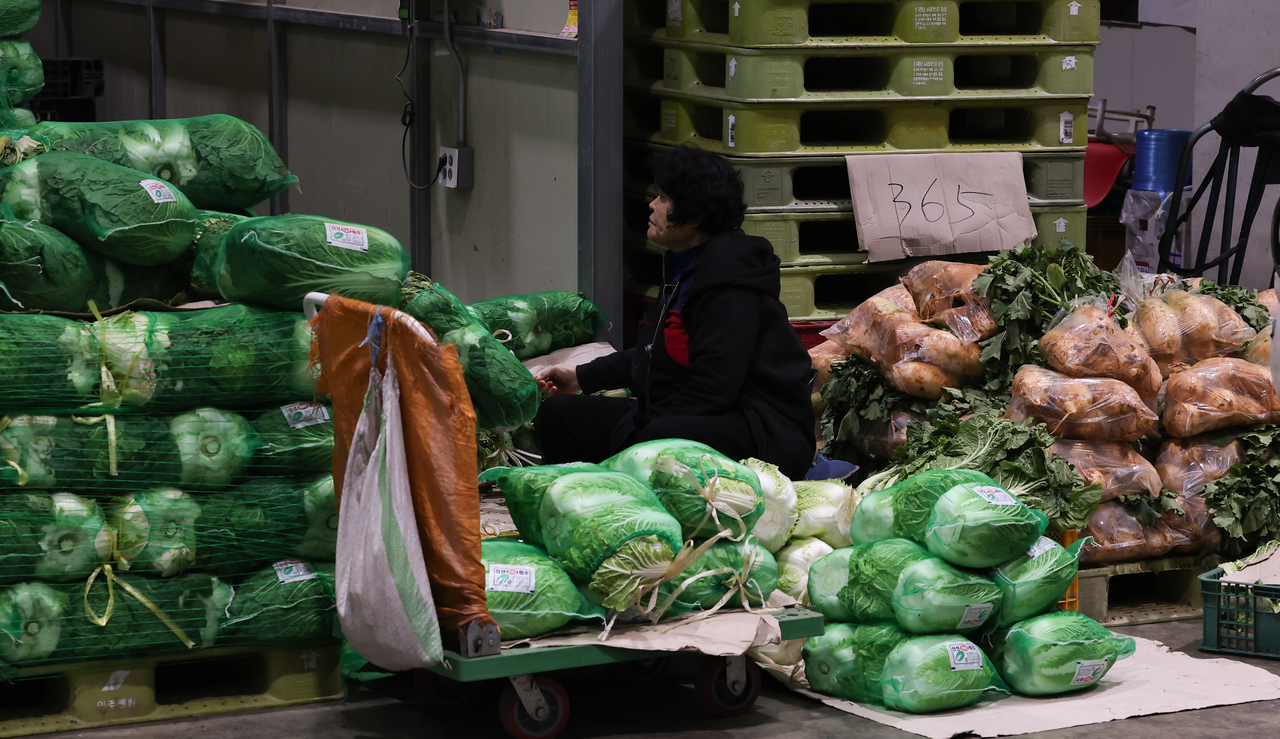
Prices for napa cabbage and radish — the main ingredients in kimchi — have plummeted ahead of the kimjang season, deepening hardship for farmers. The government has unveiled what it calls its largest-ever discount campaign, but concerns are growing about its effectiveness as more households opt to buy ready-made kimchi rather than make their own.
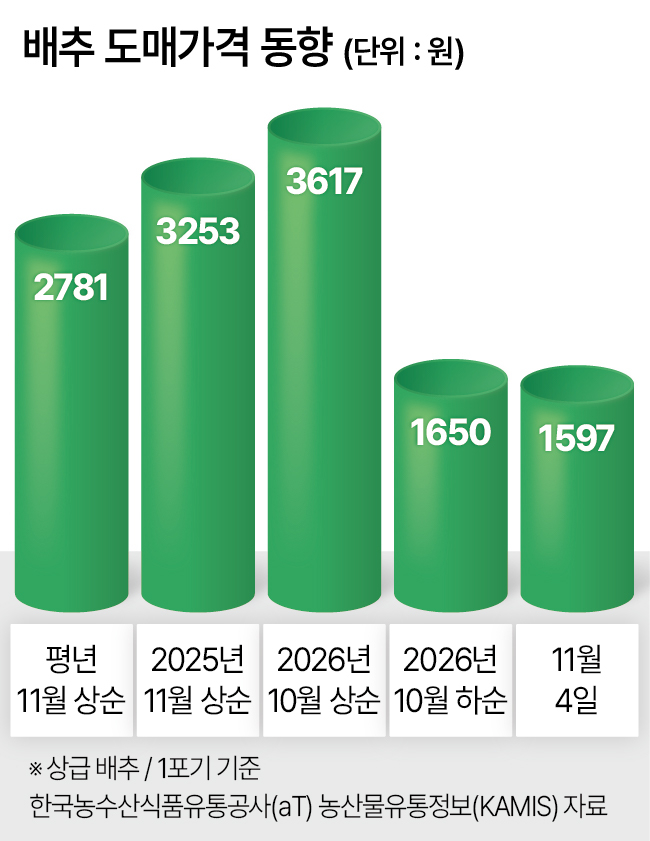
According to data from the Korea Agro-Fisheries and Food Trade Corporation's agricultural price information system released Thursday, the average wholesale price of a top-grade head of napa cabbage stood at 1,597 won on Wednesday — a 55.8 percent drop from the previous month's 3,617 won. The price is also 50.9 percent below the year-earlier level of 3,253 won and 42.6 percent below the five-year average of 2,781 won.
Retail prices are falling as well. A head that fetched more than 4,000 won as recently as last month is now trading in the 3,000-won range. The average retail price as of Wednesday was 3,768 won per head, down 38.4 percent from the previous month. It is 0.8 percent above last year's level but 6.1 percent below the five-year average.
The price decline reflects a combination of rising supply and weakening demand. The Korea Rural Economic Institute's Agricultural Outlook Center cited sluggish consumption, inventory buildup at bulk buyers and the start of the autumn cabbage harvest as the main drivers.
Output has risen sharply, putting further downward pressure on prices. Autumn napa cabbage output is estimated at 1.214 million tons, up 18.5 percent from a year ago and 2.5 percent above the five-year average. With shipments delayed from October now entering the market, November supply is forecast to rise 19.3 percent year on year.
Winter cabbage is following the same trend. The cultivation area expanded 5.0 percent from a year earlier to 3,882 hectares, partly because falling prices for onions, garlic and green onions prompted farmers to switch crops, and partly because late transplanting of autumn cabbage pushed some growers toward winter varieties. Favorable growing conditions — adequate rainfall and mild temperatures since mid-October — point to a good harvest, with output projected at 265,000 tons, up 6.8 percent from last year.
Radish, the other key kimjang ingredient, is also sliding. The wholesale price of a top-grade radish stood at 798 won per unit on Wednesday, down 49.4 percent from the previous month and 23.9 percent from a year earlier. The average retail price the same day was 2,027 won, down 22.9 percent from the previous month and 7.5 percent below the five-year average. As with cabbage, higher output is driving the decline: November shipments are estimated at 372,000 tons, up 11.1 percent year on year, while winter radish output is forecast at 381,000 tons, up 4.1 percent.
The deeper uncertainty is whether demand for napa cabbage and radish will rebound even during the kimjang season. A survey of 1,000 households nationwide conducted from Oct. 2 to Oct. 12 by the Korea Rural Economic Institute's Agricultural Outlook Center found that most respondents planned to make roughly the same amount of kimchi as last year (67.8 percent) or less (16.3 percent).
Meanwhile, kimchi imports are rising. Data from the Korea Agro-Fisheries and Food Trade Corporation's export-import information service show that kimchi imports from January through September totaled 250,742 tons, up 0.7 percent from the same period last year. In value terms, imports reached $160.8 million, a 12.0 percent increase. Most imported kimchi comes from China and is used in restaurants, institutional catering and processed food manufacturing.
The government on Tuesday announced a supply and price stabilization plan for kimjang ingredients. It will hold a discount event worth 64 billion won ($47.7 million) — the largest on record — to stimulate consumption. To manage market supply, it will purchase and stockpile 10,000 tons of napa cabbage and 3,000 tons of radish starting in the first 10 days of this month, and has said it will implement additional measures, including temporary shipping halts at production sites, if oversupply persists.
Agriculture, Food and Rural Affairs Minister Song Mi-ryeong visited Garak Market in Songpa-gu, Seoul, on Tuesday to inspect kimjang ingredient shipments and prices. Song called on wholesale corporations, NH Agri Business Holdings and other related organizations to actively cooperate in boosting consumption through a kimjang promotion drive while also helping stabilize agricultural prices and farm incomes through supply management and support for shippers.
Farmers are pressing for stronger action. Growers in the Haenam area of South Jeolla Province — the country's largest winter napa cabbage producing region — held a news conference on Wednesday demanding preemptive market intervention and crop disposal modeled on the rice supply-management system, rather than temporary measures. They also called for the introduction of a public retail platform to curb middlemen's abuses and for a realistic revision of the per-unit compensation rate for on-site disposal.
Kim Hyo-su, chairman of the National Napa Cabbage Producers Association, said stockpiling alone is not the answer. "If cabbage that has lost freshness in storage enters the market, it creates a vicious cycle of depressing consumer demand," Kim said, adding that the government must commit significant budget resources to market isolation measures.

spa@heraldcorp.com