From 'Experience the Workplace' to 'Unemployed Lee Se-dol'
Thirty-three years of hardship entertainment — and the meaning of sweat has changed
Now the struggle itself is the content
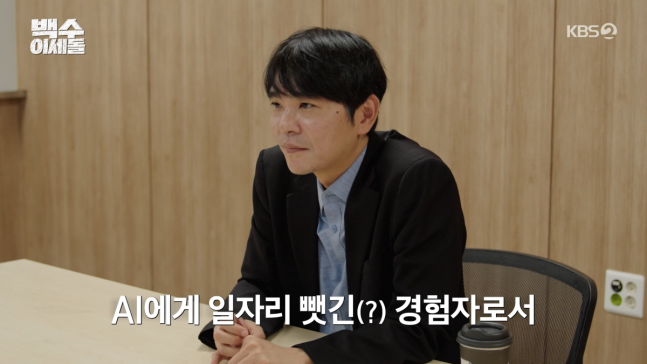
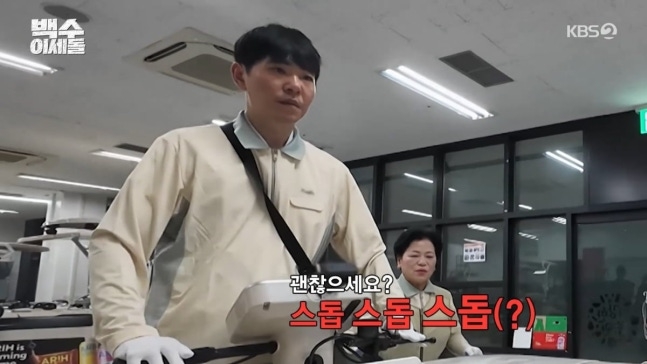
On the stadium steps at Jamsil Baseball Stadium, a "beer boy" lugging a 20-kilogram backpack struggles to bend his knees. The man is Lee Se-dol, 43, once the supreme strategist of the Go board. His eyes waver. Foam spills over every cup, and his flustered hands can barely slot a payment card into the reader. He manages to sell 86 of his 100-cup target. That is the first part-time job scorecard for the 9-dan grandmaster who handed humanity its only victory against AlphaGo.
On Aug. 27, Lee threw out the ceremonial first pitch at an LG Twins versus NC Dinos game — and after the ball hit the dirt, the 9-dan master strapped the beer backpack straight back on and returned to the stands. The scene comes from "Unemployed Lee Se-dol," a new KBS2 variety show. The hands that once played what fans call the "divine move" now pour beer, deliver yogurt and scrub the floor of a Han River swimming pool. The reason listed under "reason for leaving" on his résumé: AI.
In March 2016, at the Four Seasons Hotel in Gwanghwamun, Seoul, Lee lost the "match of the century" against Google DeepMind's AlphaGo, winning just one game out of five. His single victory — move 78 in Game 4 — is still celebrated as the divine move. Reflecting on the match in a recent variety program, Lee said he was deeply shaken after losing Game 2, realizing he could not win by conventional means.
The shockwave swept through the entire Go world. The machine, not the human, now holds the answers on the board. In the 2025 reportage "The Future That Arrived Early," author Jang Kang-myoung documented the years professional Go players spent erasing a lifetime of theory and relearning the game from AI. The word "AI" that Lee wrote as his reason for leaving — even if it appeared on a variety show — is a period at the end of an era, not something to laugh off lightly.
In the show's first episode, Lee introduced himself as "a person whose career was changed by AI." He is not literally unemployed, of course — he has continued giving lectures and appearing on television, and serves as a special-appointment professor at UNIST. He has simply not found anything that represents him the way Go once did. So he has gone looking in the one place AI cannot easily follow: the world of analog physical labor. "I hope he focuses on experiencing work that AI cannot replace," producer Lee Myeong-seop said. The premiere topped its time slot among variety programs with a peak rating of 2.9 percent, according to Nielsen Korea.

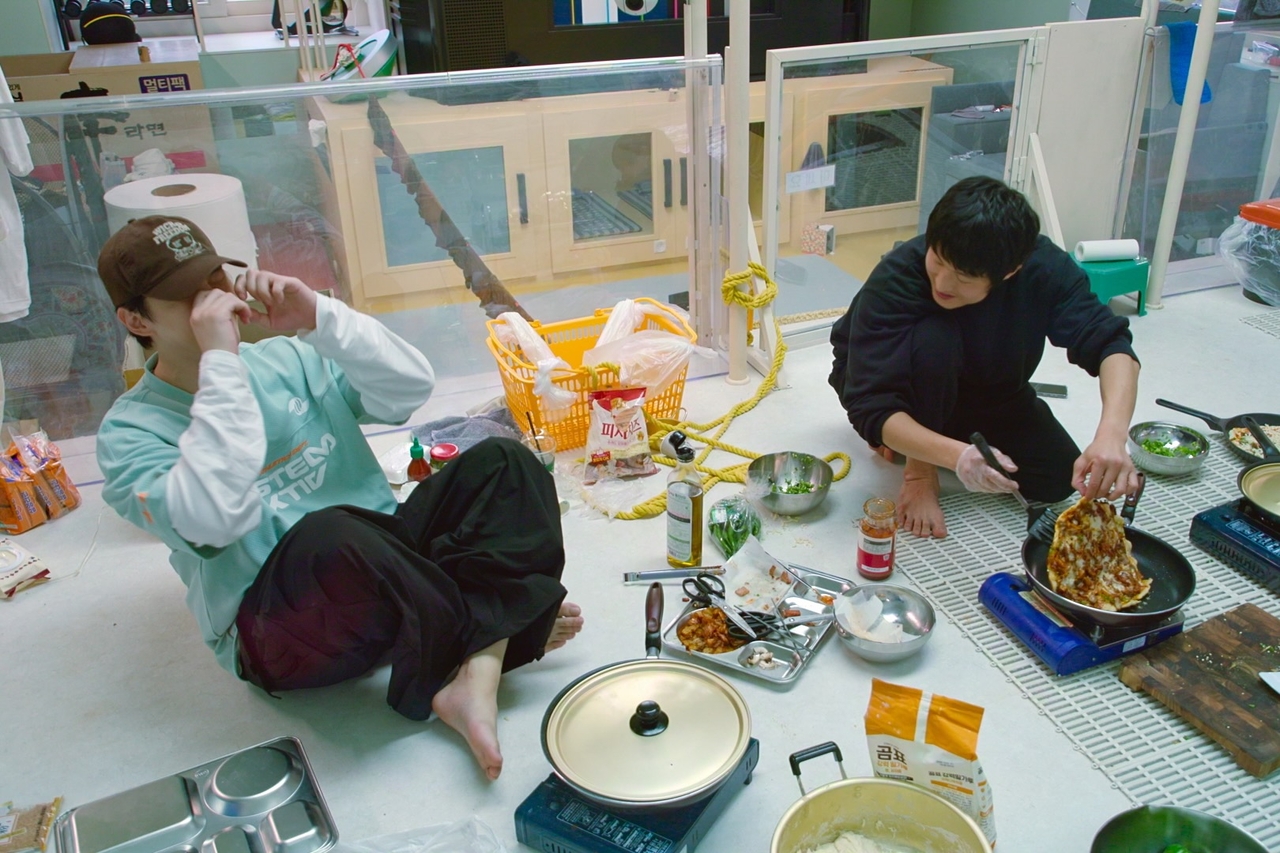
Lee is not the only one sweating. This year, Korean variety television has gone all-in on voluntary suffering. The staff of Netflix's "Yoo Jae-seok Camp" and "Chaotic Gian Jang Season 2" sprint around tending to guests, while four men in "Why on Earth Do People Hike?" are thrown onto a snow-covered mountain in the dead of winter. The four cast members of tvN's "Wooju Tteokjip" — the "Jirak-i" quartet from "Earth Arcade" (Lee Eun-ji, Mimi, Yeongji and Ahn Yu-jin) — pull rice cakes at 5 a.m., and the idols of ENA's "Idol Dispatch" hang employee badges around their necks to fill in for office workers on vacation.
The trend marks a shift in Korean variety television — away from "healing entertainment" that let viewers peek at other people's leisure, and toward "hardship entertainment" where audiences watch someone work harder and hustle more frantically than they ever would. As AI encroaches on desk jobs and strips away cognitive labor, people are turning cameras on the grind of physical work in search of what might be called analog dopamine.
Brainwork for AI, joint work for humans
"They say the jobs AI can't keep up with are the ones that use your joints a lot."
That was MC Jang Do-yeon speaking at the press conference for "Unemployed Lee Se-dol." Her remark echoes what roboticist Hans Moravec formalized in 1988 as "Moravec's paradox" — the observation that complex calculation is effortless for machines, while walking, gripping and navigating the physical world remain brutally difficult. The poignant spectacle of a genius who lost to a machine on the Go board now hauling a beer keg up stadium stairs is, in its way, a variety-show rhapsody proving that paradox.
Human anxiety shows up in the numbers. According to the Bank of Korea, 94 percent of the 285,000 jobs lost among workers aged 15 to 29 between June 2022 and June this year came from industries with high AI exposure — information services, publishing and computer programming. As desk jobs shake first, work done with the body has become the new spectacle.
The formula driving today's variety shows is a reversal: take a supreme expert and reduce them to a complete beginner. Lee Se-dol bows to An Yu-gyeong, 19 years his junior, to learn the tricks of selling beer, then declares, "Playing Go was the easiest thing I've ever done." During a yogurt-delivery shift, a customer complaint lands in his lap after a botched drop-off. The narrative comes from watching someone who was the best in a familiar world become clumsy in an unfamiliar one. Producer Lee Myeong-seop cited the show's core concept as "the humanism and survival fun that the character of Lee Se-dol conveys to modern people living in the AI age."
There is also a brand of hardship so miserable it becomes its own spectacle. Minus 27.5 degrees Celsius. Last winter, Cardigan, Day6's Dowoon, actor Lee Chae-min and All Day Project's Tarzan threw themselves into Seoraksan for the Netflix show "Why on Earth Do People Hike?" From there they went on to climb Taebaek Mountain and Hallasan in succession. Hiking was never mentioned during the casting process — Lee Chae-min, who thought he was signing up for a male version of "Earth Arcade," has gone so far as to call it a "job-offer scam."
At the press conference for the show, producer Na Young-seok said, "The answer to what 'hardship' means in today's variety entertainment is inside this program." The point is not that suffering leads to reward — the suffering itself is the reward.
"Chaotic Gian Jang Season 2," released in September, is set in a Daegwallyeong second-location guesthouse that seems purpose-built to torment its staff — a 5-meter front door that requires two people to open, a second-floor kitchen reachable only by climbing an oversized scrubbing pad, and a light that switches off only when hit with a volleyball. Even volleyball star Kim Yeon-koung said, "It was an uncomfortable place even for me." Cast member Lee Jun-ho, known for his work ethic, recalled, "I just wanted to do all the physically tiring work myself, so my only memory is working really hard." The show's buzz score in its opening week jumped 88.3 percent over Season 1. "Yoo Jae-seok Camp," released in May, drew 1.8 million views in its first week and ranked fifth among Netflix's global non-English shows.
From 'Experience the Workplace' to 'Unemployed Lee Se-dol'
Using labor as variety-show material is nothing new. KBS's "Experience the Workplace," which launched in 1993, sent celebrities into various workplaces and had them donate their appearance fees, conveying the social value of labor. In the 2000s, hardship on "1 Night 2 Days" was mainly a device for penalties and laughs, while "Law of the Jungle" turned it into a stage for proving survival and endurance. In 2014, "Infinite Challenge's" "Extreme Part-Time Jobs" segment sent cast members into real labor settings to shine a light on the grind of work and the realities facing workers.
Today's labor-themed variety shows stand in that lineage but differ in how they use hardship. Suffering is no longer a means of charity, a punitive punchline or a forced gateway to heartwarming moments. The cast of "Why on Earth Do People Hike?," dragged up Seoraksan at minus 27.5 degrees Celsius, grumble and snap that they have no interest in watching any sunrise. The honest process of saying "this is hard" when it is hard, and "I hate this" when they hate it, is the content itself.
The direction of the hardship also varies from show to show. There is the kind that pits people against their own limits — "Why on Earth Do People Hike?" — and the kind found in "Yoo Jae-seok Camp" and "Gian Jang," where the struggle is in feeding and housing other people. If the sweat of the "Experience the Workplace" era taught the value of labor, the sweat of today — when AI has begun doing people's jobs — has become proof that a human being is present. The cameras capture every drop. Netflix said it positioned its observation cameras as unobtrusively as possible, "so we could show the cast and even the regular guests exactly as they are."
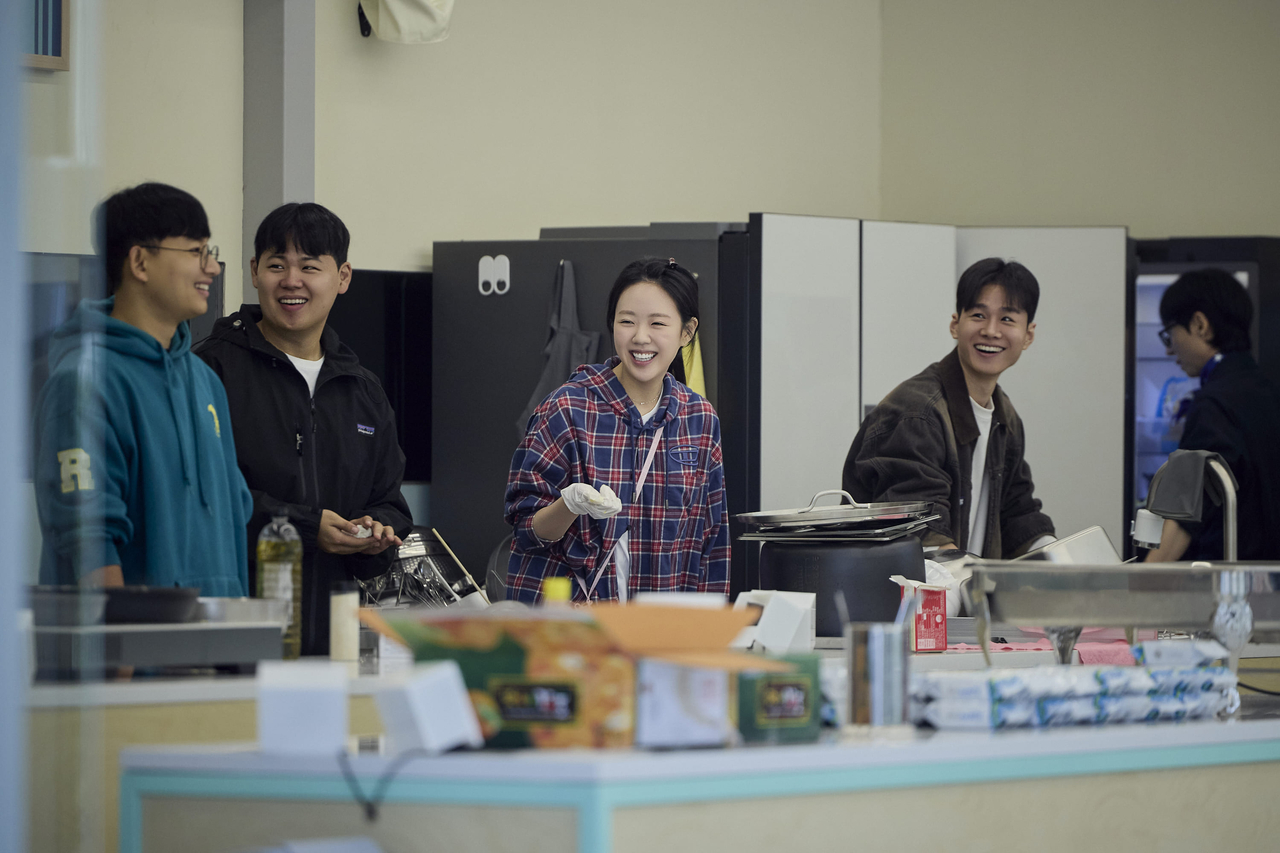
In an age when AI reframes labor as a question of efficiency and productivity, variety television is doing the opposite — zooming in on labor's most inefficient moments: when things refuse to go as planned, when the body will not cooperate, when the next step is impossible without someone else's help.
"In an era when AI produces flawless results in a single second, audiences paradoxically find a strange comfort in the physical failings of humans — the sweating, the mistakes, the hitting of limits," a broadcasting industry official said. "Where variety shows of the past tried to wring lessons or emotion out of labor, today's hardship entertainment has become a spectacle in its own right — an appreciation of the raw vitality and unfiltered reactions that are uniquely human and that no machine can ever imitate."
These programs are less interested in using hardship to prove achievement than in capturing the unguarded human face and the relationships that emerge through it. How the cast reacts to a situation, and what kind of dynamic they build with one another, matters above all else. "Viewers have been responding positively to reality variety shows that reveal the cast's unvarnished selves," a Netflix official said. "Audiences are finding vicarious satisfaction in labor-themed entertainment where honest, genuine emotions come through as they are. We are making various changes to our filming approach — including minimizing production intervention — so that the natural appeal of the cast and the work they do can come through organically."
shee@heraldcorp.com