Air Force says it is cooperating fully with probe; Cheonghae Unit's operational zone expanded to waters south of Oman
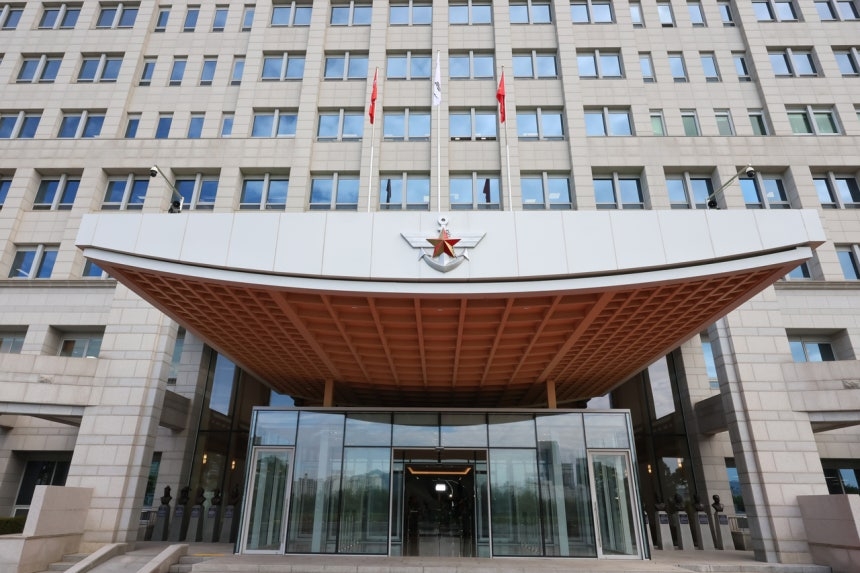
South Korea's Ministry of National Defense said Thursday it will thoroughly investigate allegations that flight training was canceled after Air Force pilots held a drinking gathering.
Defense Ministry Spokesperson Jeong Bit-na said at a regular briefing that the ministry would "verify the facts thoroughly in accordance with the minister's instructions," adding that it was "time to review whether there are areas that need to be corrected, including regulations."
Defense Minister Kang Shin-cheol had earlier directed the inspector general's office to rigorously verify the facts surrounding the allegations, and the office has already launched an audit. The ministry also said it plans to look into media reports from Wednesday that the flight cancellations were ordered by Air Force Chief of Staff Son Seok-rak.
At the briefing, a reporter said it had been confirmed that Son told pilots to drink at three of the six communication sessions Son hosted, on the premise that flights would be canceled. The reporter noted that Son had acknowledged the conduct was inappropriate and asked for the Air Force's official position.
In response, Jang Dong-ha, head of the Air Force's Seoul public affairs team, said the Defense Ministry was in the process of verifying the facts and that "the Air Force is faithfully cooperating with that effort."
Questions also arose over whether the chief of staff has the authority to order flight cancellations. Jang said he would look into the matter, adding that he expected the Defense Ministry's investigation to cover all such issues.
The ministry also briefed reporters on a motion to extend the deployment of the Cheonghae Unit, which has cleared a vice ministerial meeting. The motion expands the unit's operational zone from the Gulf of Aden to the waters south of Oman and adds a maritime patrol aircraft and an explosive ordnance disposal team.
The ministry said the prolonged situation in the Middle East had created a capability gap in the Gulf of Aden, where piracy activity has jumped more than threefold. It said the operational zone was expanded to protect South Korean nationals and merchant vessels. The motion must be approved by the National Assembly before the end of the year.
The motion newly includes "support for restoring freedom of navigation on international maritime trade routes" as a stated mission objective. When asked whether this was intended with a contribution to the Strait of Hormuz in mind, the ministry drew a line, saying the expansion did not presuppose deployment to the Strait of Hormuz. It added that the mission would only be possible under a "permissive environment" — citing the end of the war between the United States and Iran, or the conclusion of an MOU, as conditions.
The ministry said more than 70 percent of South Korea's crude oil shipments pass through the region. "Because we do not know how any given situation will unfold, we are preparing without ruling anything out," it said. The Cheonghae Unit will carry out its mission under the principle of absolute non-involvement in any war.
On safety concerns, the ministry said the expanded operational zone is more than 650 kilometers from the Strait of Hormuz in a straight line, and that the newly added patrol aircraft physically cannot operate beyond Oman's Duqm port. It said that in the event of an attack, the unit would respond under rules of engagement in the exercise of the right to self-defense.
The Joint Chiefs of Staff declined to say whether North Korea's missiles fired Wednesday had undergone performance upgrades. JCS Spokesperson Jang Do-yeong said South Korean forces had detected "several missiles fired from the Sondok area of North Korea into the Donghae" on Wednesday morning, adding that South Korea and the United States were conducting a detailed joint analysis of the exact specifications.
Asked about analysts' assessments that the simultaneous launch of defensive and offensive missiles was unusual, Jang said the military had been analyzing the possibility that the launches involved missiles from various categories. When asked which missiles the JCS announcement referred to, given North Korea's claim that it had fired a new surface-to-air missile and a strategic cruise missile, Jang said he was "limited by security considerations from providing a specific explanation."
The JCS also said its criteria for announcing missile launches remained unchanged. Jang said that "at the initial stage of the launch, there was a possibility based on detection data that the missiles belonged to various categories," adding that rather than making a definitive announcement, the intent was "to share information about North Korea's missile launch situation without exposing our military's surveillance and reconnaissance capabilities."
rimsclub@heraldcorp.com