National debt grew 11.7-fold in 25 years while population aged 0–14 fell 46.9%
Debt per child rose 22.1-fold; up 113.94 million won in the past five years alone
Taxpayers Federation urges government to use projected 63 trillion won surplus to pay down debt

As national debt has climbed and the child population has shrunk, the share of government debt attributable to each child aged 0 to 14 approached 250 million won ($186,000) last year — more than 22 times the level recorded in 2000. With rising debt and the low birth rate reinforcing each other, a taxpayer advocacy group is calling on the government to prioritize using a semiconductor-driven tax windfall to pay down the debt.
According to an analysis of national debt and child population data released Friday by the Korea Taxpayers Federation, the national debt per child stood at 248.2 million won last year, 22.1 times the 11.22 million won recorded in 2000. Compared with 134.26 million won in 2020, the figure rose 113.94 million won, or 84.9 percent, in just five years.
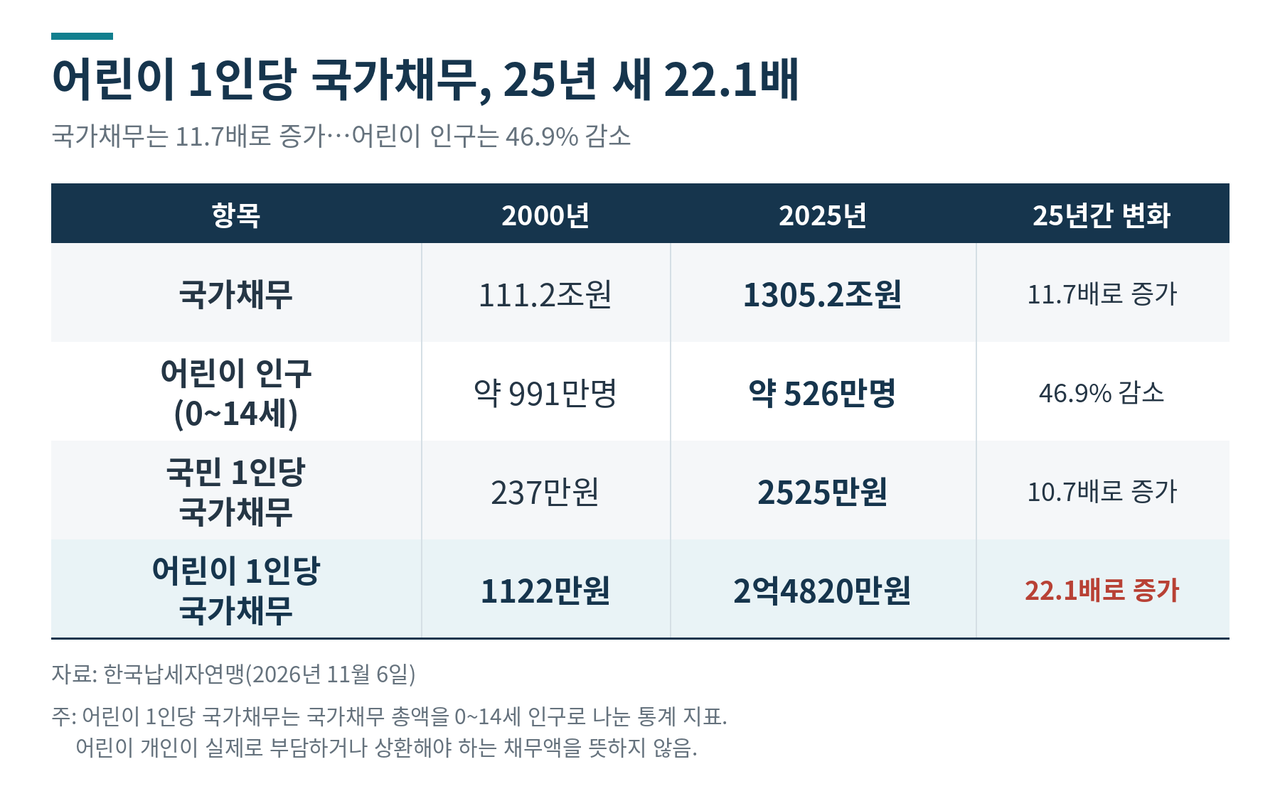
The national debt per child is a statistical indicator calculated by dividing total national debt by the population aged 0 to 14. It does not represent an amount that any individual child is personally liable to repay. The federation presented it as a measure that captures both the growth of national debt and the shrinking demographic base of future generations.
The figure has risen sharply because national debt has grown while the child population — the denominator — has fallen steeply. National debt expanded 11.7-fold, from 111.2 trillion won to 1,305.2 trillion won, between 2000 and last year. Over the same period, the population aged 0 to 14 dropped by about 4.65 million, from roughly 9.91 million to 5.26 million — a decline of 46.9 percent. With debt growing more than tenfold and the child population shrinking by nearly half, the debt burden per child rose at an even steeper rate.
The national debt per capita for the population as a whole grew 10.7-fold over the same period, from 2.37 million won to 25.25 million won — well below the 22.1-fold increase recorded for the per-child figure. The ratio of national debt to GDP also rose 32.3 percentage points, from 16.5 percent to 48.8 percent.
The national debt per child was 26.88 million won in 2005, 49.15 million won in 2010 and 84.14 million won in 2015. It first exceeded 100 million won in 2018, then reached 197.5 million won in 2023 and 214.21 million won in 2024. The compound annual growth rate from 2000 to 2025 was about 13.2 percent; the average annual rate over the past five years was also about 13.1 percent.
The federation said a semiconductor boom this year is expected to generate about 63 trillion won ($47 billion) in surplus tax revenue and argued the government should use those funds first to pay down national debt. While investment to secure future growth engines is important, it said, the rapid rise in national debt and the growing fiscal burden must also be weighed.
The federation also noted that total spending in the government's budget for next year is set at 820.9 trillion won, up 67.9 trillion won, or 9.0 percent, from this year's supplementary budget baseline. It said the government should be cautious about channeling unexpectedly strong tax revenue into additional spending rather than reducing national debt while pursuing an expansionary fiscal stance.
The group also warned that current debt could translate into a heavier tax burden in the future and that rising national debt could constrain future generations' fiscal policy choices.
Kim Sun-taek, chairman of the Korea Taxpayers Federation, said children and future generations not yet born cannot express their views on current fiscal policy through the ballot box. "The current generation must not saddle future generations, who have no right to vote, with excessive debt," Kim said.
fact0514@heraldcorp.com