Institute reflects on half a century of power technology achievements and unveils future strategy
Research highlights span power grids to power semiconductors
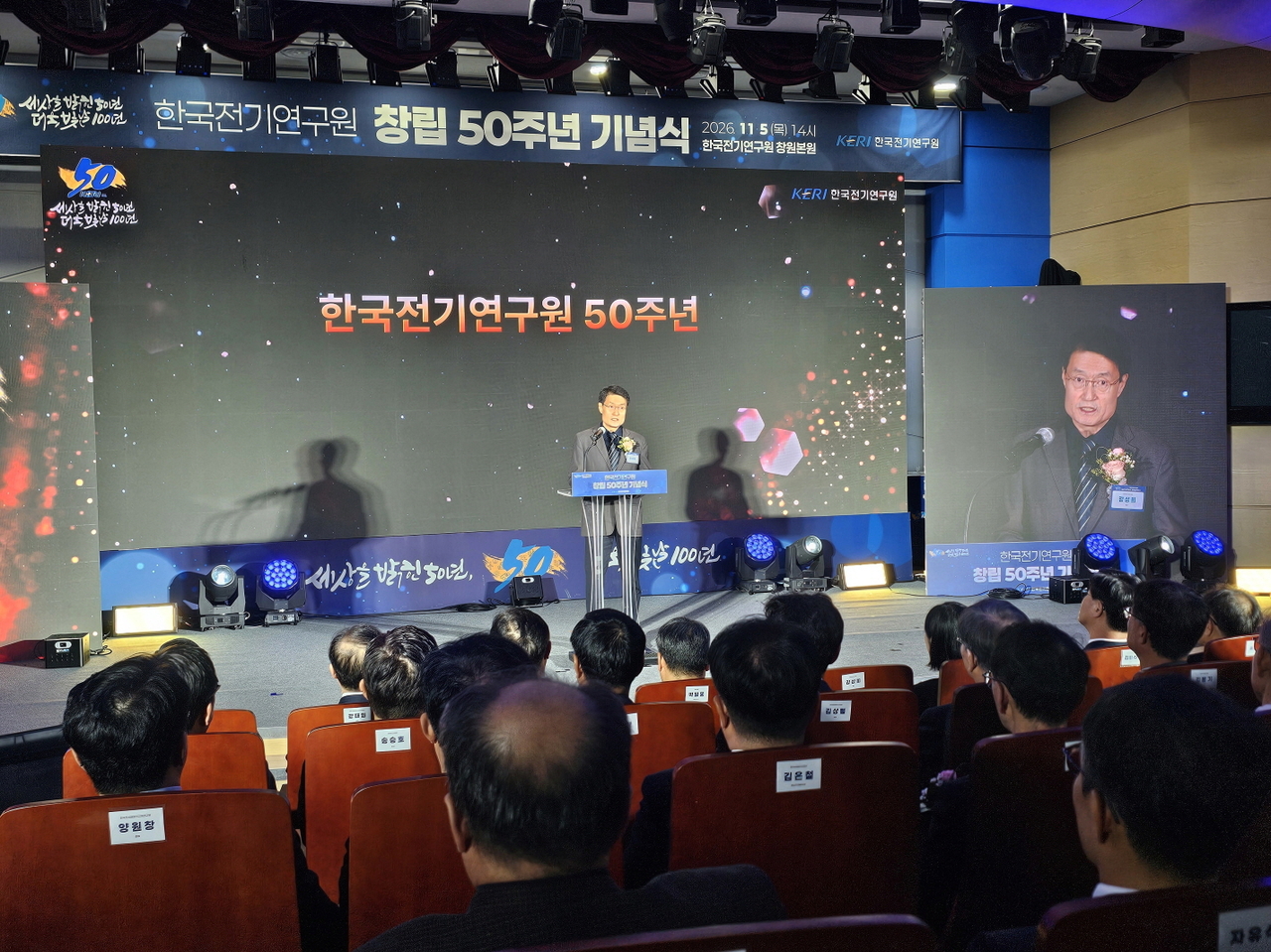
The Korea Electrotechnology Research Institute marked its 50th anniversary by reviewing its major research achievements and laying out a future vision to lead the era of electrification.
KERI held the anniversary ceremony Thursday at the main auditorium of its headquarters in Changwon, South Gyeongsang Province. Senior officials including Yoon Kyung-sook, director general for basic and original research policy at the Ministry of Science and ICT, Kim Young-sik, chairman of the National Research Council of Science and Technology, and Changwon Mayor Kang Ki-yoon attended alongside institute staff.
The event, the first major ceremony since Kang Sang-hee took office as the 16th director general, included a launch ceremony for a commemorative 50-year history publication, an awards ceremony for contributors, and a social contribution donation event.
KERI was founded in 1976 with a staff of 43 and a budget of 700 million won ($522,000). Over the following decades it developed the Korean Distribution Automation System, commercialized 765-kilovolt ultra-high-voltage power equipment, and localized a next-generation energy management system, contributing to the country's energy technology independence and power grid development.
More recently, the institute built a land-based test site for electric vessels to support the maritime and defense industries, and is conducting research on electromagnetic pulse protection technology, silicon carbide power semiconductors, and solid electrolytes for all-solid-state batteries. Since becoming a full member of the Short-Circuit Testing Liaison in 2011, KERI has also supported Korean power equipment companies in expanding overseas.
A study by a research team led by Chungnam National University professor Kang Tae-won estimated that KERI's technology has generated 102 trillion won in production-inducing effects, 26.87 trillion won in value-added effects, and 154,675 jobs.
In his commemorative address, Director General Kang outlined three priorities for the institute's future: becoming a think tank for power policy, securing strategic technologies to protect advanced industries, and building a cooperation platform linking local governments, industry and academia. "Fifty years of dedication to electricity have blossomed into the miracle of industrial advancement," Kang said. "We will press forward toward a century of innovation."
ook967@heraldcorp.com