Budget up 14.3%, or 289.8 billion won, from this year; new 1 million won marriage support grant introduced per couple
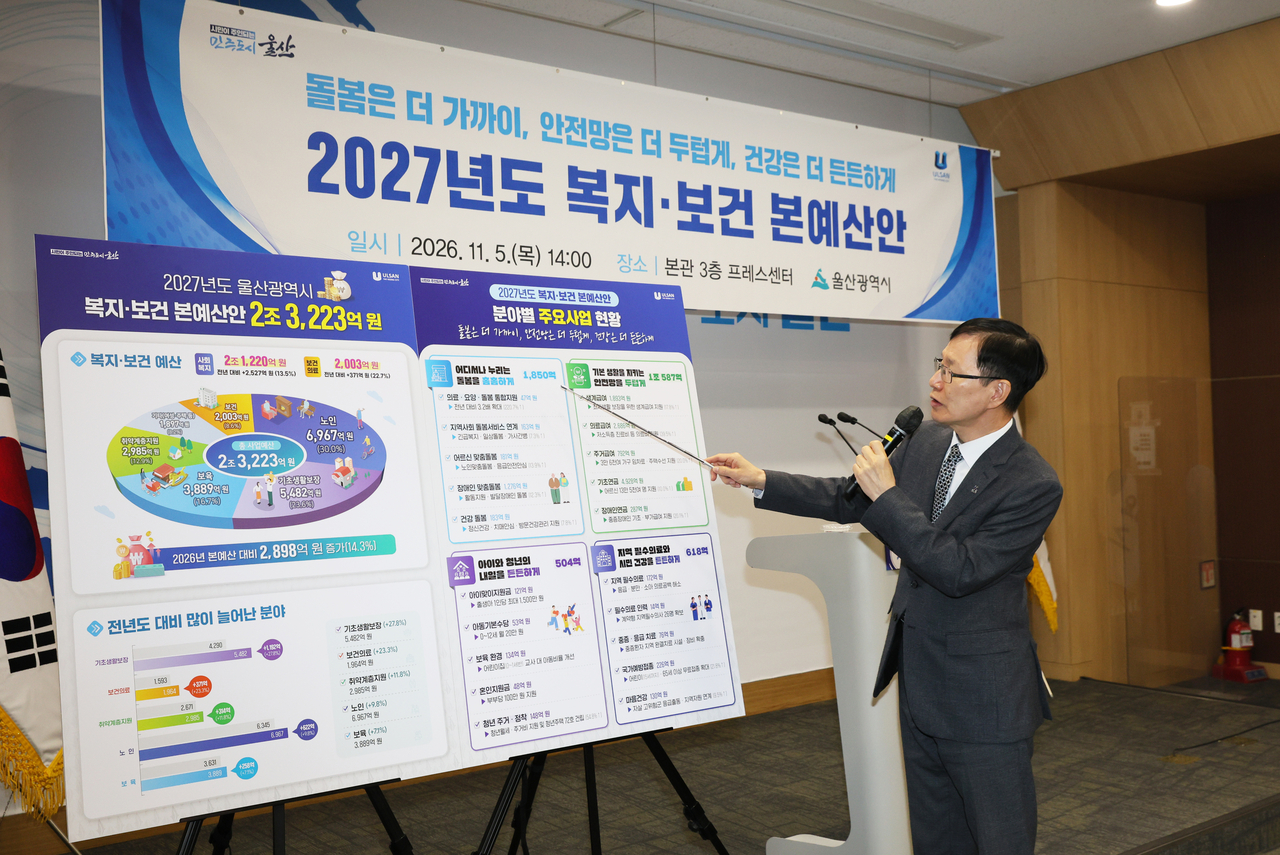
Ulsan has allocated 2.32 trillion won ($1.73 billion) for welfare and health in its 2027 budget, the city announced Friday, citing the need to prepare for rapid aging and a growing number of households vulnerable to care gaps. Of the total, 2.12 trillion won goes to social welfare and 200.3 billion won to public health — a 14.3 percent increase, or 289.8 billion won, from this year's 2.03 trillion won.
The city raised its basic livelihood security budget by 27.8 percent and its healthcare budget by 23.3 percent. The funds will be directed toward four priority areas: integrated care accessible anywhere, a social safety net protecting basic living standards, support for children and youth, and essential regional medical services and public health.
In the integrated care area, the budget for combined medical, long-term care and caregiving support was expanded 3.2 times from last year to 4.7 billion won. Additional allocations include 16.3 billion won for emergency welfare and daily care services, 18.1 billion won for senior-tailored care and emergency safety programs, 127.6 billion won for activity support and services for people with developmental disabilities, and 18.3 billion won for mental health, dementia care and home health visits.
Under the social safety net, the city will channel 189.3 billion won into livelihood benefits and 268.6 billion won into medical benefits, reflecting a 6.7 percent rise in the standard median income threshold. Some 36,000 households will receive 79.2 billion won in housing benefits, about 135,000 senior citizens will receive 492.8 billion won in basic pension payments, and 28.7 billion won has been set aside for disability pensions.
For children and youth, the city earmarked 12.1 billion won for a newborn support grant of up to 15 million won per child, 5.3 billion won for a basic child allowance of 200,000 won per month for children aged 0 to 12, and 13.4 billion won to improve the teacher-to-child ratio at daycare centers.
A new marriage support grant of 1 million won ($745) per couple has been introduced, with 4.8 billion won set aside for the program. The city also allocated 14.8 billion won for youth and newlywed housing cost support, the construction of 72 youth housing units, and youth residential settlement projects including the "Eoseowa Ulsan" and "Youth Local Base" programs.
To address gaps in essential regional medical services and public health, the city will invest 17.2 billion won to fill shortfalls in emergency, obstetric and pediatric care, and 1.4 billion won to secure 26 contract-based regional essential physicians — both new expenditures. An additional 22.6 billion won will go toward national vaccination programs and 13 billion won toward mental health and suicide prevention.
cityblue@heraldcorp.com