Re-employment means new contracts with new pay; extended retirement age keeps existing wage structure
Wage-peak schemes, shorter hours and work-rule exemptions add uncertainty — as does employers' labor-cost burden
Those born in 1967 need transitional relief before the law takes effect; those born in 1970 face potential pay cuts
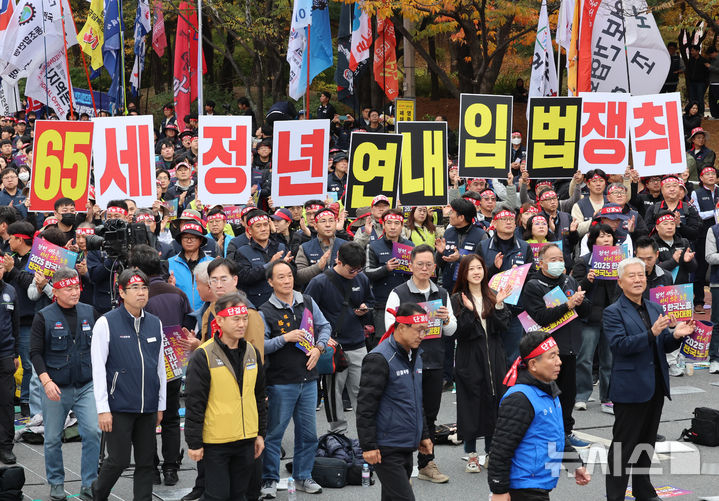
When the era of retirement at 65 arrives, how much will workers actually earn during those extra five years? Under a plan set to take effect in 2028, a worker earning 5 million won ($3,730) a month just before retirement who is re-employed after age 60 would collect 300 million won over five years if the salary stays the same. Apply the average pay cut of 20.6 percent recorded among companies that reduced wages in a Korea Enterprises Federation survey, and the total falls to about 238 million won — a gap of more than 60 million won for the same five years of work.
A draft reviewed by the Democratic Party of Korea's special committee on retirement-age extension in June proposed making re-employment of retirees mandatory starting in 2028, then raising the statutory retirement age in stages from 2029 until it reaches 65 in 2037. Rather than jumping straight to 65, the plan pairs mandatory re-employment with a gradual increase in the legal retirement age. Workers approaching retirement would gain a chance to stay employed, but their wages and working conditions could vary significantly depending on which mechanism extends their tenure.
The Democratic Party said Tuesday it would reactivate the special committee after a policy consultation with the Federation of Korean Trade Unions, pushing for passage this year while leaving open the possibility of a delay into early next year. Democratic Party leader Kim Min-seok said legislation promised during last year's regular National Assembly session had yet to bear fruit, while Federation of Korean Trade Unions Chairman Kim Dong-myung criticized the party, saying repeated delays on labor commitments were eroding trust.
The government has yet to release its own proposal. Minister of Employment and Labor Kim Young-hoon, at the national audit on Oct. 13, stressed the need to pass a retirement-age bill this year, saying the government would announce its plan "as quickly as possible once discussions have matured and only the final decision remains."
How retirement at 65 would arrive — and what happens to existing wages
A subcommittee of the Democratic Party's special committee put forward three options last December, targeting 2036, 2039 and 2041 as the years the statutory retirement age would reach 65. Under each scenario, the legal age would rise by one year every two to three years starting in 2028 or 2029, with workers who hit the retirement threshold in the interim re-employed for one to two years after leaving.
Business groups opposed the earliest-starting option, arguing re-employment should take priority over raising the statutory age. Labor groups rejected the latest-finishing option, insisting on a firm commitment to extending the legal retirement age.
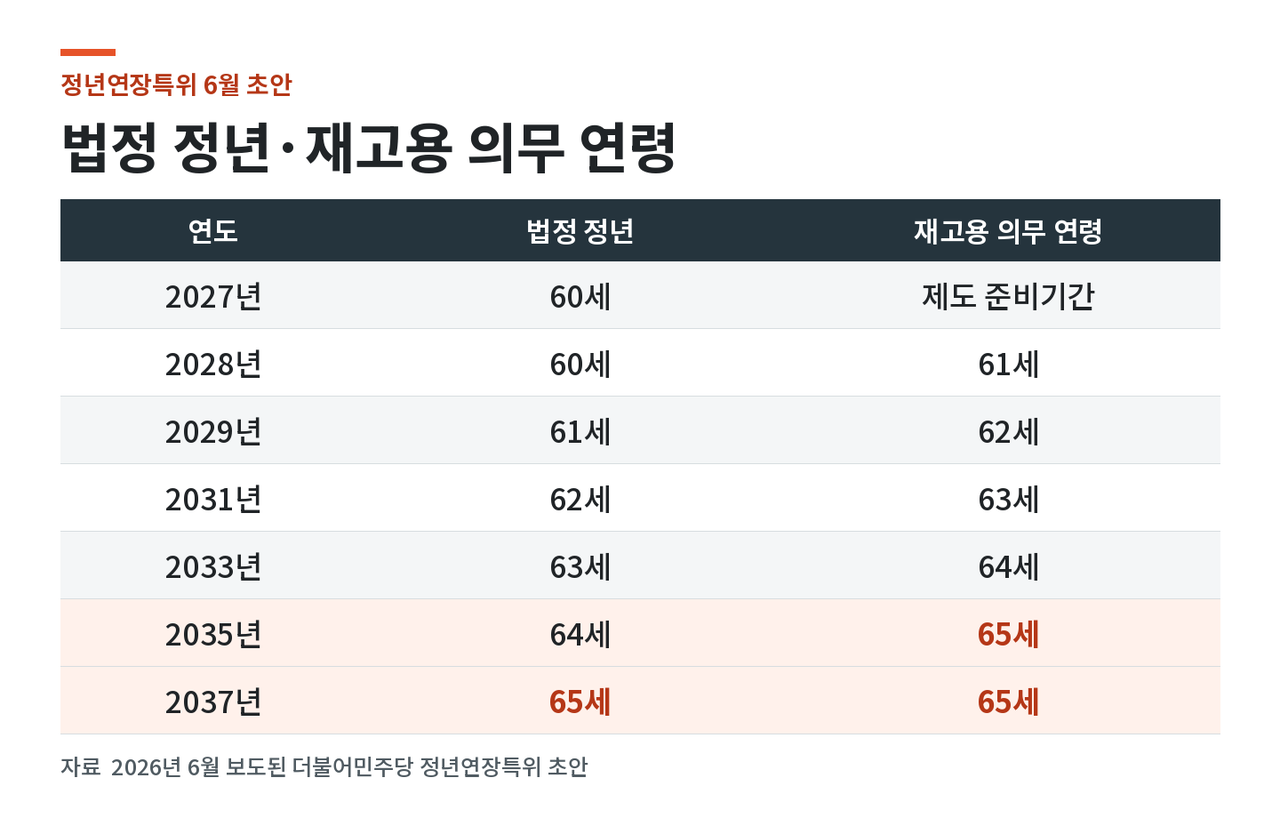
The June draft set separate timetables for re-employment and the statutory retirement age. The re-employment obligation would begin in 2028 covering workers up to age 61, then expand to age 65 by 2035. The statutory retirement age would rise to 61 in 2029, then increase by one year every two years until reaching 65 in 2037. The design would provide re-employment opportunities before the statutory age begins to climb, and would keep the mandatory re-employment age above the statutory retirement age throughout the transition.
The longer the government delays implementing the retirement-age extension, the more anxious those born in 1967 — who face mandatory retirement next year — become.
Workers born in 1967 who retire at 60 in 2027 will have already left employment by the time the re-employment obligation is set to begin in 2028 under the draft. They can only benefit from the new system if transitional provisions allow people who retired before the law took effect to apply for re-employment. Those born in 1967 and 1968 become eligible for full national pension benefits at age 64, meaning a gap of four years opens up between retirement at 60 and pension receipt. That gap is why the Korean Confederation of Trade Unions pushed back against the June draft and called for the retirement age to be aligned with the pension eligibility age.
The income gap between retirement and pension receipt is a key reason labor groups are pressing for swift legislation. Those born in 1967 turn 60 next year; those born in 1968 will do so in 2028. Both cohorts become eligible for full national pension benefits at 64, leaving a four-year gap after retirement at 60. For those born in 1969 or later, the pension eligibility age rises to 65, stretching the gap to five years.
The government can address workers nearing retirement either by accelerating implementation or by keeping the existing schedule while adding transitional provisions in supplementary clauses. Moving up the start date gives workers more time to remain employed before retirement, but shortens the preparation period for companies. Transitional provisions raise their own questions: which retirement dates would be covered, whether former employers could be required to offer re-employment, and how application deadlines would be set. Even among those born in the same year, actual retirement dates can differ depending on workplace rules.
Once re-employment begins, a key question is whether workers already re-employed will be subject to the new standard when the mandatory age rises. For example, a worker born in 1968 who turns 60 in 2028 and works until 61 under an initial contract would still face a three-year gap before becoming eligible for pension benefits at 64. If the mandatory age rises before the contract ends and the new standard applies to that worker, the gap shrinks. Determining each individual's employment period requires deciding not only the annual timetable but also whether the standard applied is the one in effect when the worker first reached retirement age or the one in effect when the contract is renewed.
For those born in 1970, more work means — what pay? Old contract vs. new contract
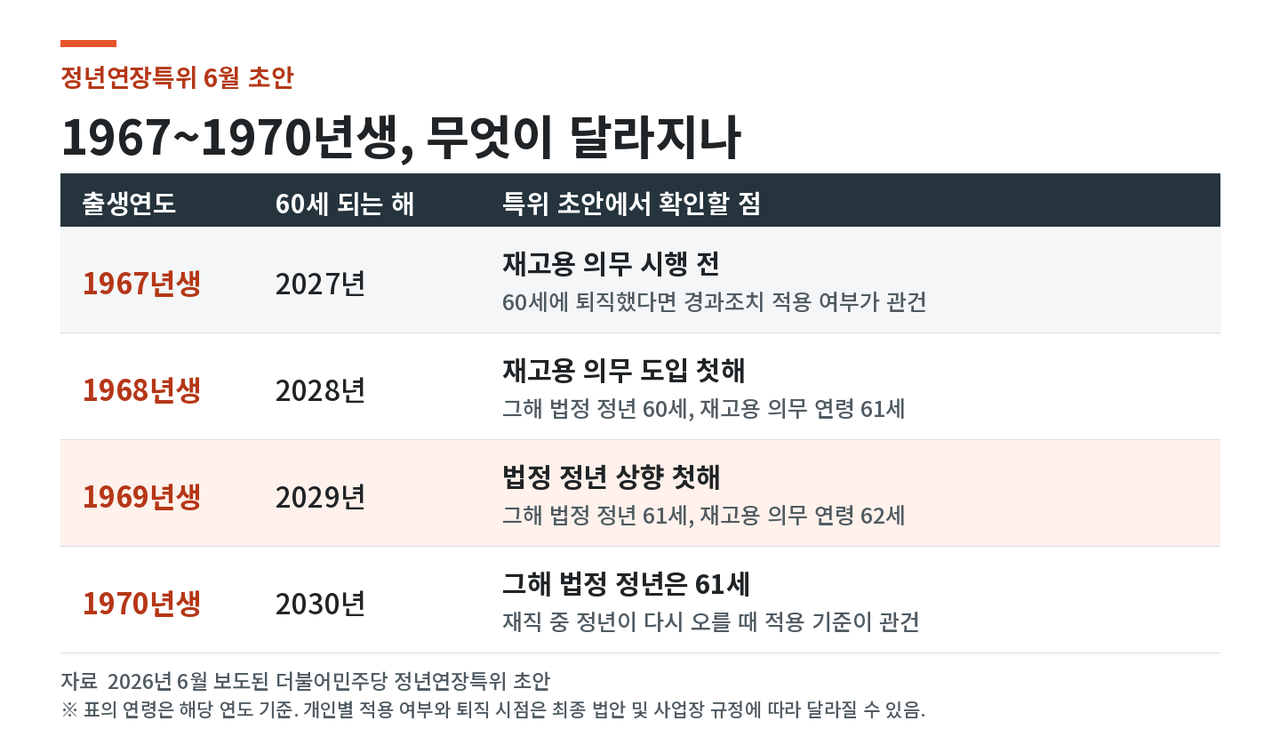
Workers born in 1970 turn 60 in 2030. Under the June draft, the statutory retirement age that year would be 61. Those at workplaces covered by the new retirement age could continue working past 60 without leaving. When they turn 61 in 2031, the draft would raise the statutory age again to 62. How that additional increase applies to workers already on the job could shift their actual retirement date. A single line stating "retirement age of 61 in 2030" is not enough to determine when someone born in 1970 will actually retire.
During the extended period, the existing employment relationship continues. For workplaces with seniority-based pay, the company's wage table and collective agreement would apply for longer. Where wage-peak schemes are in place, the timing and duration of pay reductions matter. Cutting wages only during the newly added years after 60 has a different effect on total lifetime earnings than beginning reductions before 60.
Workers re-employed at the same company after retirement enter a new contract that sets wages, duties and working hours. They may continue in the same role or step back from management to take on skills-transfer or quality-control work. If duties change, how the responsibilities and difficulty of the new role are assessed and reflected in pay becomes a point of contention. If hours and duties stay the same but pay is cut, workers will naturally ask why the same work is being compensated less.
Consider a worker whose daily hours remain unchanged but whose schedule shifts from five days a week to four, with a 20 percent pay cut. All else being equal, the hourly wage stays the same. But if the worker keeps a five-day week and the same duties while taking a 20 percent pay cut, the hourly wage falls by the same proportion. The same percentage reduction in monthly pay can mean very different things depending on how much time the worker puts in.
The June draft included a proposal for temporary work-rule exemptions allowing workplaces to adjust working hours for workers covered by the retirement-age extension and restructure their pay accordingly. The existing Act on Employment Promotion and Empowerment of Older Persons already requires labor and management at workplaces extending the retirement age to take necessary steps — including revising wage structures — to suit their circumstances. The Korean Confederation of Trade Unions objected, warning that such exemptions could allow working conditions to be rolled back without workers' consent. If the government introduces exemptions, outstanding questions include which workplaces would be covered, for how long, what consent or consultation procedures would apply, and whether the exemptions would be limited to cases involving changes in hours or duties.
The criteria for selecting who gets re-employed matter as much as pay. The June draft set re-employment of all willing workers — following consultation with worker representatives — as the default, while allowing employers to exclude some workers on an exceptional basis under criteria defined by law. Broad exceptions give companies flexibility to manage their workforce, but workers may not know until just before retirement whether they are included. Whether employers must state reasons for refusing re-employment, and whether workers can challenge such decisions, also remain unresolved.
Contract renewal is a separate issue. Offering a single one-year contract at retirement is very different from guaranteeing renewal opportunities up to the legally mandated age. Even if the mandatory re-employment age rises, an income gap before pension eligibility can reopen if a contract ends midway. For workers planning their post-retirement finances, they need to know not only the starting salary but also the grounds on which renewal can be refused and the age up to which continued work is possible.
Kim Deok-ho, a professor at Sungkyunkwan University's RISE project team, said retirement-age extension must be designed together with adjustments to wages, working hours, duties, pensions and phased retirement. He noted that extending the retirement age alone — in a system where seniority-based pay persists and job mobility is limited — risks concentrating benefits among workers in stable employment while narrowing hiring opportunities for young people.
How many workers actually reach retirement age — and where does the conflict with youth hiring arise?
Extending the retirement age directly benefits workers who remain at their companies until that age. Kim Young-joong, former head of the Korea Employment Information Service, wrote in his 2023 book "Employment Policy Theory" (Parkyoungsa) that "fewer workers than expected can actually benefit from a statutory retirement-age extension." Citing a supplementary survey on older workers from Statistics Korea's economically active population survey, he noted that in 2020, mandatory retirement accounted for just 7.8 percent of the reasons workers aged 55 to 64 gave for leaving their longest-held jobs. He concluded that the benefits of raising the retirement age could be concentrated among workers who have held relatively stable jobs for a long time.
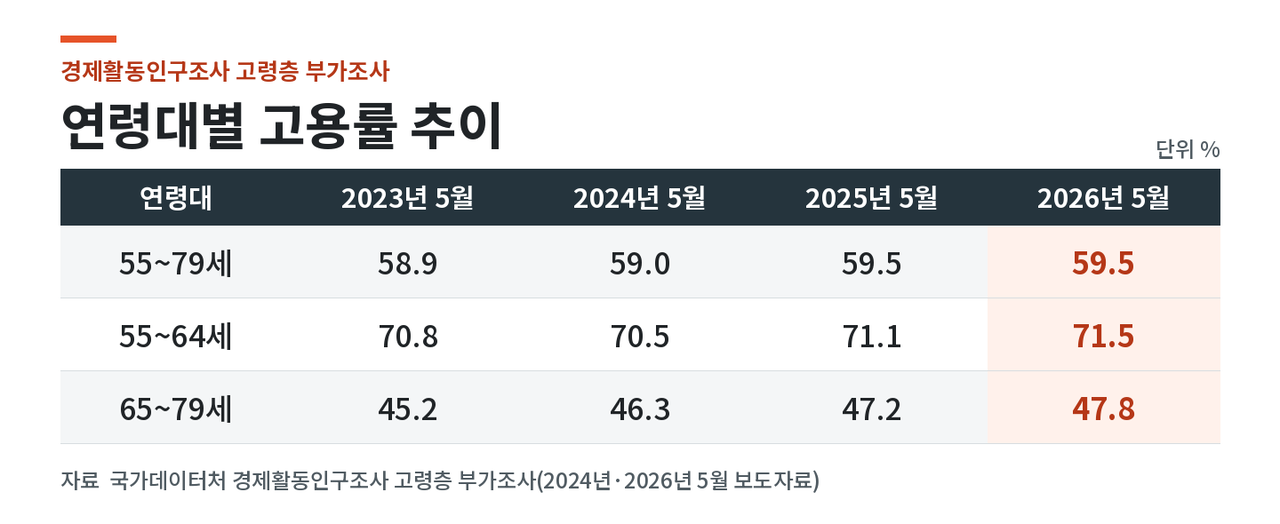
Employment rates among older workers have risen, but the underlying picture has not changed much. In the Ministry of Statistics' supplementary survey on older workers conducted this May, the employment rate for those aged 55 to 64 stood at 71.5 percent and for those aged 65 to 79 at 47.8 percent, up 0.4 and 0.6 percentage points, respectively, from a year earlier. However, only 30.5 percent of respondents were still working at their longest-held job, and the average age at which they had left that job was 53.0 — well short of the statutory retirement age of 60. A higher employment rate does not necessarily mean the statutory retirement age reaches a broad share of workers.
Transitional provisions allowing re-employment at a previous workplace would help those who retired just before the law took effect. For workers who left their primary job before reaching retirement age, what matters more is finding new employment and what it pays. Kim, the former institute head, identified employment subsidies, job-transition support services and vocational training — alongside retirement-age extension — as tools for expanding work opportunities among older workers. Even within the same birth year, the path to bridging the income gap before pension eligibility differs depending on whether a worker stayed until retirement.
The impact on youth hiring also varies by workplace. At companies that fill vacancies created by retirements, keeping existing workers longer with the same headcount could reduce the number of new positions available. Where total labor costs are also fixed, the expense of retaining older workers longer and the cost of hiring new staff must come out of the same budget. At workplaces with growing order books or skill shortages, older workers can help prevent production disruptions and pass on expertise to new hires.
A Korea Development Institute analysis of the phased introduction of the mandatory retirement age of 60 — implemented from 2016 — found that jobs for workers aged 55 to 60 increased at private firms while jobs for those aged 15 to 29 declined. The effect was concentrated at large companies and at firms that had previously set their retirement age below 60. Assessing the hiring impact of raising the retirement age to 65 requires examining how much overlap exists between workplaces where existing workers would stay longer and those where adjusting headcount or labor costs is difficult.
At public institutions, headcount and total labor costs must be considered separately. Even if wage adjustments free up room in the labor-cost budget, new hires cannot be taken on if there are no vacancies in the authorized headcount. Managing re-employed workers under a separate headcount category would preserve slots for new recruitment, but the question of who bears the additional labor cost would need to be resolved. Even where private companies receive support for wage restructuring or continued employment, whether youth hiring actually increases must be verified independently. Distinguishing between permanent positions and fixed-term or internship roles, and comparing hiring plans against actual intake, is necessary to determine what kinds of jobs are being created.
The two major labor federations called on the Democratic Party on Thursday to pass legislation this year, while also demanding support measures for small and medium-sized enterprises and policies to expand youth employment. The government currently provides continued-employment subsidies to small and mid-sized companies that extend the retirement age, abolish mandatory retirement or introduce post-retirement re-employment, subject to certain conditions. If new obligations are introduced, the design will need to distinguish between how much support to provide small businesses seeking to retain skilled workers and how to sustain new hiring at public institutions constrained by headcount and total labor-cost limits.
Avoiding a French-style backlash: jobs and income must be considered alongside pensions
Japan requires companies to secure employment up to age 65 and lets them choose among raising the retirement age, abolishing it entirely or continuing employment. Companies that opt for continued employment must in principle cover all workers who wish to stay on. A transitional provision that had allowed labor-management agreements to limit eligibility expired at the end of March last year. As of June last year, among companies with 21 or more regular employees that had implemented employment-security measures, 65.1 percent chose continued employment, 31.0 percent raised the retirement age and 3.9 percent abolished it.
Kim, the former institute head, assessed Japan's approach favorably, noting that the country combined retirement-age extension with expanded re-employment opportunities and employment subsidies, and tightened corporate obligations gradually over a long period to build acceptance on the ground. At a Korea-Japan seminar held by the Economic, Social and Labor Council last year, examples were presented of Japanese companies adjusting the position and duty allowances of workers stepping down from management roles, and of the government providing subsidies to cushion pay reductions. The Japanese experience offers a reference point for examining both how to give companies time to prepare and how to sustain the income of workers who retire in the interim.

France saw mass strikes and protests in 2023 over a reform that gradually raised the minimum age for public pension eligibility from 62 to 64. Delaying pension access lengthens the income gap for those who cannot continue working in the interim. The push for a higher retirement age in South Korea is rooted in the same gap between leaving work and receiving a pension. Kim, the former institute head, explained that because South Korea's corporate retirement age and national pension eligibility age are set separately, extending employment allows workers to maintain income until pension payments begin.
In a survey conducted by the Federation of Korean Trade Unions between May 27 and May 28 among 1,000 people aged 20 to 69 nationwide, 88.3 percent supported gradually raising the statutory retirement age from 60 to 65. Even within labor circles that back the increase, proposals that delay implementation or allow wages and working conditions to deteriorate after re-employment could face resistance. The objections the Korean Confederation of Trade Unions raised to the June draft centered on the income gap and the work-rule exemptions. For companies, the scope of the re-employment obligation and its labor-cost implications are paramount; for young jobseekers, the key question is how many new positions will be available during the years the retirement age is being raised.
Once the government releases its proposal, those born in 1967 will need to check the supplementary clauses to see whether workers who retired before the law took effect can apply for re-employment. Those born in 1970 will need to read the main text and the implementation schedule to determine how long their existing contracts will run and what wages and contract terms will apply afterward. For workers who left their primary job before reaching retirement age, re-employment support will be the measure of whether the income-gap policy works; for young people waiting to be hired, the actual recruitment plans will be the benchmark.
Kim Yun-tae, a sociology professor at Korea University, said South Korea must gradually raise the income replacement rate of its public pension to the OECD average to reduce elderly poverty. "At the same time," he said, "a social compact among labor, management, government and generations must be forged to ensure that extending the retirement age does not come at the cost of youth employment."
fact0514@heraldcorp.com