Why 4 UK modular firms collapsed or withdrew
LH targets 18,000-plus units by 2030
'Public sector must lay the groundwork first'
As the South Korean government turns to modular housing as a tool to accelerate housing supply, the experience of Britain — which developed the industry earlier — offers a sobering lesson: several companies there have gone bankrupt or halted operations. Despite large-scale government investment, firms struggled to secure a steady pipeline of projects, and those difficulties were compounded by production and quality problems as well as funding shortfalls. Experts say South Korea will need to standardize costs and quality and build a foundation for sustained demand if it hopes to make modular housing work.
The Korea Land and Housing Corporation plans to order more than 18,000 modular housing units — and potentially more — at a total cost of about 4.8 trillion won ($3.58 billion) by 2030, according to government sources Thursday. Next year's order volume will expand to at least 3,500 units, and the corporation plans to introduce a volume-price linkage system that ties follow-on orders to cost-reduction performance.
To ease the upfront financial burden on companies, the corporation also plans to revamp payment schedules so that construction fees are disbursed in line with factory production progress, and to introduce a technology lead-in period that allows firms to complete research and prepare manufacturing equipment before ground-breaking.
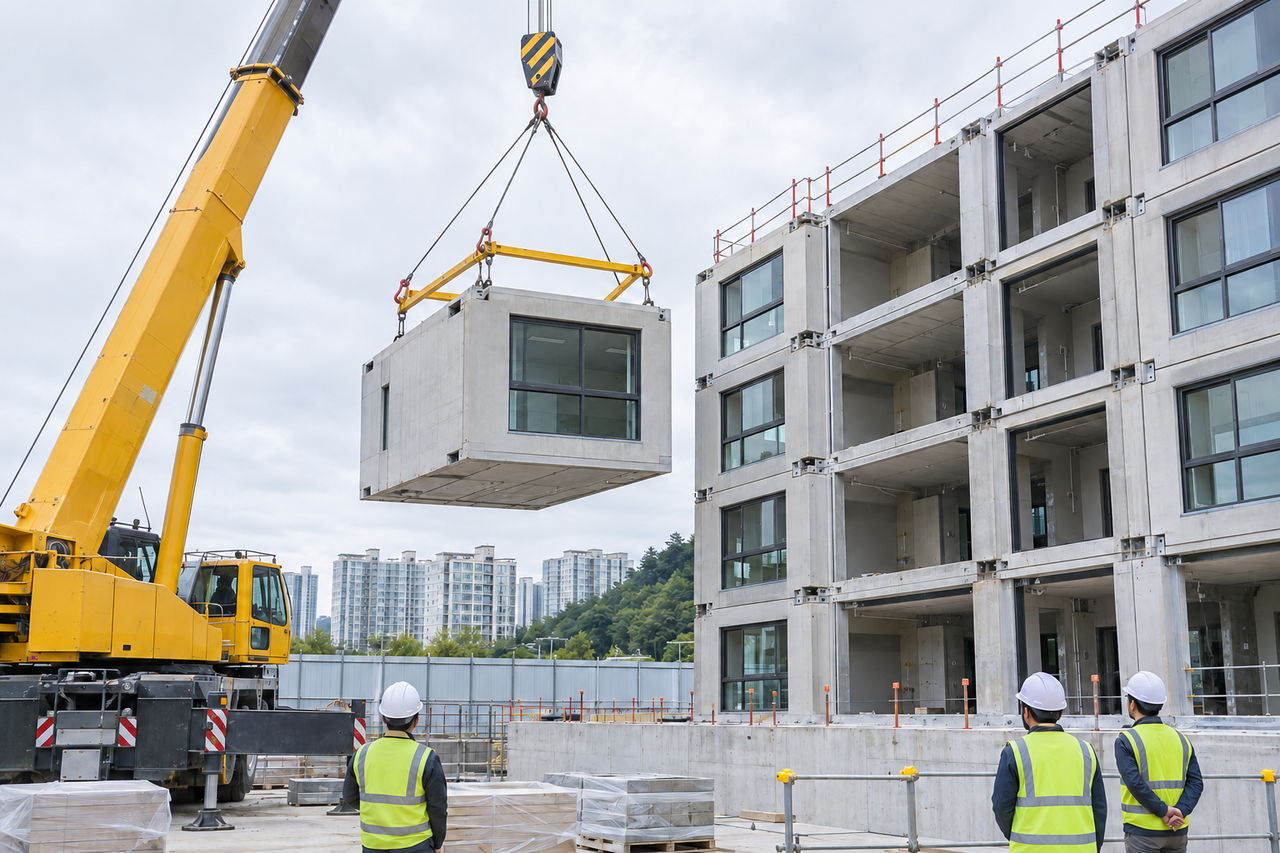
The government's interest in modular housing stems from its speed. Modular units are built by prefabricating the main structural components and fittings at a factory, then transporting and assembling them on site. Unlike conventional reinforced-concrete construction, factory fabrication and foundation work can proceed simultaneously, cutting overall construction time by 20 to 30 percent.
Stable supply of modular housing requires not only higher order volumes but also a reliable base of ongoing demand. In Britain, even government efforts could not prevent a string of corporate failures and project shutdowns as practical obstacles mounted.
A paper titled "Structural misalignment and insolvency of volumetric modular enterprises in the UK housing sector," published in the international academic journal Building Research & Information, found that modular housing had attracted attention in Britain as a solution to housing shortages and declining construction productivity.
Yet many companies failed to overcome a structural mismatch between manufacturing-style production and the conventional housing supply system. Because modular housing requires heavy upfront capital investment, factories must run continuously to bring down per-unit costs — but housing projects proceed on an individual basis, subject to land acquisition, permitting and financing, making it difficult to maintain a steady flow of orders.
Ilke Homes, one of the companies examined in the study, expanded its production facilities with backing from Homes England, the government's housing delivery agency, and private investors. But permitting delays and project cancellations destabilized factory operations, and when rising raw material costs and deteriorating access to financing piled on, the company entered compulsory liquidation in 2023.
L&G Modular Homes, a venture of the major financial group Legal & General, also failed to secure a stable order pipeline, saw its factory utilization rate fall, and ultimately decided in 2023 to halt new modular housing production.
House by Urban Splash entered administration in 2022 after production and design defects generated additional repair costs that combined with a funding shortfall. Connect Modular similarly ran into financial difficulties as losses from existing contracts mounted alongside rising operating costs.

In South Korea, the modular housing sector faces its own constraints, with adoption largely limited to the public sector. Construction costs run about 30 percent higher than with conventional methods, and ensuring residential quality suited to the country's four distinct seasons remains a challenge. Demand is also concentrated in industrial precast concrete, leaving PC manufacturers with little incentive to enter the housing market, which demands comparatively higher quality standards.
In response, the Ministry of Land, Infrastructure and Transport plans to subsidize the cost premium over conventional construction and to enact a special modular housing act that would provide tailored exemptions and incentives.
Kim Sung-hwan, a research fellow at the Korea Research Institute of Construction & Economy, said public rental housing appears to be the most practical way to kick-start the modular housing market given the range of limiting factors. "There is a need to build an institutional foundation that allows the market to expand from the public sector and eventually attract private investment," Kim said.
shy@heraldcorp.com