'Black Friday' selloff driven by AI ecosystem fears
Kospi briefly breaks below 5,000 before partial recovery
Samsung Electronics falls 6%, SK hynix drops more than 10%
Circuit breaker, sell-side sidecar triggered in succession
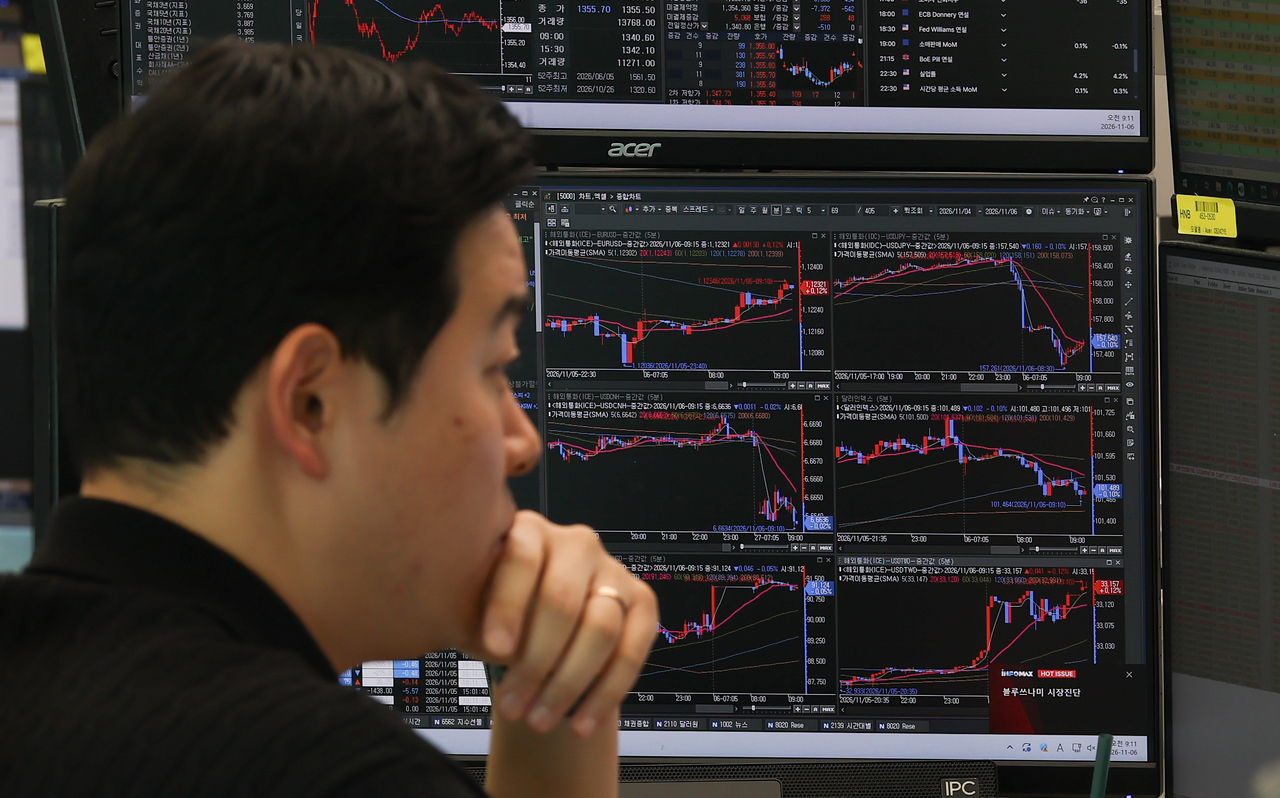
The Kospi plunged more than 6 percent on Friday, barely holding the 5,000 line, as concerns over delayed AI investment swept US markets following the Democratic Party's sweeping midterm election victory — and South Korea's benchmark index took a direct hit.
According to Korea Exchange, the Kospi closed down 324.11 points, or 6.02 percent, at 5,059.69.
The index opened 120.54 points, or 2.24 percent, lower at 5,263.26 before accelerating its decline, falling as far as 4,911.28 — a drop of 8.78 percent — shortly after the open.
It was the first time since Feb. 6 that the index had fallen below 5,000 intraday, a breach that sent investors into a panic and left fear dominating the market.
A Level 1 circuit breaker was triggered on the Kospi market at around 9:03 a.m., halting trading for 20 minutes. Even after the circuit breaker was lifted, the index continued to slide, prompting a sell-side sidecar to be activated at around 9:34 a.m.
The immediate trigger appeared to be an overnight report that Microsoft had been tightening oversight of its data center operations — stoking fears that AI investment delays tied to the Democratic sweep could already be materializing.
OpenAI, facing growing community opposition to data centers, announced plans to cover grid expansion costs directly and strengthen cooperation with local residents, raising concerns in the market about mounting cost burdens.
Those worries were compounded by signs that cash flows at some major tech companies had recently deteriorated, casting doubt on whether they have the capacity to absorb additional costs going forward.
Domestic semiconductor stocks bore the brunt of the selloff. Samsung Electronics fell 6.35 percent to close at 188,700 won ($141), while SK hynix tumbled 10.44 percent to 1.13 million won. It was the first time Samsung Electronics' closing price had dropped below 200,000 won since April 7.
SK hynix slid as low as 1.07 million won intraday, threatening the 1 million won threshold. Most large-cap stocks also declined, including Samsung Electronics preferred shares (down 6.3 percent), SK Square (down 10.51 percent), LG Energy Solution (down 2.46 percent), Samsung Biologics (down 0.26 percent), Samsung Electro-Mechanics (down 7.84 percent) and Hyundai Motor (down 4.77 percent).
Naver bucked the trend, closing up 2.87 percent on news of an equity investment by Nvidia. Hanjin Kal, embroiled in a battle over its largest shareholder stake, rose 2.99 percent, while Hanjin Kal preferred shares hit the daily upper limit. Hanjin Kal preferred shares have posted sharp gains for five consecutive trading sessions since Monday.
The Kosdaq closed down 34.14 points, or 5.03 percent, at 644.27. The index opened 23.98 points, or 3.53 percent, lower at 654.43 before widening its losses to as much as 7.26 percent, touching 629.17 early in the session.
A sell-side sidecar was also triggered on the Kosdaq market at around 9:06 a.m. Major large-cap stocks fell across the board, with Alteogen down 5.2 percent, Ecopro down 6.89 percent, Ecopro BM down 7.36 percent, Rainbow Robotics down 4.04 percent and Jusung Engineering down 9.48 percent.
Han Ji-young, a researcher at Kiwoom Securities, said the AI growth narrative in equity markets had retreated sharply since the midterm elections, with leading stocks undergoing consecutive corrections and investor sentiment turning cold. "In an environment as chilled as this, markets can be swept more easily by news flow around AI regulation," Han said.
Han added that the Kospi had entered a phase where traditional fundamental logic — earnings, valuations — was no longer being reflected in share prices.

jiyun@heraldcorp.com