Korea-EU trade up 64% over 15 years
Bilateral investment more than doubles on both sides
Seminar explores path toward 'competitiveness partnership'
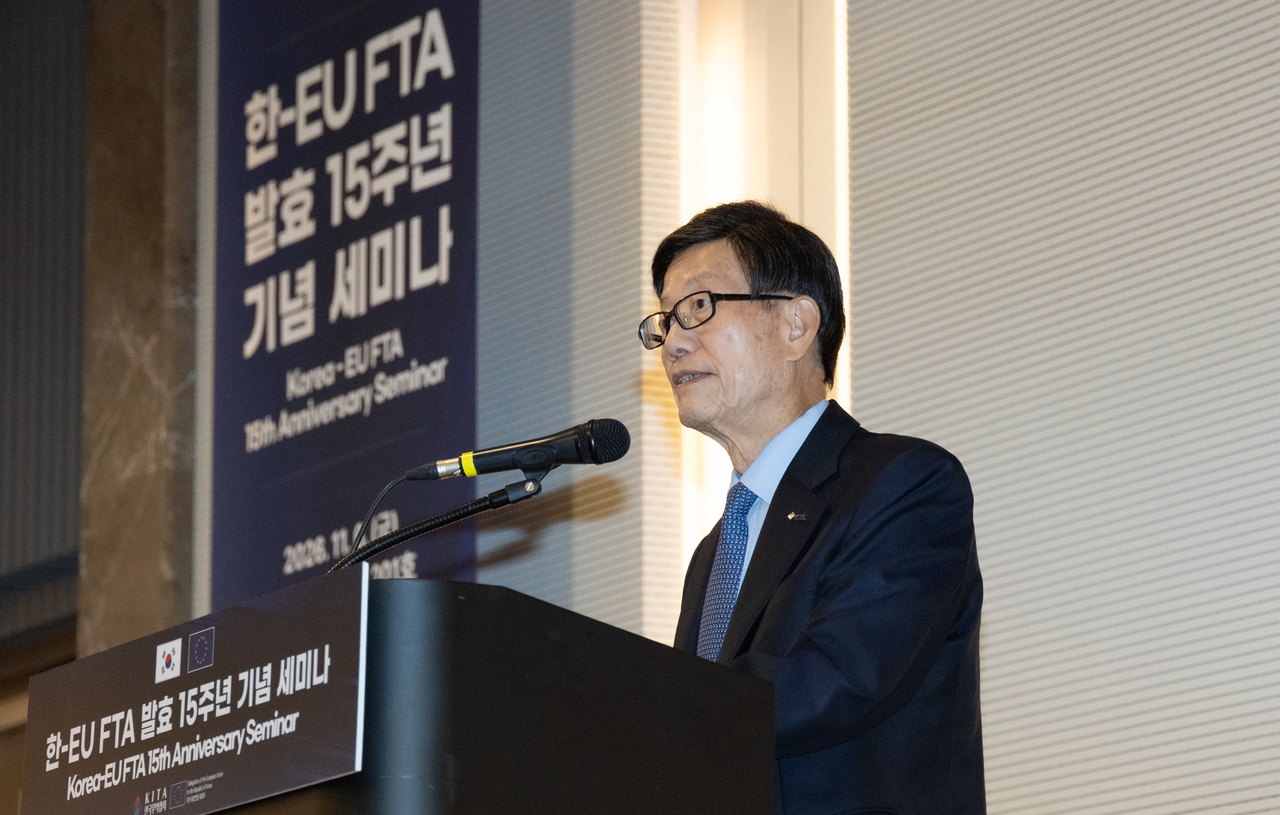
The Korea International Trade Association (KITA) held a seminar Friday to mark the 15th anniversary of the Korea-EU Free Trade Agreement, co-hosting the event with the EU Delegation to Korea at COEX in Samseong-dong, Gangnam-gu, Seoul.
The seminar was organized to review trade and investment achievements since the FTA took effect on July 1, 2011, and to explore avenues for economic cooperation amid a shifting global trade environment. About 100 people attended, including EU Ambassador to Korea Hugo Astuto, European Chamber of Commerce in Korea Vice Chairman Moon Go-young, Ministry of Trade, Industry and Resources Trade Policy Bureau Chief Kim Young-man, ambassadors from key EU member states, and executives from the trade industry.
KITA President Yoon Jin-sik said in his opening address that trade and investment had grown substantially over the 15 years since the FTA entered into force, deepening industrial and supply chain ties between the two sides. "Now, as trade friction and global overcapacity intensify, is precisely the time for Korea and the EU to strengthen cooperation further," he said.
Ambassador Astuto said in his welcoming remarks that Korea had become the first Asian country to join the EU's research support program Horizon Europe as an associate member, laying the groundwork for joint research in future technology fields such as AI and quantum technology. "I hope we can expand cooperation further into critical raw materials and semiconductor supply chains, as well as clean energy such as offshore wind and the circular economy," he said.
Kim said in his congratulatory remarks that the "competitiveness partnership" agreed upon at the Korea-EU summit last June must translate into concrete results. "We will work closely to identify and implement joint projects in key areas of cooperation through high-level economic dialogue," he said.
Expert presentations at the seminar covered three topics: the achievements and implications of 15 years of the Korea-EU FTA, changes in EU trade policy and the challenges ahead, and strategic partnership opportunities between Korea and the EU.
Cho Sung-dae, head of KITA's trade research division, said Korea-EU trade last year was up 64 percent compared with 2010, the year before the FTA took effect, while Korean investment in the EU and EU investment in Korea had expanded 2.5-fold and 2.8-fold, respectively.
Cho added that industrial linkages between the two sides had also strengthened, with Korean semiconductor exports and imports of EU-made manufacturing equipment rising in tandem, and local production of automobiles and batteries and joint development of biopharmaceuticals expanding.
Walter Van Hattum, minister-counselor for economic and trade affairs at the EU Delegation to Korea, said trade had become more than a matter of efficiency — it was now a core instrument underpinning competitiveness, resilience and economic security. "The Korea-EU relationship is moving beyond the FTA," he said.
Park Geun-hyung, a team leader at the Ministry of Trade, Industry and Resources' Europe trade division, noted that Korea-EU business cooperation was extending to third countries, citing a case in which a European company supplied industrial gas to a Korean firm's production facility in the United States.
A panel discussion followed, bringing together all the presenters along with Kang Yu-duk, a professor at Hankuk University of Foreign Studies' School of Languages and Trade, Seo Jeong-ran, an executive director at the Korea Automobile Manufacturers Association, and Park Ju-young, head of research and innovation at L'Oréal Korea. The panelists discussed how changes in the trade environment are affecting business operations and what Korea-EU cooperation challenges lie ahead for each industry.
KITA will hold the 2026 KITA International Conference at COEX on Nov. 30 to mark the achievement of $1 trillion in exports. Domestic and international experts will examine new growth drivers for Korean exports and discuss trade strategies for responding to economic security concerns and supply chain restructuring.
Meanwhile, KITA also held the sixth Korea-Japan Economic Roundtable on Friday, co-hosted with Japan's Keizai Doyukai at Trade Tower in Samseong-dong, Gangnam-gu, Seoul.
The Korea-Japan Economic Roundtable is an official cooperation channel established jointly by KITA's Korea-Japan Exchange Special Committee, launched in February 2024, and its Japanese counterpart, Keizai Doyukai, to strengthen private-sector cooperation and networking between business leaders of the two countries. The roundtable has been held twice a year, alternating between Korea and Japan, since its inaugural session in Tokyo in May 2024.
likehyo85@heraldcorp.com