Rail and subway unions push for joint strike after Nov. 20
Korea Workers' Compensation and Welfare Service union targets Nov. 26; school non-regular workers set Nov. 27
Incheon Airport shift dispute tests new direct-bargaining rules
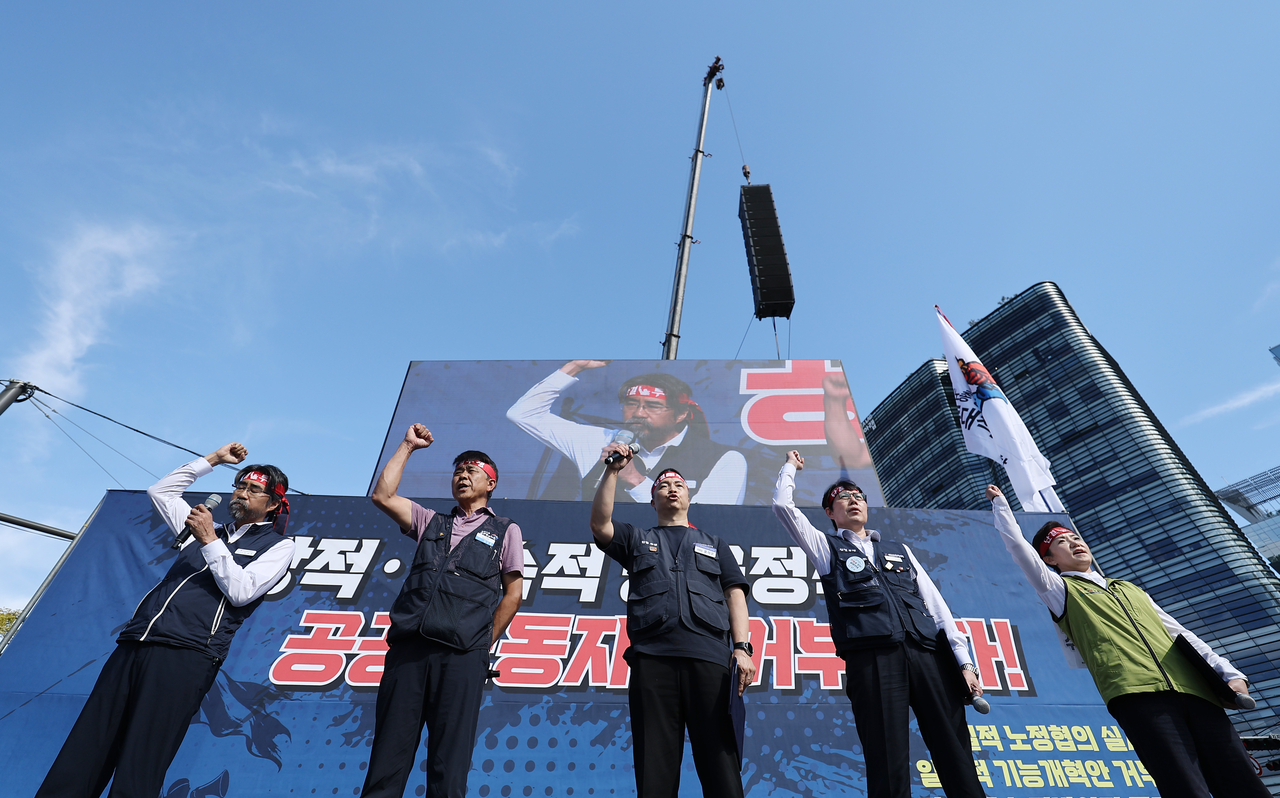
Unions representing railway and subway workers, Korea Workers' Compensation and Welfare Service employees, and non-regular school staff have all announced strikes for late this month. If negotiations fail to produce agreements, the walkouts could disrupt train services, school meals and childcare, and industrial accident compensation work.
According to labor circles Monday, the National Railway and Subway Labor Council — an umbrella body under the Korean Confederation of Trade Unions' Korean Public Service and Transport Workers' Union — is pushing for a joint strike after Nov. 20. Six affiliated unions, including the National Railway Workers' Union and the Seoul Metro Workers' Union, have passed strike authorization votes. The Airport Railroad branch, which passed its own separate vote, is set to stage a one-day warning strike Thursday. The council is demanding the withdrawal of workforce reduction plans, the hiring of additional safety personnel, and legislation requiring two-person work teams.
The Korea Workers' Compensation and Welfare Service union plans to hold two warning strikes — Thursday and Nov. 17 — before launching a general strike Nov. 26. The union is calling for a reduction in the wage gap with other social insurance agencies and for additional staffing and budget to support reforms to the employment insurance system and an expansion of the retirement pension program. If workers at affiliated hospitals join the strike, services at industrial accident hospitals could also be affected.
The National Council of Non-Regular School Workers has announced a nationwide general strike for Nov. 27 after failing to reach agreement with education authorities on the size of a base-pay increase. The council is also demanding an end to welfare benefit disparities and a resolution to the issue of unpaid wages during school vacations.
Unions at Incheon International Airport subsidiaries, which staged a warning strike Oct. 23, are demanding a shift to a four-team, two-shift rotation system and the filling of vacant positions. Incheon International Airport Corp. considers industrial safety a matter for direct bargaining with the parent company. The unions argue that reforming the shift system to reduce night work also falls under the safety agenda. They have said they could launch a full strike during the peak December travel season if their demands are not met.
According to the Ministry of Employment and Labor, of the 439 primary contractors that received bargaining demands from subcontractor unions between March 10 — when the revised Trade Union Act took effect — and June 19, 190, or 43.3 percent, were in the public sector. In figures the Korean Public Service and Transport Workers' Union released last month, only 18 of roughly 70 primary contractors that had received bargaining demands had actually held negotiations.
The union argues that determining employer status and consolidating bargaining channels takes time, and that wages and staffing — which fall under the government's total labor cost guidelines — are in practice difficult to negotiate because the government's status as an employer is hard to establish.
Two issues are expected to shape public-sector labor relations next year: a second round of relocating public institutions to regional areas, and improvements to the treatment of public service workers. As relocation targets and timelines become more concrete, resistance from unions at the affected agencies is likely to grow. If the Public Service Workers' Committee — launched in September — fails to narrow differences over wages and other working conditions, the standoff could escalate into broader labor-government conflict.
fact0514@heraldcorp.com