KRISO becomes first in Korea to receive approval in principle for dual-cargo shipping technology in two categories
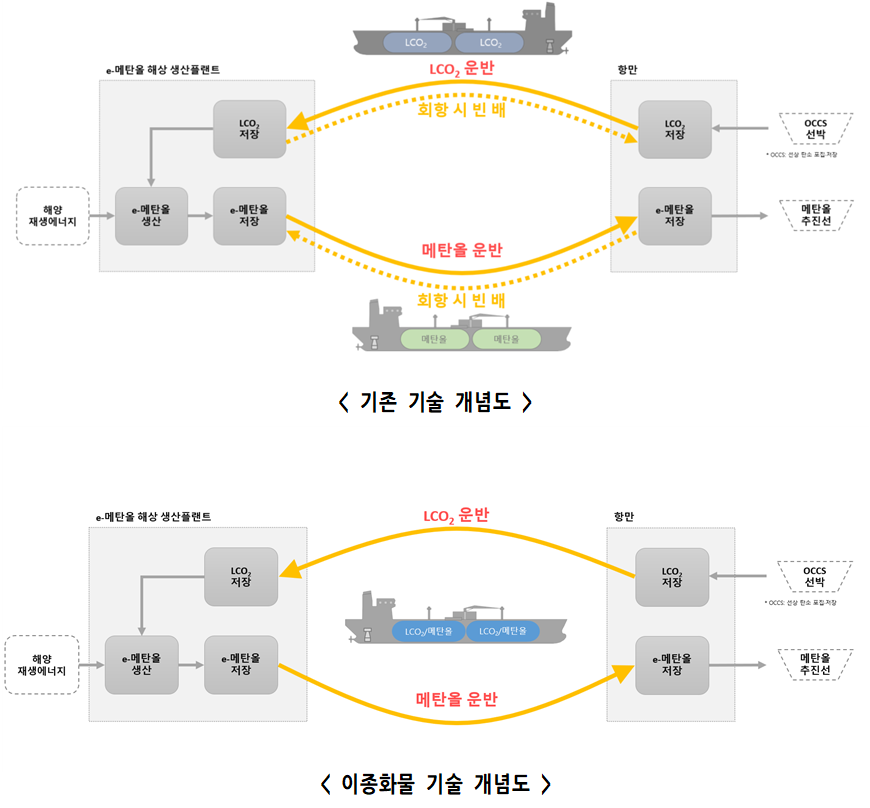
A technology has been developed that allows a ship carrying carbon dioxide to load methanol for the return voyage instead of sailing back empty. By alternating between two different cargoes on a single vessel, the technology is expected to reduce unnecessary ballast voyages and lower maritime shipping costs.
The Korea Research Institute of Ships and Ocean Engineering (KRISO) announced Monday that it had received approval in principle (AiP) from Korean Register (KR) in two categories for a dual-cargo transport technology that stores and carries liquefied carbon dioxide (LCO₂) and methanol alternately in the same cargo tank.
The two areas granted approval are a dual-cargo tank for LCO₂ and methanol, and an integrated dual-cargo loading and unloading system. Approval in principle is a procedure that reviews the technical feasibility and safety of a new technology or design and formally recognizes the design concept.
Previously, the differing storage and transport conditions required for LCO₂ and methanol meant each had to be carried on separate vessels. As a result, ships would often complete a delivery and then sail on to the next port without any cargo.
The research team focused on carbon dioxide's role as a raw material for producing e-methanol, a clean fuel. The concept involves transporting captured CO₂ to an e-methanol production facility, then loading the methanol produced at that facility onto the same ship for the onward journey.
E-methanol is a fuel made using hydrogen produced from renewable energy and captured carbon dioxide. It is drawing attention as an eco-friendly marine fuel that can replace conventional fossil-fuel-based methanol.
The core technical challenge is safely transporting two cargoes with different physical and chemical properties within a single tank.
LCO₂ remains liquid under low-temperature, high-pressure conditions, while methanol is a flammable substance that stays liquid at room temperature and atmospheric pressure. Alternating between the two therefore requires precise control of temperature and pressure conditions and ensuring safety during the cargo-switching process.
Taking these characteristics into account, the KRISO team designed a cargo tank capable of accommodating the different temperature and pressure requirements of each cargo. The team also developed an integrated loading and unloading system that minimizes the time and energy needed when switching between cargoes.
The approval is the first of its kind in Korea and is believed to be only the second in the world for technology that alternately transports LCO₂ and methanol.
KRISO plans to verify the technology's performance and safety through land-based demonstration tests beginning in the second half of next year. The institute aims to obtain third-party inspection and design approval in 2028.
Once commercialized, the technology is expected to improve vessel operating efficiency and the economic viability of maritime transport by linking LCO₂ shipping with the supply of eco-friendly fuel.
"The transition to green shipping requires not only the development of new technologies but also efforts to improve the efficiency of existing transport systems," KRISO Director General Jeong Jong-jin said. "We will continue to prepare diverse technological alternatives in response to changes in the shipping industry and work to apply them in the field."
nbgkoo@heraldcorp.com