Data from the Bank of Korea obtained via People Power Party lawmaker Lee Jong-uk's office
Net selling in the first nine months was 2.6 times last year's figure
Dollar sales up 56.1% on record current-account surplus
Demand for cheap-dollar buying also grows as rate falls
Rate climbs after US midterms; upward and downward pressures balanced
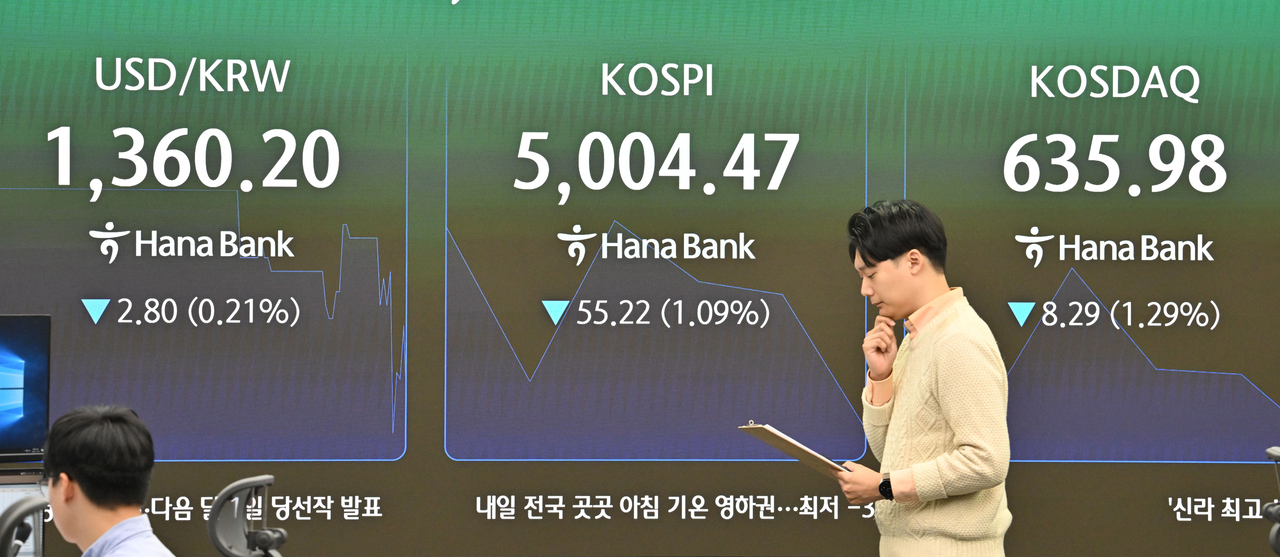
After the won-dollar exchange rate peaked in June and fell for four consecutive months through October, private non-financial companies in South Korea sold nearly twice as many dollars on the foreign exchange market in the first nine months of this year as they did in all of last year. The trend reflects a strengthening won, driven by large-scale currency conversions by export-oriented firms — particularly in the semiconductor sector — converting their dollar earnings into won.
The exchange rate has risen for three consecutive trading days since the US midterm elections, however, as investor sentiment toward AI-related assets weakened. With the current-account surplus expected to remain large, upward and downward pressures on the exchange rate are seen remaining evenly matched for some time.
According to Bank of Korea data on foreign exchange transactions by non-financial private companies — obtained through the office of People Power Party lawmaker Lee Jong-uk of the National Assembly's Finance and Economy Planning Committee — the combined net dollar sales (total sales minus total purchases) of spot and forward foreign exchange contracts by non-financial private companies reached $286.57 billion in the first three quarters of this year.
That figure was 2.6 times the $109.32 billion recorded in the same period last year, and 1.9 times the full-year net selling total of $149.13 billion for last year. Non-financial private companies refers to general businesses excluding financial institutions and state-owned enterprises.
Both sales and purchases rose, but the increase in sales outpaced that in purchases. Cumulative dollar sales through the third quarter reached $736 billion, up 56.1% from $471.55 billion in the same period last year — already surpassing last year's full-year sales total of $646.44 billion by 13.9% in just nine months. Purchases came to $449.43 billion, up 24.1% from the same period last year and equivalent to about 90% of last year's full-year figure of $497.31 billion.
The surge in dollar selling was driven largely by a rapid buildup in corporate dollar holdings on the back of a record current-account surplus. The September current-account surplus hit $61.46 billion, surpassing $60 billion for the first time in history. The cumulative surplus for January through September reached $340.66 billion, more than four times the $83.89 billion recorded in the same period last year. Government encouragement to convert foreign currency, combined with corporate demand to convert dollars for tax payments and domestic investment, further increased the number of companies exchanging dollars for won.
"Through the second quarter, foreign equity selling, portfolio rebalancing and forward contract purchases for currency hedging had not subsided — but once they did, the effect of corporate dollar selling tied to the current-account surplus became clearly visible from the third quarter onward," a Bank of Korea official said.
On a quarterly basis, net selling shrank in the third quarter, as purchases rose 11.2% from the previous quarter, outpacing the 2.8% increase in sales. This suggests that demand for dollars grew more sharply even as companies continued selling. "As the exchange rate fell, there was a considerable wave of bargain buying, mainly from importers," the official said.
With dollars in abundant supply, demand is also growing among companies to deposit unconverted dollars. Corporate dollar deposits stood at $117.87 billion at the end of September, setting a record high for the fifth consecutive month. "Importers buy dollars in advance at a lower rate and park them in foreign-currency deposits for future payments, while some exporters, seeing the rate fall below where they had been selling, hold back on converting and deposit instead," the official said. "When you break it down by exporters and importers, that pattern is clear."
The won-dollar rate tumbled in the third quarter. After averaging 1,528 won in June (based on weekly closing prices), it fell for four consecutive months — to 1,488.9 won in July, 1,404.4 won in August, 1,358.8 won in September and 1,336.4 won in October.
Market participants broadly expect corporate dollar selling to continue, putting gradual downward pressure on the exchange rate through year-end. A recent decline in international oil prices is also seen adding to that downward pressure.
Monetary authorities also see room for the rate to fall further. Bank of Korea Governor Shin Hyun-song said at a monetary policy press briefing last month that "in terms of the real effective exchange rate, the won is weaker than in previous years."
Upward pressure on the exchange rate is also expected to be significant, however, as risk-averse sentiment has intensified since the US midterm elections amid concerns over data center regulation, boosting demand for safe-haven assets such as the dollar.
The exchange rate rose for three consecutive trading days from Tuesday, when the US midterms began, closing at 1,341 won, through Friday at 1,356.6 won. Friday's session was particularly sharp, with the rate jumping 14.5 won from the previous day as South Korean stocks tumbled on concerns — centered on the Democratic Party — over potential AI data center regulation.
kimstar@heraldcorp.com