Won-dollar rate falls 4.8 won despite 15.8 trillion won payout
SK hynix set to pay 7 trillion won by year-end
Demand for won to fund dividends also rises
Record current-account surplus cushions dollar outflows
Short-term volatility, net selling remain wild cards
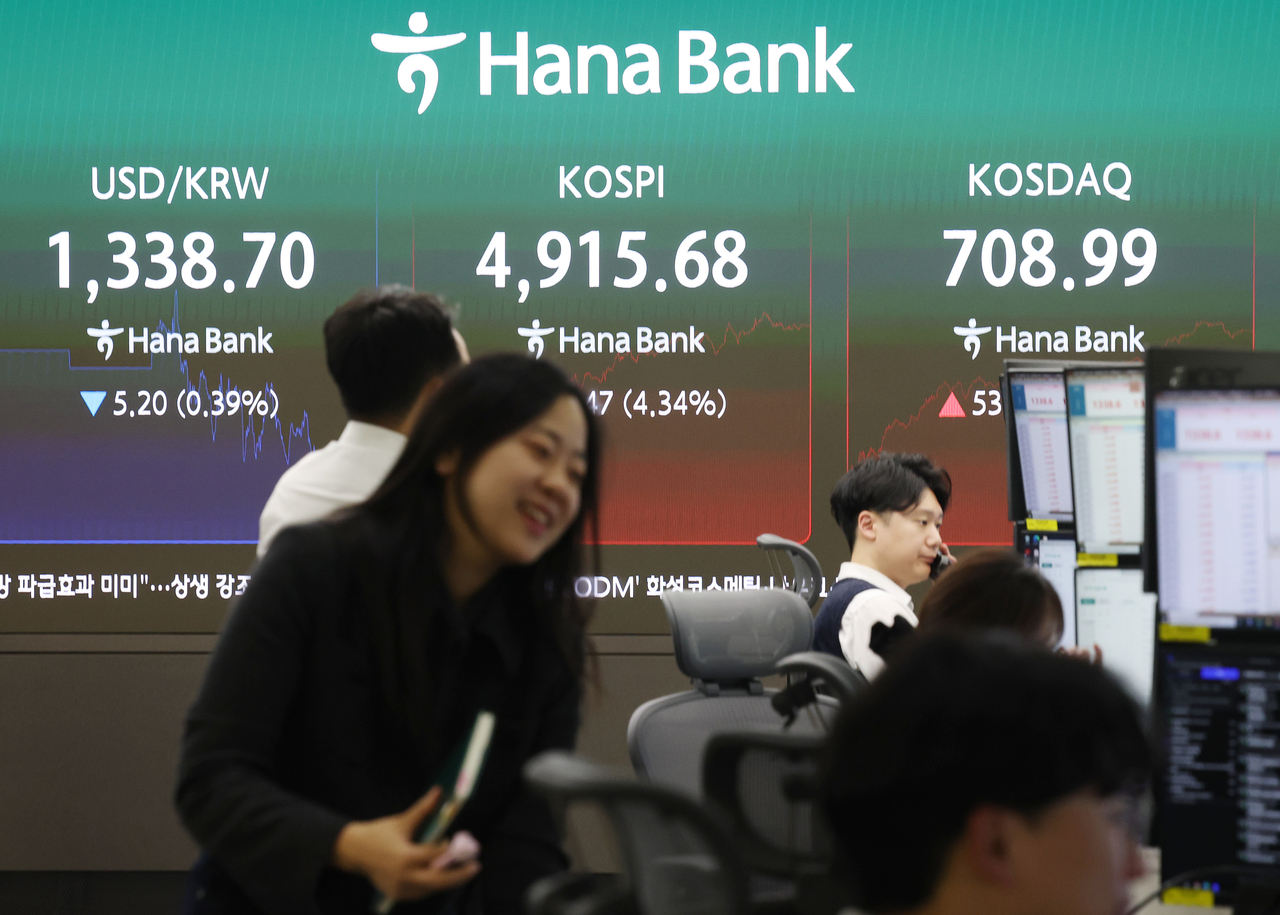
The won-dollar exchange rate actually fell on Friday despite the largest foreign dividend payout on record, as month-end dollar selling by exporters more than offset demand from dividend recipients converting their payouts into dollars.
With domestic listed companies set to pay foreign investors roughly 23 trillion won ($17.1 billion) by year-end, some market watchers have raised concerns that the won could weaken again. Authorities, however, believe the impact on the exchange rate will be limited, as the dollars companies bring in from overseas to fund those dividends largely cancel out the dollars flowing back out through repatriation.
The won-dollar rate closed at 1,337.9 won on Friday — down 4.8 won from the previous session — even as the record dividend payout was made that day, according to financial industry sources. Markets attributed the move to a recovery in risk appetite centered on US technology stocks, combined with month-end dollar selling by exporters that exceeded the volume of dividend-related repatriation.
Listed companies paid foreign investors 15.8 trillion won on Friday alone, the largest single-day payout on record — more than double the previous record of 7.7 trillion won set on April 16, 2021. Samsung Electronics accounted for 15.3 trillion won of that total.
According to the International Finance Center, listed companies will pay out a combined 46.6 trillion won in dividends from Tuesday through year-end, of which foreign investors' share comes to 23.4 trillion won. Samsung Electronics and SK hynix — which is scheduled to pay foreign investors 6.98 trillion won at the end of next month — together account for 95 percent of total foreign dividend payments, making the two chipmakers the dominant factor.
Markets are watching closely whether foreign investors will repatriate their dividends and push the exchange rate higher. The monthly average won-dollar rate peaked at 1,528 won in June before falling for four consecutive months through October, when it averaged 1,336.4 won. In November, net selling of domestic shares by foreign investors nudged the average rate up slightly to 1,339.8 won through Friday.
If foreign investors hold their dividends in won or reinvest them in domestic equities, the exchange rate is unaffected. But if they convert the proceeds into dollars and remit them abroad, the resulting demand for dollars in the foreign-exchange market can push the rate higher. On average, foreign dividend repatriation is estimated to account for between half and two-thirds of total dividend payments — a range that implies dollar-conversion demand of 12 trillion to 16 trillion won through year-end.
Some analysts expect a larger-than-usual share of dividends to be converted into dollars, given the significant correction in domestic equities this year. Kim Jin-wook, an economist at Citi, estimated in a recent report that foreign dividend repatriation in November and December could reach as much as $12.6 billion — well above the $6.9 billion repatriated in April and May this year.
However, dividend payments do not exert only upward pressure on the exchange rate. Companies also convert into won the dollars they have earned overseas in order to fund those payouts, adding to the supply of dollars in the market. A foreign-exchange authority official said that, based on historical averages, if between half and two-thirds of dividends are sent abroad but more than that amount in dividend funding has already come in as dollars from overseas, "the net effect over the period is neutral or even a downward factor for the exchange rate."
The International Finance Center also found that, taking into account the overseas sales ratios of the two major chipmakers, the volume of dollar selling to fund dividend payments is roughly twice the estimated foreign repatriation demand.
How foreign investors manage their funds is another key variable. Investors tracking total-return indexes — which include dividends — automatically reinvest the dividends they receive by buying back into equities. The official said that investors following such indexes "essentially buy back shares equal to the dividend amount almost automatically," adding that "even when investors are selling out of equities, not all of the dividends will end up being repatriated as one might expect." The official suggested that the historically lower-than-expected repatriation ratio may partly reflect the weight of such index-tracking capital.
A surge in dollar inflows has also provided a buffer. Last April, foreign dividend payments of around $6.8 billion exceeded that month's current-account surplus of $5.7 billion. By contrast, this April, foreign dividends totaled $7.7 billion, but the current-account surplus came in at $28.29 billion — nearly five times larger. The cumulative current-account surplus through September reached $340.66 billion, roughly four times the year-earlier figure. The Bank of Korea projected that the full-year current-account surplus will exceed $500 billion.
Looking at past dividend seasons, there has been no clear directional pattern in the exchange rate. According to the Bank of Korea, in only half of the past 10 years — from 2017 to 2026 — did the monthly average won-dollar rate in April, when year-end dividend payments are concentrated, rise from the previous month. Even this April, when foreign dividends were estimated at $7.7 billion, the rate averaged 1,485 won — actually 0.5 percent lower than March's 1,492.5 won.
Short-term volatility, however, remains a risk. The International Finance Center said that while companies' dollar selling tends to be spread over an extended period, repatriation flows are often concentrated within a single day or a few days, which could amplify exchange-rate swings. The authority official also cautioned that "if foreign equity selling increases sharply around the time of dividend repatriation, dollar demand from a supply-and-demand perspective could rise further." According to Korea Exchange, foreign investors recorded net selling of 14.9 trillion won in the domestic stock market — including the Kospi, Kosdaq, Konex and exchange-traded products such as ETFs, ETNs and ELWs — from Nov. 1 through Friday.

kimstar@heraldcorp.com