Korea Research Institute of Chemical Technology confirms nitrogen compounds degrade catalyst performance; pilot demonstration targeted for 2030
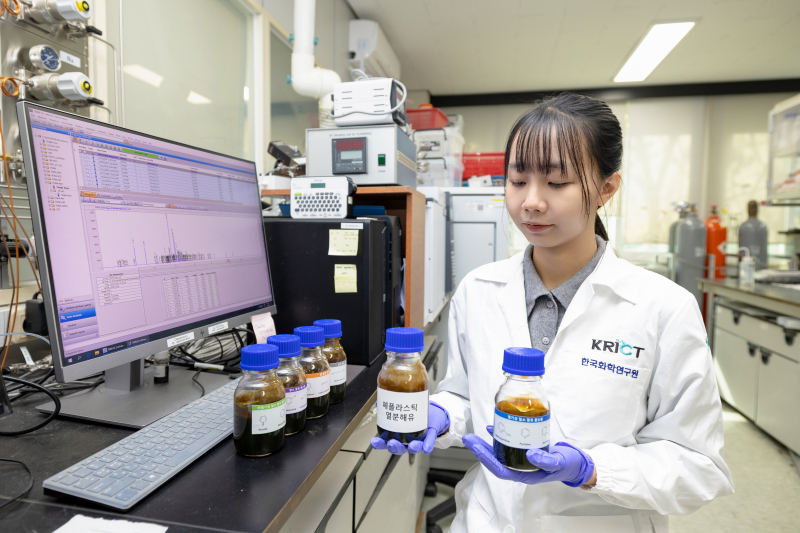
South Korean researchers have used AI to identify how specific impurities in oil extracted from waste plastics degrade catalyst performance — a finding expected to accelerate the commercialization of technology that recycles waste plastics into high-value petrochemical feedstocks.
The Korea Research Institute of Chemical Technology announced Monday that a research team led by Kim Do-kyung, in collaboration with a team led by Professor Kim Tae-yong of Korea University of Technology and Education, had identified how impurities in pyrolysis oil derived from waste plastics affect catalyst performance and the mechanisms behind that degradation.
Pyrolysis oil is produced by breaking down discarded plastics at high temperatures. It has drawn attention as a potential substitute for conventional petroleum and naphtha. When processed with a catalyst, it can yield light olefins such as ethylene and propylene — the basic building blocks of plastics and a wide range of chemical products.
The challenge lies in the various additives and impurities present in waste plastics. These substances interfere with the catalyst's chemical reactions, reducing production efficiency. Because impurity composition varies depending on the type of waste plastic, stable large-scale production has remained difficult.
The research team added 13 types of nitrogen-, sulfur-, chlorine- and oxygen-based impurities individually to actual pyrolysis oil samples, then used a zeolite catalyst to compare changes in light olefin output.
Sulfur-, chlorine- and oxygen-based compounds had a relatively limited effect on catalyst performance. Some nitrogen-based compounds, however, caused a significant decline.
Among them, the nitrogen compound 2-methylpyridine sharply degraded catalyst performance, while benzonitrile had a comparatively minor effect. The findings suggest that the type of nitrogen compound present matters more than the total amount of nitrogen in the impurities.
The team also used machine learning potential (MLP), an AI-based computational chemistry technique, to uncover the underlying cause.
Inside a zeolite catalyst, there are active sites that break down hydrocarbons. The researchers confirmed that certain nitrogen-based impurities occupy these sites first, blocking the hydrocarbon cracking reaction. The size of the impurity molecules and the spatial structure inside the catalyst also influenced reaction efficiency.
Higher concentrations of nitrogen-based impurities led to greater catalyst degradation, though raising the reaction temperature helped mitigate the decline. Catalysts that had lost performance through repeated use also recovered their initial effectiveness after a regeneration process that removes carbon deposits.
The research is significant for establishing a scientific basis to predict catalyst degradation by analyzing the type and concentration of impurities in pyrolysis oil before it enters the production process.
The institute developed a circulating fluidized bed catalytic cracking technology in 2024 that converts pyrolysis oil into light olefins without a separate hydrotreatment step. Building on these latest findings, it plans to pursue catalyst and process optimization and scale-up research, with a goal of pilot demonstration around 2030.
"We expect this research to be used to assess the likelihood of catalyst degradation by analyzing impurity composition before feedstocks enter the process, and to develop impurity management and operational strategies tailored to the characteristics of the feedstock," said institute director Shin Seok-min.
The findings were published as the cover paper in the April issue of ACS Catalysis, an international journal in the field of catalysis.
nbgkoo@heraldcorp.com