- Korea Institute of Industrial Technology, Hanyang University solve graphene clumping with cheap commercial material
- Film measuring 0.1 mm thick designed for foldable phones, wearable devices
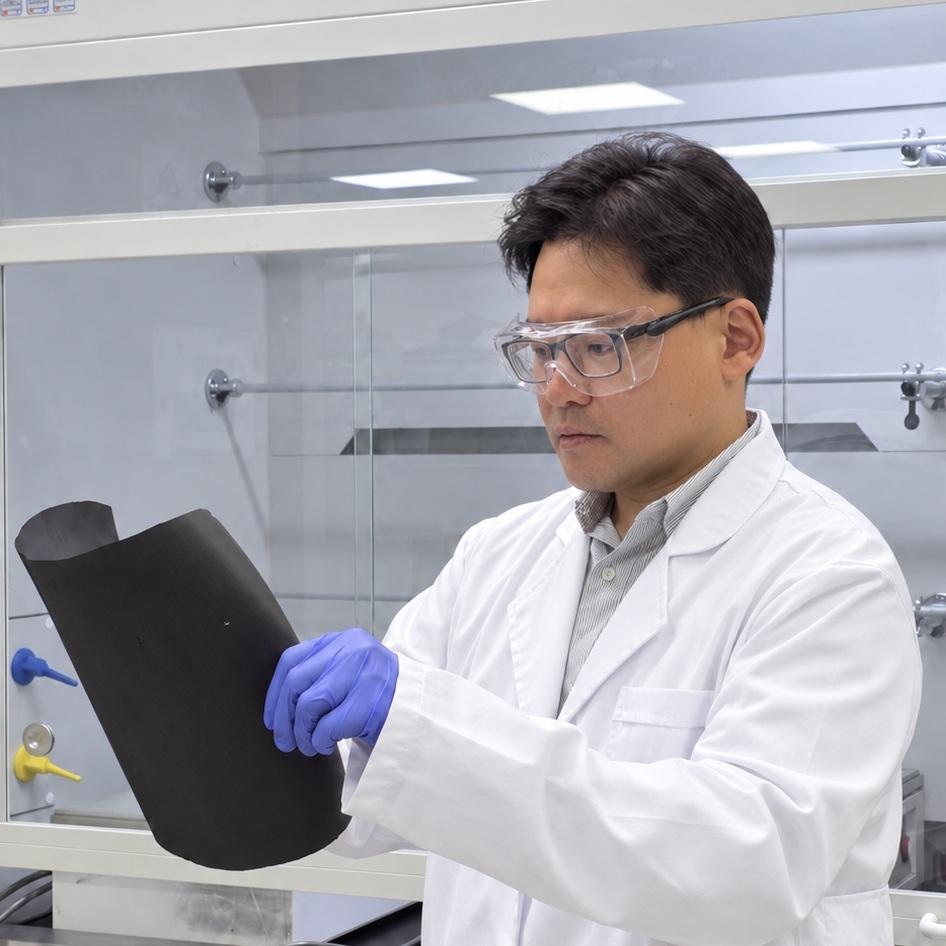
South Korean researchers have developed an ultrathin film that retains nearly all of its electromagnetic shielding performance after being folded more than 400,000 times. Just 0.1 mm thick, the film can reduce electromagnetic energy to one hundred-thousandth of its original level.
The Korea Institute of Industrial Technology announced Monday that a research team led by Senior Researcher Hong Seong-u of its Green Circulation Research Division had jointly developed the high-performance, high-durability graphene-based electromagnetic shielding film with a team led by Ko Min-jae, a professor in the Department of Chemical Engineering at Hanyang University.
Electromagnetic shielding films are a key material that blocks electromagnetic waves generated inside electronic devices or entering from outside, preventing malfunctions. As foldable smartphones and wearable devices that can be bent or folded become more common, demand has grown for shielding materials that are thin and lightweight yet able to withstand repeated deformation.
Graphene has drawn attention as a next-generation electromagnetic shielding material because it is lighter than metal and highly electrically conductive. A persistent problem, however, has been that graphene particles tend to clump together, degrading performance in actual products.
Previous approaches to solving this included chemically treating graphene surfaces or using expensive specialty dispersants. Chemical treatment diminishes graphene's inherent electrical properties, while specialty dispersants are costly and involve complex manufacturing processes.
The research team resolved the problem by identifying the molecular structure needed to disperse graphene evenly. Instead of expensive specialty additives, they used triethylamine, a substance readily available on the commercial market.
A graphene solution containing triethylamine showed no noticeable precipitation even after six months. The graphene was also confirmed to be uniformly distributed throughout the finished film.
The team then combined flexible plastic, cellulose nanofibers derived from plants, and carbon nanotubes using a water-based, eco-friendly process.
The plastic enhances flexibility, the cellulose nanofibers strengthen the bonds between graphene layers, and the carbon nanotubes boost electrical conductivity. Together, these materials form tight connections between brick-like aligned graphene layers, creating a structure that resists cracking even under repeated folding.
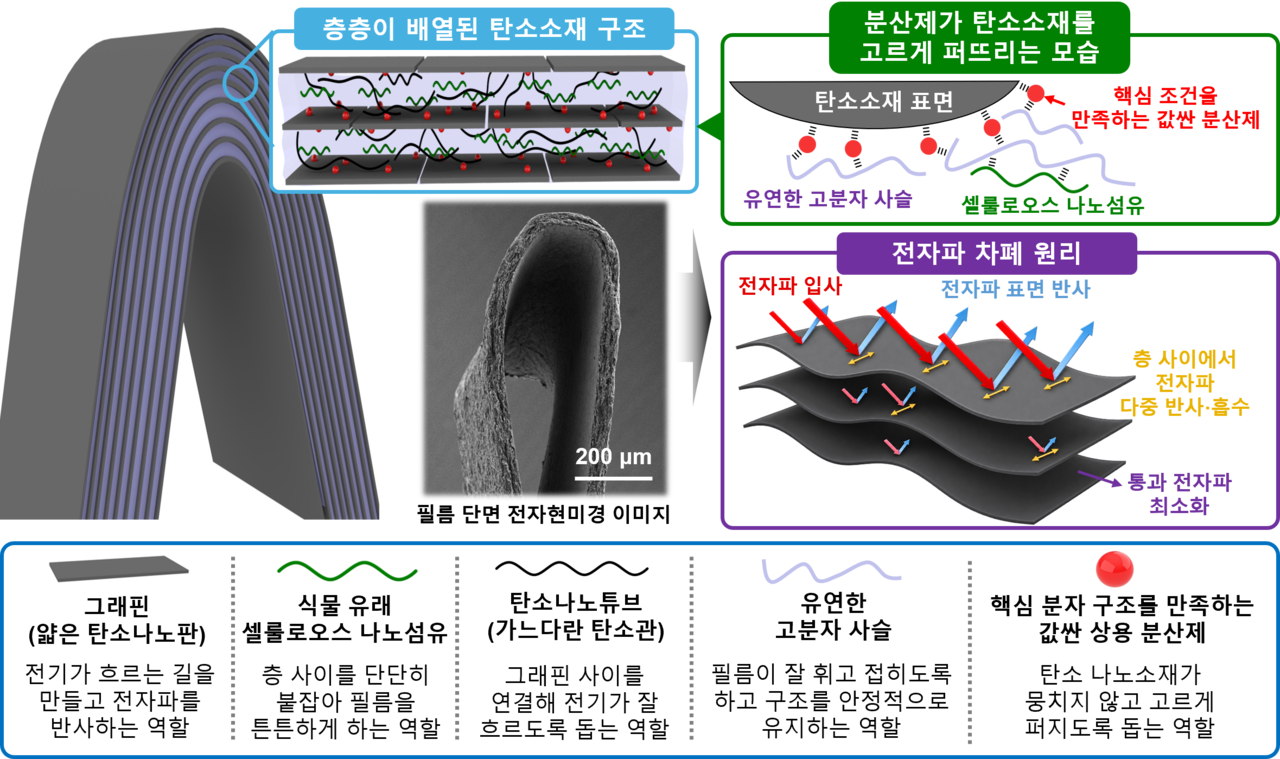
Despite measuring just 0.1 mm in thickness, the film demonstrated the ability to block 99.999% of electromagnetic energy.
After 400,000 bending cycles at a radius of 3 mm, the film retained 99.4 percent of its initial electromagnetic shielding performance and 97.9 percent of its electrical conductivity, with no visible physical damage.
The film also maintained more than 92.5 percent of its initial performance in tests simulating real-world conditions, including high temperature and humidity, exposure to artificial sweat, and rapid temperature fluctuations.
The technology can be applied to existing film and coating production processes, allowing expansion to large-area, high-volume manufacturing without major changes to existing facilities.
"We found a way to maximize graphene's dispersion performance using commercially available materials without expensive additives," Hong said. "We expect this to serve as a key material in the next-generation electronics market, including foldable displays, where flexibility and high performance are required at the same time."
The findings were published in the international journal Advanced Composites and Hybrid Materials.
nbgkoo@heraldcorp.com