GIST becomes first Korean institution selected for Horizon Europe in wind energy research, targeting 2% output gain
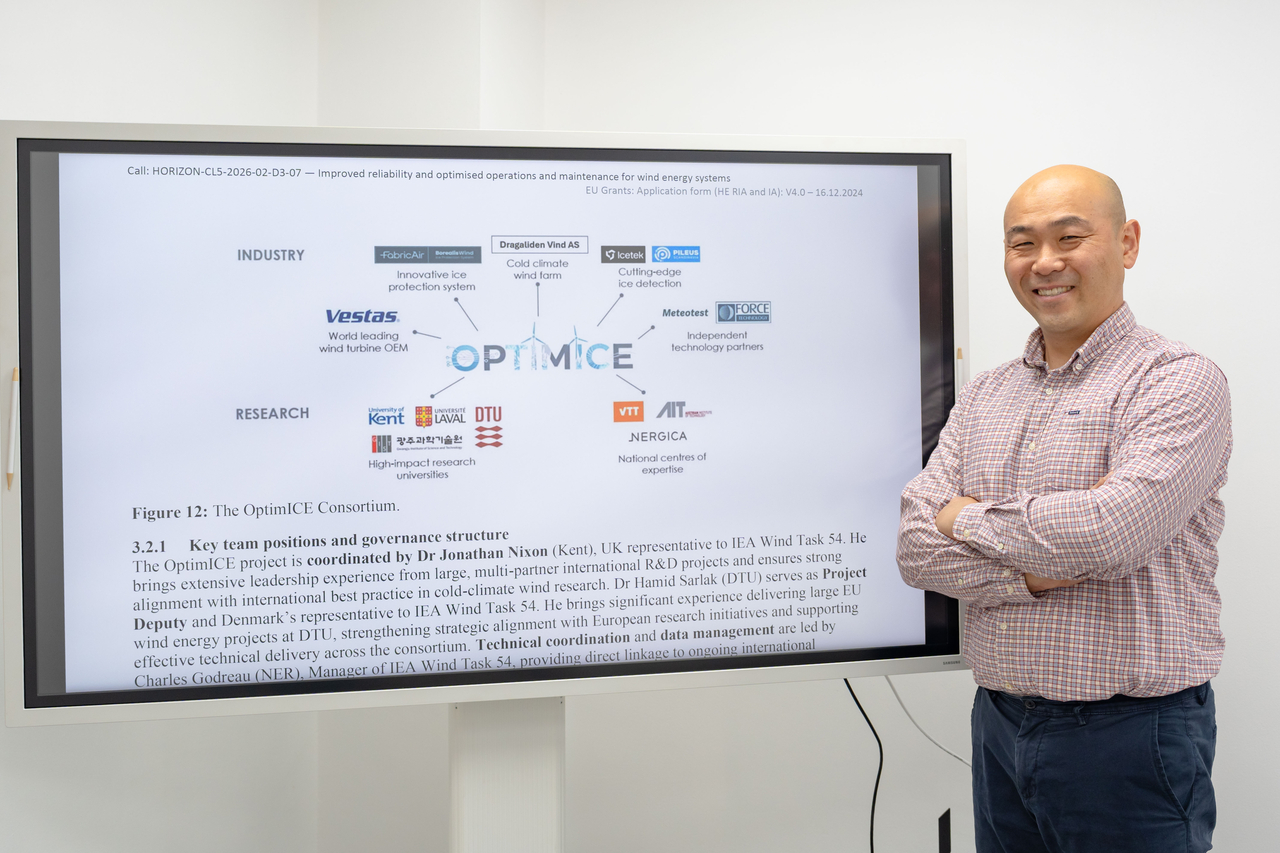
Korean researchers are joining a European collaborative study to address the problem of wind turbine blades freezing in winter cold, which reduces power output and can force shutdowns.
The Gwangju Institute of Science and Technology (GIST) announced Monday that a research team led by Professor Kim Tae-sung of the Department of Mechanical and Robot Engineering has been selected for a project under Horizon Europe, the EU's flagship research and innovation program. It marks the first time a Korean research team has been chosen for a Horizon Europe project in wind energy research.
The selected project, called OptimICE, carries a total research budget of 5.2 million euros ($5.8 million) over 42 months. The University of Kent in the United Kingdom leads the consortium, which brings together 14 institutions from eight countries — including GIST, Danish wind turbine manufacturer Vestas, the Technical University of Denmark and the VTT Technical Research Centre of Finland.
The project proposal submitted with GIST's participation received a perfect score of 15 out of 15 in the Horizon Europe review, with evaluators recognizing its technological innovation and potential for industrial application.
Icing on wind turbines in winter is widely regarded as one of the wind industry's most pressing challenges. About 25 percent of the world's onshore wind capacity — roughly 300 GW — operates in cold climates. Ice accumulation on blade surfaces degrades generation efficiency and, in severe cases, forces turbines into shutdown.
Within the international collaboration, the GIST research team will lead the core area of numerical modeling and benchmarking.
The team will use computer simulations to replicate how ice buildup roughens blade surfaces and alters airflow, enabling precise predictions of how icing affects power output.
The research will also analyze the melting and refreezing that occurs when blades are heated to remove ice. The technology developed will be validated against real-world wind complex operational data and icing wind tunnel experiments, and will also be used to improve Vestas's wind turbine analysis models.
The team also plans to develop an intelligent control system that combines AI with weather and sensor data to predict icing conditions in advance and activate heating systems only when needed.
If the research succeeds, it is expected to cut annual turbine shutdown time due to icing by 100 to 150 hours and raise annual power generation by more than 2 percent. The team also aims to reduce icing-related inspection time by more than 15 percent.
"We will work with world-class research institutions and companies to solve the icing challenge facing wind turbines and play a key role in strengthening the competitiveness of Korea's wind energy industry," Kim said.
nbgkoo@heraldcorp.com