- Korea Railroad Research Institute develops modular bridge technology
- Safety verified through full-scale 30-meter test
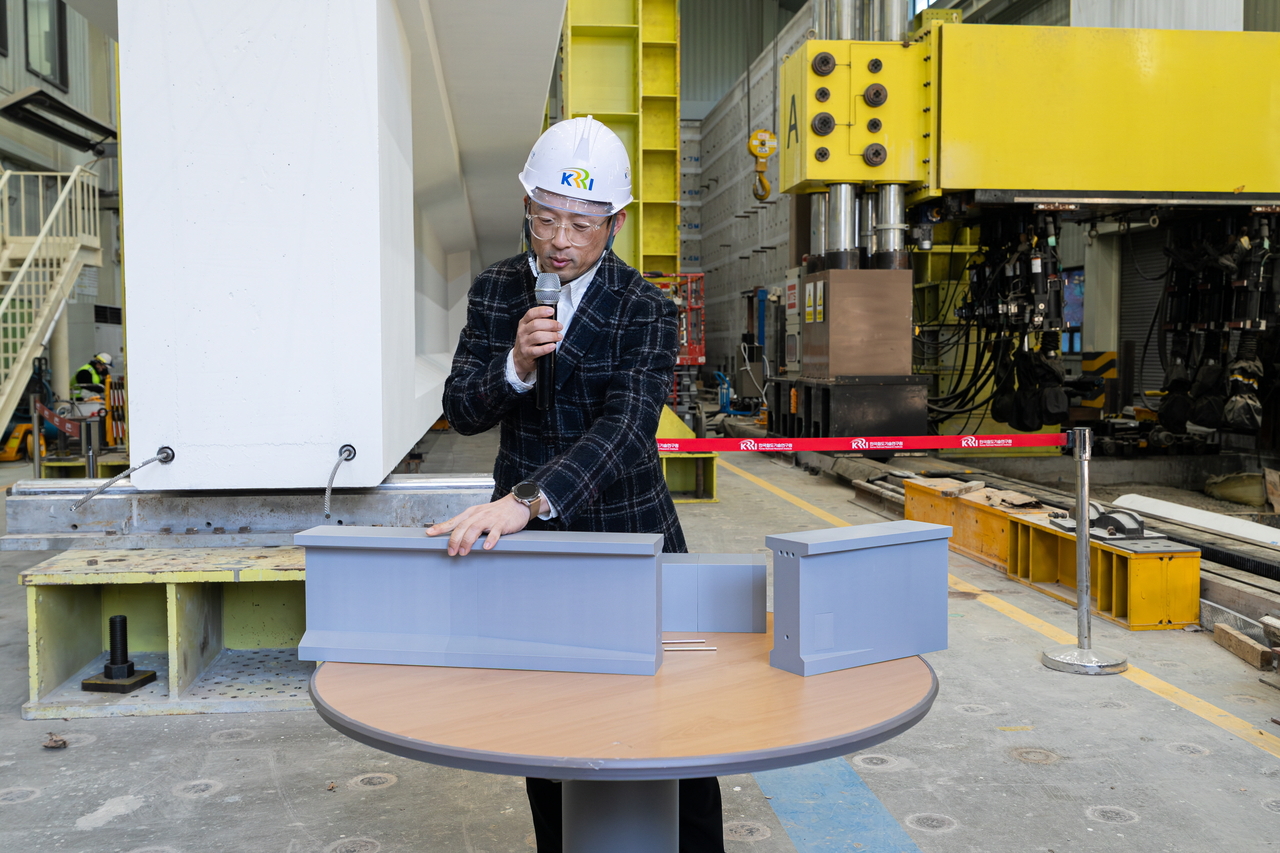
South Korean researchers have developed a technology that allows railway bridges tens of meters long to be prefabricated in a factory and assembled on-site like building blocks, a method expected to cut construction time and improve worker safety.
The Korea Railroad Research Institute announced Monday that it has developed modular railway bridge technology, in which key structural components are manufactured at a factory and then assembled at the construction site.
The institute publicly demonstrated the technology Friday at its headquarters in Uiwang, Gyeonggi Province, with about 100 officials from Korea National Railway and the railway construction industry in attendance.
The technology adopts an off-site construction method that moves away from the conventional on-site approach to bridge building. Its core aim is to minimize on-site fabrication work, thereby shortening construction periods while improving build quality and safety.
The research team designed both the superstructure of the railway bridge and the substructure supporting it to be manufactured as separate modules and assembled on-site.
The KR-U girder — a 45-meter standard bridge used by Korea National Railway — is divided into nine modules, while the 30-meter KR-I girder is split into five modules for production.
Particularly notable is a proprietary "self-actuating modular joint technology" developed to connect bridge components quickly and precisely.
The system uses magnetic force to automatically extend connecting parts inside the bridge. This allows for precise alignment when joining heavy bridge components, reducing errors and delays during assembly.
The research team verified the structural performance of the joints by first conducting tests on a one-tenth scale model, then fabricating and testing a full-scale 30-meter specimen. The modular bridge demonstrated structural safety equivalent to that of a conventional one-piece girder bridge.
Prefabrication technology was also applied to the bridge piers. The team developed a "socket-type elastic duct coupler" that precisely connects the foundation, column and coping sections, reducing construction errors and improving joint stability.
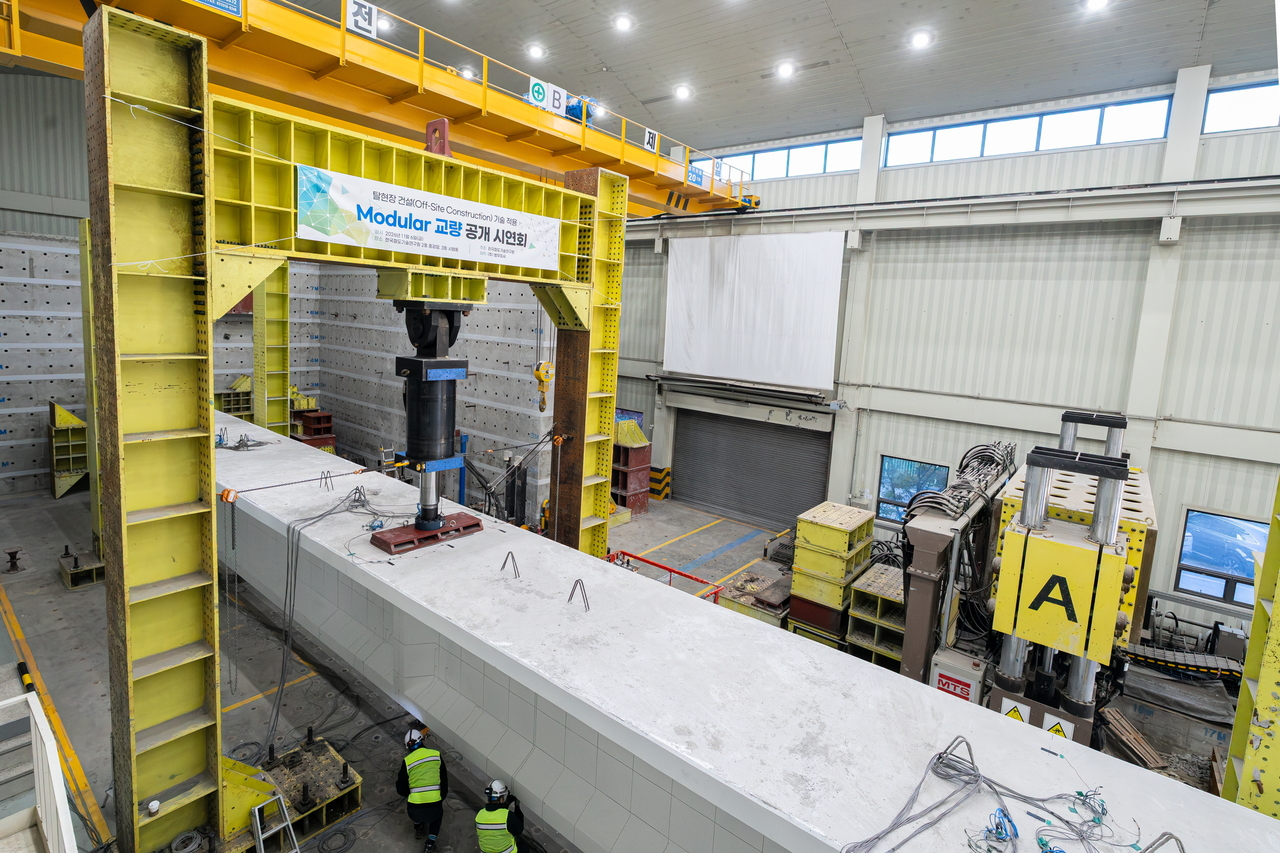
The institute also unveiled a technology that uses a smartphone to verify in advance whether bridge components can be properly assembled.
Photographing a structural connection point with a smartphone, the system renders a three-dimensional image that lets workers confirm whether components fit correctly before assembly begins. The process takes only a few minutes without any separate surveying equipment, reducing the need for on-site rework.
The technology is expected to be used not only for building new railway lines but also for replacing aging bridges. Because it reduces the space needed for on-site work, it is well-suited for application on railway sections where trains are still in operation.
Bridges account for a significant share of domestic railway lines. The Gyeongbu high-speed railway runs about 115 kilometers of bridge sections, or 28.7 percent of its total length, while the Honam high-speed railway has about 112 kilometers of bridge sections, accounting for 48.4 percent. The total length of railway bridges in South Korea exceeds 550 kilometers.
The institute plans to further refine its manufacturing and construction processes and pursue a pilot project to apply the technology at actual railway construction sites.
"We have secured core modular railway bridge technology that minimizes on-site work to improve construction efficiency and safety," said Kim Seong-il, a senior researcher at the institute. "We will push ahead with a pilot project to apply it at real railway construction sites and move toward practical use."
Institute President Sagong Myeong said the technology "can simultaneously improve the productivity and safety of railway bridge construction," adding that the institute would expand its technical support so the technology can be applied to new railway line construction and the replacement of aging bridges.
nbgkoo@heraldcorp.com