Solo show 'Darkness of White Milk' at Hakgojae
21 works on view, including 'All Skies' series
A baby tooth buried in the earth as a child. A land mine still lodged somewhere underground. A peaceful summer afternoon eating corn on a wooden bench. A story of someone killed in a minefield. Fragmented memories resurface as a single landscape.
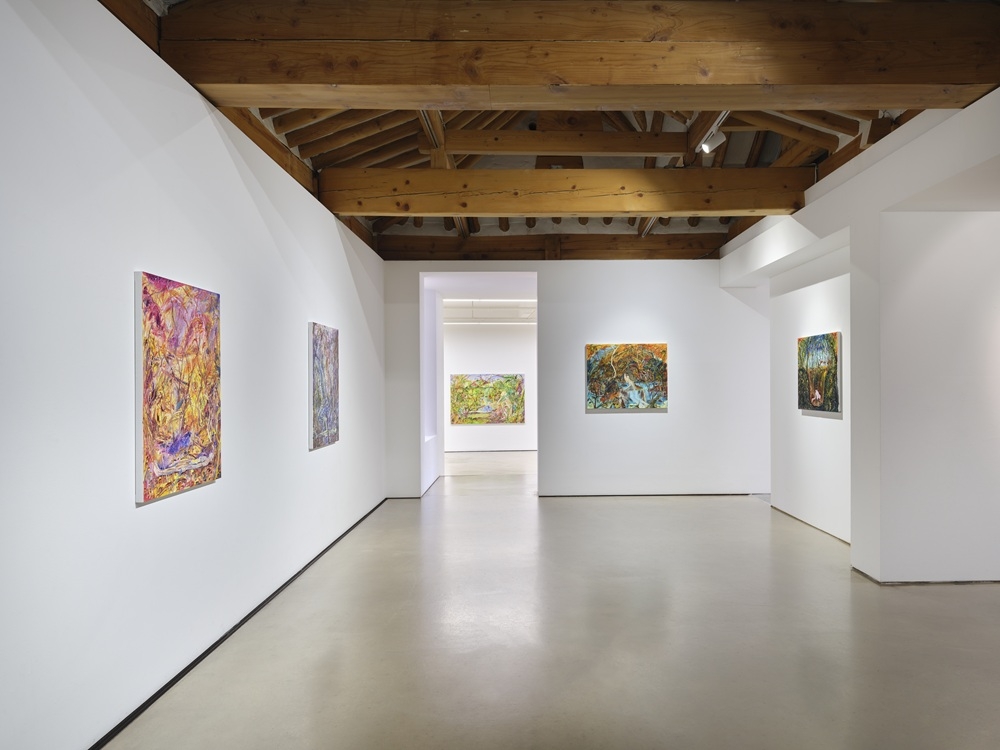
Park Gwang-su, 42, a native of Cheorwon in Gangwon Province, presents a world born of intertwined memory and imagination in his solo exhibition "Darkness of White Milk," now on view at Hakgojae gallery. Park reconstructs scenes of everyday life from his hometown into images that could not exist in reality yet feel entirely natural in a dream. The show features 21 flat paintings that extend his pictorial explorations.
For this exhibition, Park has centered his attention on the emotion of longing. "Longing keeps alive what has already disappeared," he said. "A house and a hometown may remain in the same place, but the time that made them a house and a hometown is gone." He described longing as "the impulse to summon what is absent into the present through memory and imagination."
The starting point of that longing is Cheorwon, where Park was born and spent much of his life. The Chugaryeong Rift Valley, which connects Seoul and Wonsan, runs through the region, and lava flows shaped the plains, mountains and rivers that define the landscape. It is a place of natural beauty that also bears the scars of war and division.
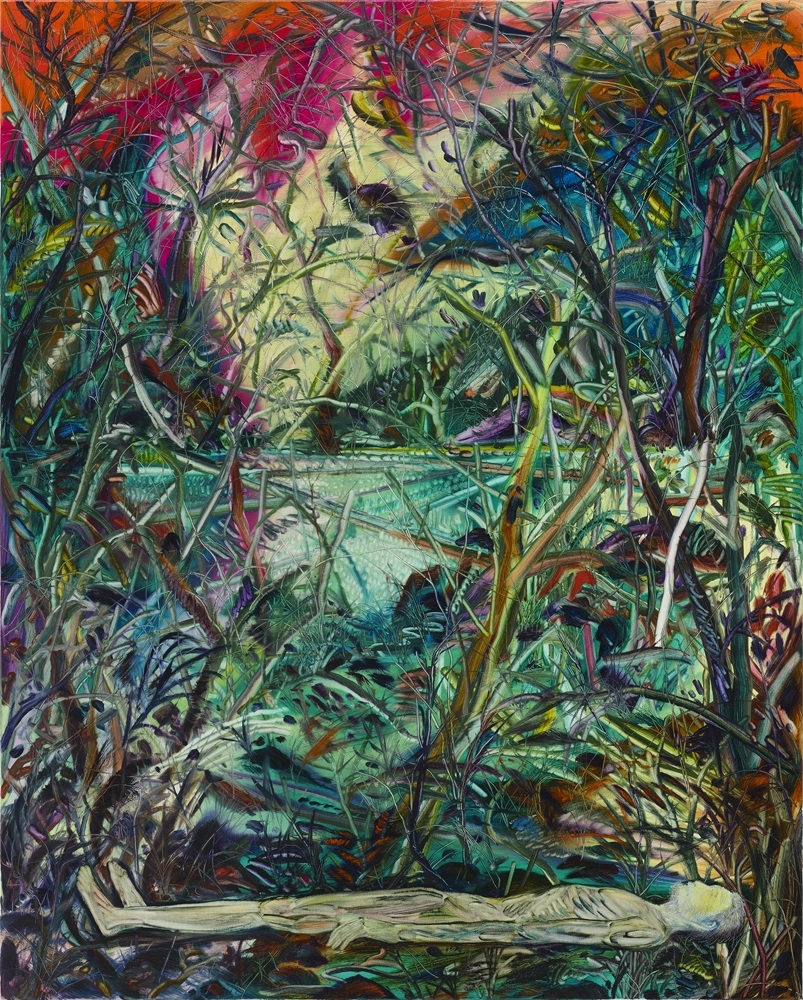
Park has woven childhood memories of Cheorwon throughout the works. In the eight-painting "All Skies" series, figures lie suspended in mid-air amid dense branches and leaves. Resting quietly in forests suffused with teal, pink and violet, these figures hover in an ambiguous state — it is unclear whether they are asleep and dreaming or lingering somewhere between life and death.
Where "All Skies" conjures a space freed from gravity and time, "Inward" unsettles the act of looking. A lone figure stands in a forest bathed in red, while darkly tangled vegetation deepens the surrounding gloom. The red that floods the canvas gives the impression of viewing the world through a lens.
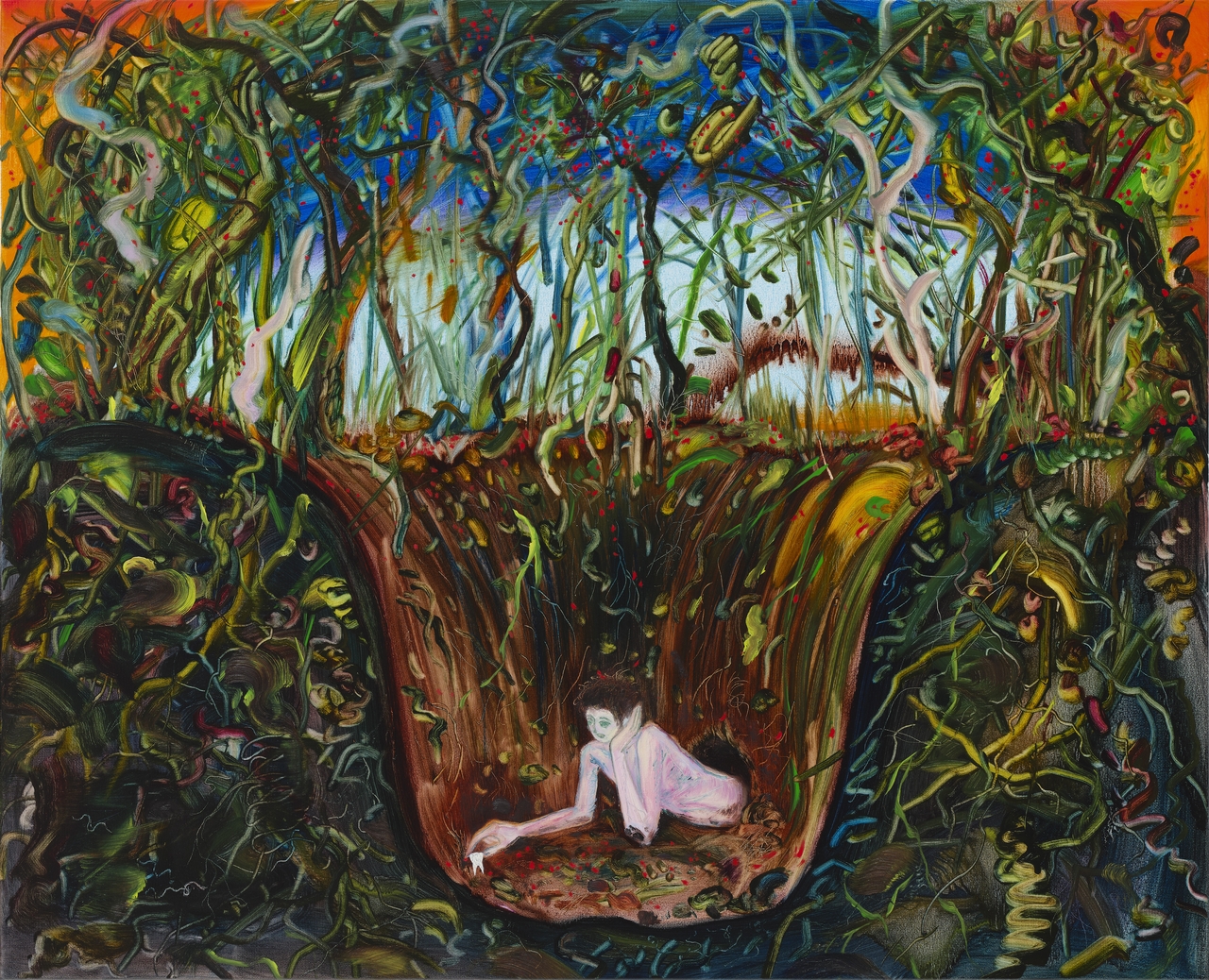
"Cornfield" and "Baby Tooth and Tunnel" both originate in the childhood ritual of burying a fallen baby tooth in the ground. In "Cornfield," rows of corn kernels call to mind teeth, and a buried baby tooth is reborn in the form of a plant. In "Baby Tooth and Tunnel," a figure lies propped on its elbows inside an enormous pit — the small hole a child once dug to bury a tooth has grown into a space deep and wide enough to hold a person.
In Park's paintings, line both separates forms and connects places and objects. He draws line over line, then rubs or scrapes away what he has already painted before adding more pigment. As lines cross, the boundary between subject and background dissolves.
Color operates similarly: some hues develop into legible forms while others remain permanently unnamed. Layers of color accumulate, leaving traces that are partly accidental and partly deliberate.
The exhibition title, "Darkness of White Milk," was inspired by French philosopher Gaston Bachelard's book "Earth and Reveries of Repose." Bachelard imagined a darkness that might exist beneath the thick, opaque whiteness of milk, pointing to a depth of matter that visible qualities alone cannot reveal.
In Park's paintings, white carries no simple association with brightness. Placed between intense color and deep shadow, white imparts a sense of weight. Passages that approach black, by contrast, warp the space around them.
"Painting is something like this," Park said. "It is the act of imagining, within what one has seen, remembered and experienced, something that does not yet exist. As reality and imagination, concrete form and unnameable trace, enter into each other, a space emerges that was not there at the beginning." He added: "I may be building something invisible inside the visible, then breaking it apart and building it again."
Park holds a bachelor's and master's degree from Seoul National University of Science and Technology's Department of Fine Arts. He has held solo exhibitions at Hakgojae, Doosan Gallery in New York and Kumho Museum of Art, and has received the Chong Kun Dang Art Award and the Doosan Yonkang Art Award.
The exhibition runs through Dec. 5.
pink@heraldcorp.com