The protagonist of the sageuk drama "Yeoin Cheonha," famous for the line "What on earth?", is Queen Munjeong, wife of King Jungjong of the Joseon Dynasty.
During the reign of Jungjong — who came to power by overthrowing the regime of Yeonsangun — Queen Munjeong of the Yun clan stood at the center of a turbulent political landscape marked by the bitter feud between the Soyun and Daeyun factions. Her rivals included Royal Consort Gyeongbin of the Park clan and the quietly formidable Changbin of the An clan. Changbin would become the great matriarch of the Joseon royal family for generations to come, but in her own time, Queen Munjeong occupied the commanding center of a world ruled by women.
The royal tomb of Taelung, where Queen Munjeong is buried, has recently emerged as a coveted prize among six municipalities across Gyeonggi Province and Gangwon Province, each vying to become its successor.
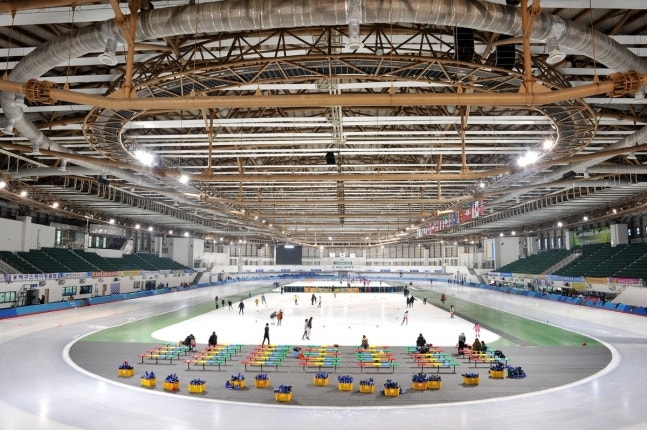
As restoration work proceeds at Taelung — a UNESCO World Heritage Site listed under the name "Royal Tombs of the Joseon Dynasty" — the Taelung International Skating Rink is set to be demolished, and a competition to select a replacement international skating facility has entered a new phase.
After the original bidding process, launched three years ago, stalled with little progress, the entire process was scrapped and the Korean Sport & Olympic Committee is now leading a fresh round of applications. Cities that had applied in the first round are expressing disappointment while preparing to reapply.
Within Gangwon Special Self-Governing Province, Chuncheon, Wonju and Cheorwon had submitted bids in the original competition. Gangneung, which hosted the Winter Olympics, did not apply but instead proposed using its existing facilities as the international ice venue.
In Gyeonggi Province, Yangju, Dongducheon and Gimpo had applied in the first round.
While additional cities may enter the new competition, the same contenders are widely expected to reapply if the process moves forward smoothly.
Amid this, reports have emerged that Gyeonggi Province is moving to consolidate its support behind Yangju, narrowing the new competition to a likely showdown between one city in the Yeongseo region of Gangwon Province and Yangju.
The term "re-competition" seems to implicitly exclude Gangneung's proposal to use its existing facilities, yet many find merit in the city's efficiency argument. Given how long the first round stalled before ultimately being scrapped, there remains a real possibility that the international skating rink question could be resolved through an unexpected third option.
If a new competition does go ahead, the three Gangwon cities face another round of costly internal rivalry. The three cities spent a combined 600 million won ($449,000) pushing their bids during the first round, which was ultimately nullified.
Wonju Mayor Gu Ja-yeol held a press briefing Thursday, arguing that Gangwon Special Self-Governing Province should take the lead in consolidating support behind a single candidate within the province — a call clearly prompted by reports that Gyeonggi Province is moving to unify behind Yangju.
The public may see the six-way contest between local governments in Gangwon and Gyeonggi provinces differently. The Lee Jae Myung administration has pursued an "efficiency"-oriented governance approach, seeking to concentrate the second round of public institution relocations in innovation cities such as Wonju, which already have well-developed infrastructure. If a significant share of the public agrees there is little point in building a separate international skating rink when the Olympic ice facilities in Gangneung — including a figure skating arena right next door — are already there, the outcome could well be not a new competition at all, but a full cancellation and a pivot toward repurposing the Olympic legacy.
With re-competition now looking increasingly likely, a recent remark by Gangwon Special Self-Governing Province Governor U Sang-ho comes to mind.
"When Gangwon Province tries to win something from the central government, cities and counties within the province compete in good faith," U said. "A healthy level of competition is meaningful and legitimate. But overheating is the problem. If cities compete up to a reasonable point and then coordinate to throw their weight behind one applicant, it becomes much easier for the province to make the case to the central government, and the chances of being selected rise sharply. If they tear into each other, even a winnable bid can fall apart. A city that steps aside now will earn the goodwill of others when the next project comes around."
If a regional government steps in to designate a specific city amid what should be a good-faith competition among local governments, the backlash will be far louder.
The only workable path is for the local governments to coordinate among themselves — you take the pot this time, and next time I will make sure you get the cow. Breaking the pot in half and splitting it down the middle is no solution at all.
abc@heraldcorp.com