Buk-gu Office staff propose spatial strategy for Ulsan's future
Plan envisions transit-oriented area and broader metropolitan complex
City asked to incorporate proposals into official development project
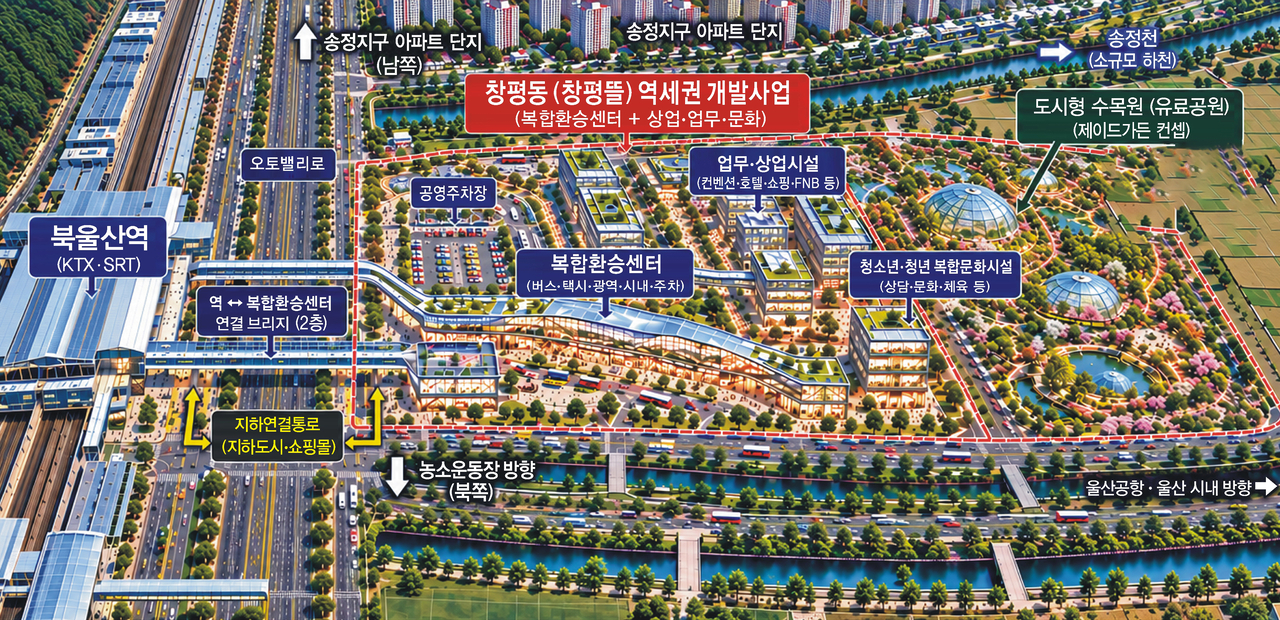
Civil servants who know their city inside out have drawn attention by studying urban development cases at home and abroad and translating their findings into a concrete vision — and a policy push — for the city where they work.
A civil servant research group at Ulsan Buk-gu Office has proposed three spatial strategies to transform Buk-gu, currently home to 210,000 residents, into a future-oriented city of 300,000 by 2035: mixed-use development around the North Ulsan transit-oriented area, creation of a broader metropolitan complex linking Ulsan and Gyeongju, and revitalization of a commercial district connecting an art exhibition hall with Hogye Market.
Eleven civil servants from the urban affairs division joined forces with five private-sector specialists in urban development, urban planning, transportation and culture to carry out a professional review of the proposals. Buk-gu has since asked Ulsan city to incorporate the group's recommendations into its North Ulsan transit-oriented area development project.
At the heart of the plan is a vision centered on North Ulsan Station: below-ground floors would be reorganized as shopping space, while above-ground floors would house office, commercial and cultural facilities, all linked to a multimodal transit hub and connected to a broader living zone stretching to Gyeongju. The design calls for passengers leaving North Ulsan Station to reach the transit hub via either an elevated bridge over a six-lane road or an underground shopping passage, giving them seamless access to destinations across the region.
In front of the transit hub, the plan envisions office and commercial buildings alongside a youth cultural complex and an urban arboretum, creating a "stay-and-explore" transit-oriented area that draws visitors from outside the district. The aim is to establish North Ulsan Station as the hub of wide-area transportation for the Yeongnam region and a new engine of urban growth for Buk-gu.
The group also proposed dissolving the administrative boundary between Ulsan and Gyeongju to create an integrated metropolitan complex where industry and residential life coexist. Under the plan, Gyeongju would host an advanced industrial complex for physical AI materials and components, while Ulsan's Buk-gu would accommodate research support facilities, a smart village, and medical and education facilities — forming a wide-area living zone where industry and residential development go hand in hand.
Alongside this, the group proposed linking the art exhibition hall with Hogye Market to create a stay-oriented commercial district blending culture and tourism. Expanding public parking, adding a dedicated parking structure and increasing parking capacity at Nongso Stadium would improve visitor access, while a specially designed pedestrian route from the parking areas to the art exhibition hall would naturally draw visitors into Hogye Market. The group also suggested introducing tourist accommodation in vacant storefronts, drawing on Japanese examples of converting idle commercial spaces into lodging facilities.
Park Gwang-bok, head of the urban affairs division and chair of the research group, said the team analyzed domestic and international cases — including Jade Garden in Chuncheon — and used AI to design future urban spaces, then sought advice from private-sector experts to strengthen the policy viability of the proposals.
Buk-gu plans to use the research group's findings as baseline data for establishing urban development policies and reviewing related projects.
cityblue@heraldcorp.com