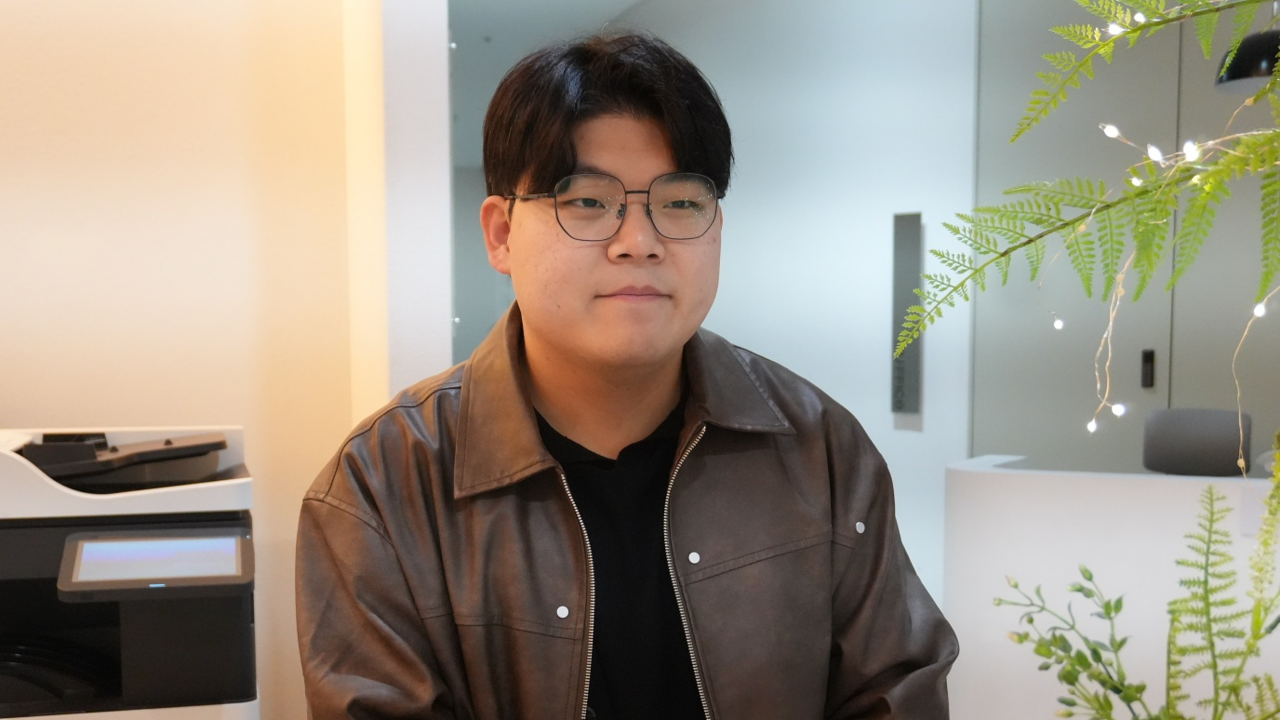
From a two-award sweep at BIFAN with 'Pokseol' to live-action, AI and interactive filmmaking — a director expanding the boundaries of creation
Overseas experience and formal film study form the foundation; in Yokohama, Bae guided ethnic Korean residents through AI filmmaking
'The ability to choose is what matters,' says Bae, who wants to help people take their first steps toward finding their own stories
"I think we're living in an age where what you want to make — what you want to do — has become incredibly important."
That was the point Director Bae Jun-won kept returning to when discussing AI video production: the creator's own vision. Even with identical tools, a work takes shape differently depending on which story is chosen and which scenes are kept. As technology grows more capable of generating images on command, the people who know what they want to express become more valuable, Bae said.
Bae won both the technical award and the audience award in the "Bucheon Choice: AI Film" section of the 28th Bucheon International Fantastic Film Festival (BIFAN) in 2024 with his short film "Pokseol" (Heavy Snow). He now works across live-action films, AI-generated films and interactive content that invites audiences into the story. Most recently, he traveled to Yokohama, Japan, to teach AI video production to ethnic Korean residents there. Making his own films and helping others complete their first works have become parallel pursuits in his daily life.
Bae's starting point was film direction. He graduated from the film and video direction program at Korea Animation High School and went on to study film at Seoul Institute of the Arts. Before he became known for AI filmmaking, his 2023 short "Chimuk" (Silence) won the grand prize at the 18th Korea University Film Festival. That grounding in how to put emotion and story on screen became the foundation for his experiments with new production methods.
The work has continued into 2026. His AI short "Cheolsu Iyagi" (Cheolsu's Story) screened in the "AI Frontier" section of the 30th BIFAN. Actor Kim Bo-ra, who appeared in his short "Monsaro," won the acting award in the Korean short film competition at the 16th Seoul International Pride Film Festival. Bae was also selected for the Korean Film Council's 2026 AI-based film production support program in the short film category.
At HOUSE XITA, the production company Bae leads, the team develops software for creative use alongside making films. That is the source of his interest in three-dimensional tools for pre-visualizing scene composition and space, as well as in AI-assisted production environments. What began as a search for the right expressive tools as a director gradually widened into building those tools himself.
Asked about the roots of his willingness to move across disciplines, Bae traced it to his childhood. Growing up abroad, he tried many sports and sought out unfamiliar places. Rather than following a set path, he spent a lot of time doing things firsthand and discovering what he enjoyed. He said that process was where he found the pleasure of watching and the appeal of storytelling.
His fascination with filmmaking goes back to his time in Indonesia. He stumbled upon a film set and watched a group of people come together to build a single world. The screenplay was just a small file of text, but on set those words were being transformed into spaces, characters and movement. The process of a story on paper becoming a world before his eyes stayed with him for a long time.
A single film left an equally deep impression. It was "Ikiru," directed by Akira Kurosawa, which he saw at a school screening in Indonesia. The film was old, but the characters and emotions on screen felt alive to him. He said he still watches it once a year. The reason a director working with cutting-edge technology keeps returning to an old film, he explained, lies in the story and feeling it holds.
The support of a family that believed in what he wanted to do also gave him strength. When something caught his interest, he was able to try it, and after he found his dream of becoming a film director, he pursued the relevant studies. Back in Korea, he received arts education, directed films and expanded his range of expression into writing and exhibitions. For Bae, those varied experiences were a process of learning, in concrete terms, what he wanted to make.
The more he learned and made films, the more clearly he saw the practical constraints. Filmmaking requires collaboration and capital. Even a scene a director wants can be cut from the script when the budget or production conditions do not allow for it. The process of coordinating investment, distribution and the opinions of collaborators can be grueling. Bae's interest in AI grew from seeing, within those constraints, a possibility for individuals to realize their imagination more freely.
Scenes too large in scale to shoot conventionally become worth attempting with AI, he said. The appeal was being able to put landscapes and stories that had existed only in his head directly onto a screen. Deciding what to make and refining the result, he added, remained the creator's responsibility throughout.
Winning awards for "Pokseol," a film about loss and waiting, opened up his world. At the time a university student, he began meeting a wide range of creators at film festivals and lectures. Opportunities to explain new production methods multiplied, and he started seeing people who had attended his classes go on to make their own work or find a direction for their careers. The joy of meeting audiences through his films was joined by the satisfaction of teaching.
For readers unfamiliar with AI filmmaking, Bae suggested picturing a conventional film set. You start by settling on a story, then imagine what the characters look like and what kind of space they inhabit. Reviewing generated background images resembles scouting locations. Choosing how a character appears on screen feels something like casting an actor.
From there, you use prompts — instructions describing the desired result to the AI — along with reference materials to generate images and footage. That stage corresponds to shooting. Then comes editing: selecting the generated scenes and assembling them into a narrative flow. The many steps of a physical film set, Bae explained, have essentially been moved into a virtual space inside a computer.
The pace of technological change is something he feels directly. When he was making "Pokseol," he said, even small movements or a character speaking were difficult to render. Now he finds far more room to adjust expressions, gestures and framing. He noted, however, that issues remain — faces and body details can go wrong in scenes with multiple characters, and those still require manual correction.
What a director needs in that moment is the judgment to evaluate results. "As the AI era arrives, I think the ability to choose is becoming truly important," Bae said. Even using the same model, the quality of the finished work depends on which scenes are discarded and which are used. A generated image cannot be chosen simply because it looks good. You have to judge what role that scene plays within the story you are trying to tell.
That does not mean clinging to the scene you first imagined. Bae gave the example of generating a character intended to cry, only to get something that looked like laughing through tears. It differed from his intention, but the emotion could feel more nuanced for it. Just as a director accepts an unexpected performance from an actor, he examines whether an unexpected AI result might serve the work. The approach is to stay true to what you want to express while remaining open to a better scene when one appears.
He is also experimenting with bringing audience choice into the story itself, through interactive film work that led to "Oryeong." In an interactive film, the story unfolds differently depending on the choices the audience makes. Bae said he is developing a method that goes beyond selecting from a few pre-shot endings, using AI to generate story developments that respond to each choice in real time.
He presented a related prototype at the 2025 Cheonan K-Culture Expo, where he saw potential in the way audiences engaged with the work, curious about the consequences of their own decisions. His interest in extended reality (XR) — immersive virtual environments — is also feeding into that exploration of how audiences can relate to a story.
Passing on the pleasure of making your own story continues to be part of his work. During his recent stay in Yokohama, he guided ethnic Korean residents through AI video production and accompanied participants all the way through completing their works and watching them in a theater.
The scene that stayed with Bae most vividly came after class ended. When he asked whether anyone wanted to stay and keep working, nearly every participant raised a hand, he said. Children, too, spent hours on a single scene they wanted to get right. One child was so frustrated when things would not come out as intended that they were moved to tears. To Bae, that was the look of someone who desperately wanted to finish their own work.
Several of the children told him afterward that the workshop had made them certain about what they wanted to do. Hearing that, he said, brought back the moment he had discovered his own dream of becoming a film director — because he knew firsthand that a single experience could be the turning point that helps someone find what they want to pursue.
That is also why he tries to make time for teaching requests whenever he can since winning the awards. He holds close the stories of people who had given up on film and then started making it again, and of people he later ran into at other film festivals who had kept creating after attending his classes. "It is such a gift of a time for me, and a precious experience," he said — words that carried the meaning that a teacher, too, draws strength from students.
What he is particularly watchful against in his classes is the tendency to treat whatever AI proposes as one's own intention. If someone receives a script from AI and follows it without first thinking about what kind of horror film they want to make, it becomes easy to lose sight of what story they actually wanted to tell. Bae said there is a clear difference in the results between someone who has something they want to make and someone who simply follows the direction AI offers.
That is why he emphasizes becoming the subject of one's own creative work, alongside learning how to use the tools. Knowing what scenes you love and what stories move you is what gives you a basis for making choices. He also said it matters to try to understand why a particular result comes out the way it does, rather than simply memorizing prompts. The way he found his own interests through varied experiences as a child has carried through into his philosophy of teaching.
There is no need to hesitate just because you did not major in film, he believes. He has seen non-specialists who have long carried their own worlds and stories inside them produce impressive work in AI filmmaking. While he values the fundamentals he built through formal film study, he sees the door to creation as one that can open for people who started from a different place.
As the barriers to creation fall, ethical questions must be considered alongside them, he said. AI-generated faces or voices can unintentionally resemble real people, and synthetic footage can be mistaken for reality. Bae said that as technology advances, discussion and education addressing those issues become increasingly important.
His plans ahead span multiple formats. He said he is preparing both an AI feature film and a theatrical release for a live-action film. He also intends to continue work on AI animation, interactive content and XR projects. Rather than staying within a particular technology or a single form, he said, he wants to find the method that fits the story he is trying to tell.
He is also drawn to rendering in visual language stories that people have encountered only in words or text — because even a familiar story can produce different emotions and understanding when seen on screen. When asked about the standard he holds for the work he wants to make, though, his answer was modest: a story that someone will enjoy, and from which they might draw hope.
Teaching is something he wants to keep doing as well. He said he wants to share what he has learned about production not only with filmmakers and specialists but with a wide range of people from many countries — because he wants to encounter more moments when someone who has finished their own work starts thinking about the next story.
To those who want to start learning AI video production, he offered this: "I hope you won't be too afraid of that wall." And before choosing a tool, he advised, think carefully about what it is you want to do.
"Think as much as you can about what you want to make, and then try using AI as you work toward bringing it to life."
wssong@heraldcorp.com