Superintendents launch relay protest against grants reform
South Gyeongsang education office warns cuts could accelerate regional decline
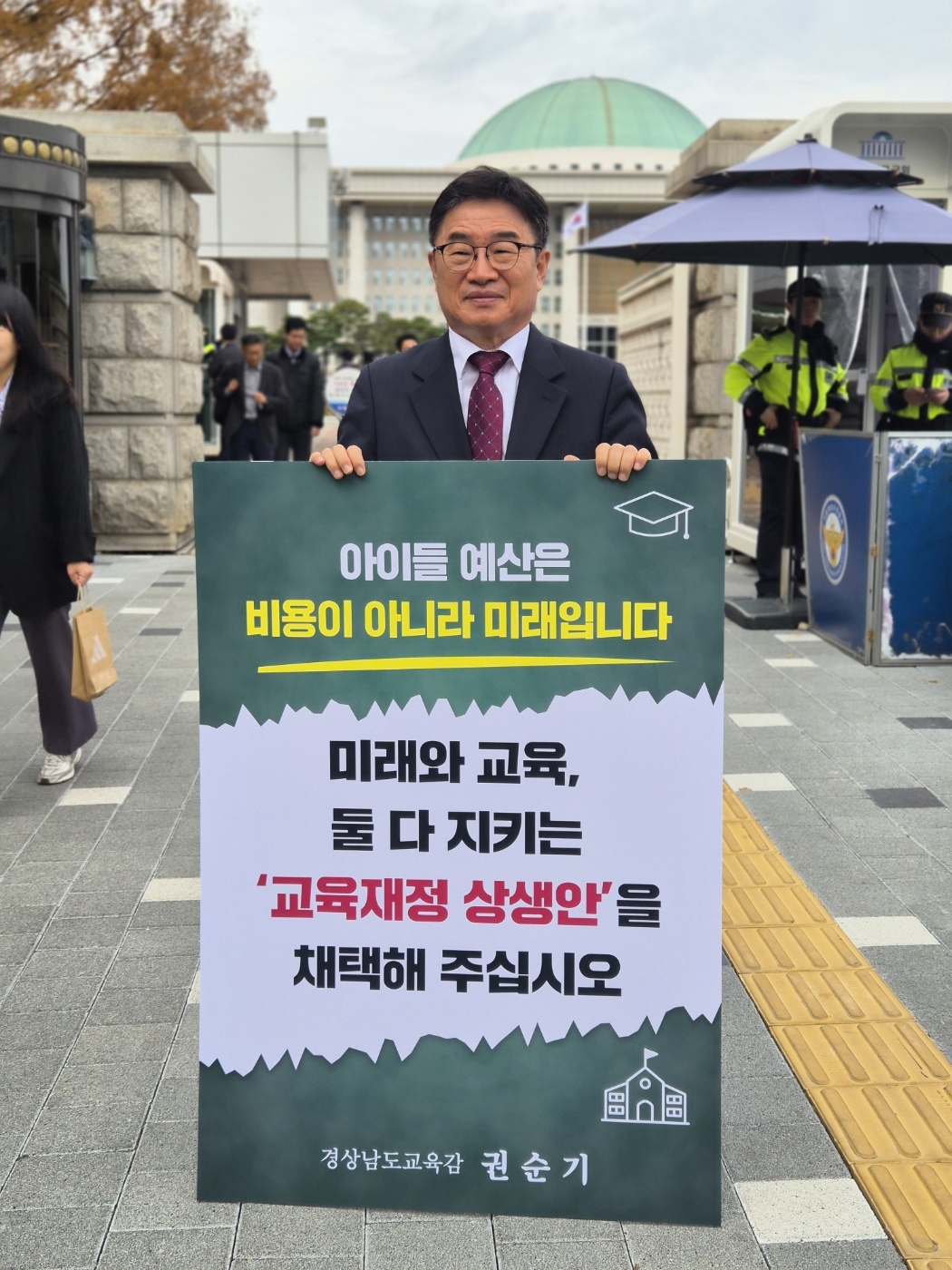
Kwon Sun-ki, superintendent of education for South Gyeongsang Province and chair of the Special Committee on Local Education Finance under the Korea Superintendents Association, launched a nationwide relay solo protest Tuesday outside the main gate of the National Assembly in Yeouido, Seoul, calling for legislation of a "mutual-benefit plan" for local education finance.
The relay protest was timed to coincide with the start of full-scale deliberations on next year's budget and related bills. Beginning with the superintendents of South Gyeongsang and North Jeolla provinces, the demonstrations will continue for seven days through Nov. 26, with the exception of the College Scholastic Ability Test day.
The "mutual-benefit plan" proposed by superintendents in response to the government's reform of the local education finance grants formula centers on maintaining the current linkage rate of 20.79 percent of domestic tax revenue. It also includes a buffer mechanism for tax revenue fluctuations: if tax revenue rises more than 5 percent from the previous year, two-thirds of the surplus would be contributed to a national future-response fund; if it falls more than 5 percent, the government would cover one-third of the shortfall.
Several related bills are pending in the National Assembly, including an amendment to the Local Education Finance Grants Act introduced by Democratic Party lawmaker Park Beom-gye, as well as bills filed by Rebuilding Korea Party lawmaker Kang Gyeong-suk and People Power Party lawmaker Lee In-seon.
When the government revised its domestic tax revenue estimate in late September, projected revenue was expected to increase by 56.2 trillion won ($42.1 billion) from the original forecast. Applying the linkage rate under the mutual-benefit plan, the South Gyeongsang Provincial Office of Education estimates it would see a revenue gain of about 890 billion won.
If the grants formula is revised according to the government's original proposal, however, the office's budget could shrink by about 2.5 trillion won. The provincial education office warned that a fiscal contraction of that scale would deal a blow to efforts to build an AI-based digital education environment, provide tailored support for students with special needs, and sustain small rural schools — potentially accelerating the decline of local communities.
"Simply cutting budgets on the grounds of falling student enrollment undermines the foundation of future education," Kwon said. "We will do everything in our power to ensure the mutual-benefit plan — which buffers the impact of tax revenue swings and improves the predictability of education finance — is reflected in the budget-accompanying bill review process by the end of this month."
ook967@heraldcorp.com