Working-age population to fall below 50% in Gangwon, North Gyeongsang, North Jeolla and South Jeolla provinces by 2045; Greater Seoul's share of national population to rise to 53.7%

In 20 years, working-age residents will make up less than half the total population in four regions — Gangwon Province, North Gyeongsang Province, North Jeolla Province and South Jeolla Province — according to a new government forecast.
As low birth rates and rapid aging shrink the working-age population, securing an adequate labor supply is expected to become a defining challenge for regional economies. Analysts warn that even industrial cities built around manufacturing are aging quickly, adding pressure to workforce supply.
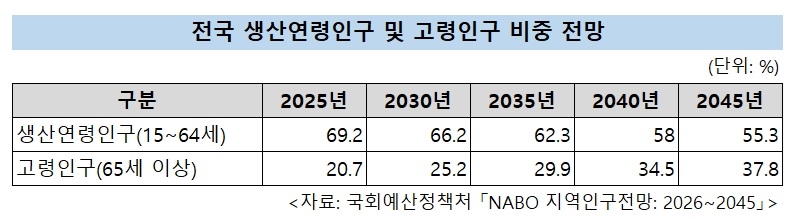
A report published Thursday by the National Assembly Budget Office, titled "NABO Regional Population Outlook: 2026–2045," projects that the share of the national working-age population — those aged 15 to 64 — will fall from 69.2 percent in 2025 to 55.3 percent in 2045, a drop of 13.9 percentage points. Over the same period, the share of people aged 65 and older is expected to rise 17.1 percentage points, from 20.7 percent to 37.8 percent.
Regional disparities are even more stark. By 2045, the working-age population share in Gangwon, North Gyeongsang, North Jeolla and South Jeolla provinces is projected to fall below 50 percent. North Gyeongsang, Gangwon, North Jeolla and South Gyeongsang provinces are all expected to see their elderly population share exceed 44 percent. Cities that have historically maintained relatively young demographics are also aging rapidly. In Ulsan, the share of residents aged 65 and older is forecast to climb from 18.2 percent in 2025 to 40.8 percent in 2045; in Gwangju, from 18.5 percent to 40.2 percent.
South Korea's total population is also set to begin declining. From about 51.76 million at the end of 2025, the population is expected to edge up through 2028 before contracting from 2029 onward, reaching about 48.84 million by the end of 2045 — a decrease of roughly 2.92 million people, or 5.6 percent, over two decades. The Greater Seoul area is projected to shrink by just 0.6 percent, while non-metropolitan regions will lose 10.9 percent of their population, pushing the capital region's share of the national total from 50.9 percent to 53.7 percent.
Among individual regions, Gwangju is projected to see the steepest population decline at 17.4 percent, followed by Busan at 16.3 percent, North Jeolla Province at 15.3 percent, North Gyeongsang Province at 14.7 percent and South Gyeongsang Province at 14.2 percent. Sejong, Incheon, Gyeonggi Province and South Chungcheong Province are expected to post population gains of 6.6 percent, 5.5 percent, 3.8 percent and 2.1 percent, respectively. However, even those regions are forecast to peak and then begin declining — Sejong in 2037, Gyeonggi Province in 2039 and Incheon in 2040.
The primary driver of regional depopulation is also expected to shift. What has largely been a story of youth outmigration will give way to natural population decline — more deaths than births. The annual natural decrease nationwide is projected to widen from about 80,000 in 2026 to about 380,000 in 2045, while the number of people moving between provinces is expected to fall from about 2.186 million to about 1.364 million. The trend suggests that attracting businesses and creating jobs alone will no longer be enough to reverse regional population loss.
Growth in the foreign-born population is identified as a potential buffer against the regional labor shortage. The number of foreign nationals in South Korea is projected to rise from about 2.18 million in 2026 to about 3.44 million in 2045, accounting for 7.0 percent of the total population. Notably, the foreign-born population outside the Greater Seoul area is expected to reach about 1.75 million, surpassing the capital region's roughly 1.69 million. By 2045, an estimated 83.8 percent of the foreign-born population will be of working age.
The demographic shift is also expected to strain local government finances. A shrinking working-age population reduces the labor supply and economic activity in a region, while a growing elderly population drives up demand for medical care and social services. Even as overall populations fall, the facilities and personnel needed to maintain essential public services will remain, potentially raising the per-capita cost of service delivery.
The National Assembly Budget Office said local governments should resist across-the-board cuts to public services during the period of population decline, and instead redesign their service delivery systems — redistributing facilities and repurposing functions to match each region's demographic profile and projected future needs.
fact0514@heraldcorp.com