Fee-setting model signaled cuts in 13 of 19 years, yet actual reductions: zero
Had 2024 model been followed, savings estimated at 3.4 trillion won — 28% of government subsidy
Last year's surplus only 499.6 billion won; reserves may run dry between 2028 and 2033
South Korea's national health insurance system has a working mechanism for boosting revenue when finances deteriorate — raising the premiums subscribers pay — but the parallel mechanism for reining in spending by adjusting medical fees paid to providers has largely failed to function.
A fee-setting model used in negotiations has signaled the need to cut medical fees 13 times over the past 19 years, yet actual reductions have never once followed. The result is a system that asks the public to shoulder a heavier financial burden while leaving the structure for managing medical expenditure effectively inoperative.
According to the November issue of Fiscal Forum, a monthly publication of the Korea Institute of Public Finance released Wednesday, researcher Hong Hye-young analyzed the decision-making structures for premium rates and medical fees. The analysis found that premium rates tend to rise more steeply in the year following a deterioration in the system's finances. By contrast, the conversion index used to set medical fees showed little correlation with the financial situation and no discernible effect in curbing the growth of medical spending.
The national health insurance system is funded primarily by subscriber premiums and government subsidies, which it uses to pay medical providers for services rendered. When finances weaken, the system must either raise premium rates to increase revenue or manage medical fees and service volumes to slow spending growth.
In practice, however, the two levers — one on the revenue side, one on the spending side — have operated very differently. A telling example is the Sustainable Growth Rate model, which has been used in fee negotiations since 2008.
Under the SGR model, when actual medical expenditure exceeds a preset target, the conversion index for the following year is supposed to be adjusted downward. But over the 19 years from 2008 to 2026, the model called for a reduction in 13 of those years, and the index was never actually cut. The model-derived adjustment rates ranged from -7.34 percent to 2.83 percent, while actual index increases stayed within a band of 1.64 percent to 2.37 percent.
The fiscal impact of that gap is not trivial.
In 2024, the actual conversion index rose 1.98 percent, even though the SGR model had called for a reduction of 1.60 percent. Had the model's figure been applied, spending could have been reduced by an estimated 3.4 trillion won ($2.54 billion) — roughly 28 percent of the 12.2 trillion won in government subsidies to the health insurance system that year. The estimate assumes no change in service volumes and reflects a single-year price-adjustment effect, so actual savings could differ.
A deeper problem is that even lowering the rate of fee increases does little to contain overall medical spending. Health insurance expenditure depends not only on the price of each medical act but also on the number of consultations and their intensity. In all years from 2008 to 2024 except 2020, the actual increase in covered service costs exceeded the additional funding projected at the time of fee negotiations — underscoring that fee adjustments alone cannot offset the spending expansion driven by rising service volumes.
Warning signs for the health insurance system's finances are already flashing.
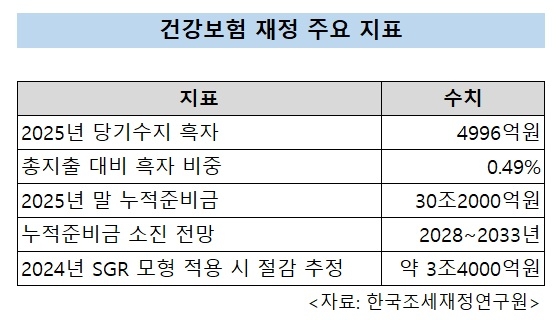
The national health insurance system posted a current-account surplus for five consecutive years from 2021 to 2025, but last year's surplus amounted to only 499.6 billion won — just 0.49 percent of total expenditure. Cumulative reserves at the end of 2025 stood at 30.2 trillion won, equivalent to roughly 3.5 months of benefit payments. Projections by the National Assembly Budget Office and the government have indicated that, if current premium rates and the trend of fee increases continue, the reserves could be exhausted sometime between 2028 and 2033, depending on the scenario.
The separate decision-making tracks for premium rates and medical fees have also been identified as a structural problem.
Medical fee negotiations are currently concluded by the end of May each year, while premium rates are typically set between late August and early September. A 2013 amendment to the National Health Insurance Act moved the fee negotiation deadline earlier, weakening the previously linked structure under which both variables were adjusted against the same fiscal outlook.
"Securing the long-term sustainability of national health insurance finances requires a discussion not only about how much more to collect in premiums from the public, but also about how to manage medical expenditure," Hong said.
fact0514@heraldcorp.com