Analysts say talks confirmed need for great-power communication and crisis management
Experts warn Seoul must stay engaged with Washington, Beijing and Moscow to avoid being sidelined on North Korea
US may have asked China, Russia to help broker North Korea-US dialogue, analysts say
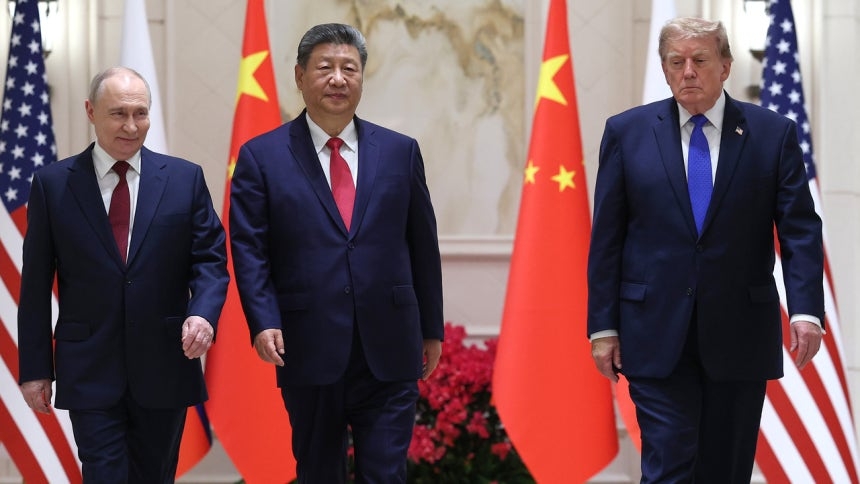
Nuclear disarmament and Korean Peninsula issues were reportedly on the agenda at the first-ever trilateral summit among the United States, China and Russia, held on the sidelines of the Asia-Pacific Economic Cooperation forum in Shenzhen, China — but North Korea's nuclear program and the prospect of US-North Korea talks were left off the core agenda. Experts are urging close attention to follow-up consultations among the three powers at upcoming events such as the G20 summit in Miami.
Park No-byok, chairman of the Sejong Institute, said Friday that the meeting among US President Donald Trump, Chinese President Xi Jinping and Russian President Vladimir Putin had "eased surface tensions despite the three sides coming to the table with different objectives," but cautioned that "there is still a long way to go before long-term peace and stability can be expected."
Yu Ji-hun, a research fellow at the Korea Institute for Defense Analyses, said the summit "can be assessed as a stage at which the great powers confirmed the need for mutual communication and crisis management," adding that "the substantive outcomes of the talks will have to be judged by whether concrete follow-up consultations and agreed measures are actually carried out."
Yu said that while no specific discussions on North Korea's denuclearization had been confirmed, "there is a possibility that the issue could be taken up as a separate negotiating agenda item, or linked to other strategic concerns, as nuclear disarmament consultations among the three countries expand going forward." Yu stressed that South Korea "must actively communicate not only with the United States but also with China and Russia to continuously convey its position, so that Korean Peninsula security issues are not discussed in a state of 'Korea being bypassed.'"
From Seoul's perspective, analysts say the summit produced no clear gains but avoided the worst-case outcome.
A hoped-for North Korea-US meeting on the sidelines of APEC fell through, and the talks fell short of spurring Pyongyang back to dialogue or building shared understanding on Korean Peninsula peace. But analysts note that the most feared scenario — tacit acceptance or quiet tolerance of North Korea's nuclear arsenal — was also avoided.
Lee Sin-hwa, a professor at Korea University, said it "would not have been easy to give significant weight to the North Korea nuclear issue given the many pressing matters such as Ukraine and Iran," but noted that "there is a possibility that Trump asked Xi and Putin to deliver a message or play a mediating role for US-North Korea dialogue."
Whether China and Russia will actually move on that remains uncertain, however. Lee said the two countries "likely drew a line against active mediation in order to preserve their own leverage over North Korea," adding that "it is a bitter limitation that South Korea, as a US ally, finds it difficult to know how US-North Korea dialogue is actually progressing."
youknow@heraldcorp.com
rimsclub@heraldcorp.com