Kospi tumbles more than 4% intraday, breaking below 4,700
Market volatility widens unusually amid external uncertainty
Petroleum price cap seen as likely to continue into next year
The government has begun preparations to activate the stock market stabilization fund as the Kospi tumbled more than 4% intraday Monday, sliding to the 4,600 range. Officials are reviewing procedures to ensure the fund can be deployed immediately depending on market conditions, though the timing and size of any actual injection have not been decided. The government is placing greater emphasis on cracking down on illegal short selling and strengthening surveillance of unfair trading practices rather than imposing additional restrictions such as an outright short-selling ban.
Deputy Prime Minister and Minister of Economy and Finance Lee Hyung-il held a press briefing at Government Complex Sejong on Monday and addressed the possibility of expanding the fund's size. "The fund was established in April 2020, and time has passed since then, so we are reviewing various procedures to be ready for activation depending on market conditions," Lee said. "As for the size, that is something we still need to examine as we watch how the operation unfolds."
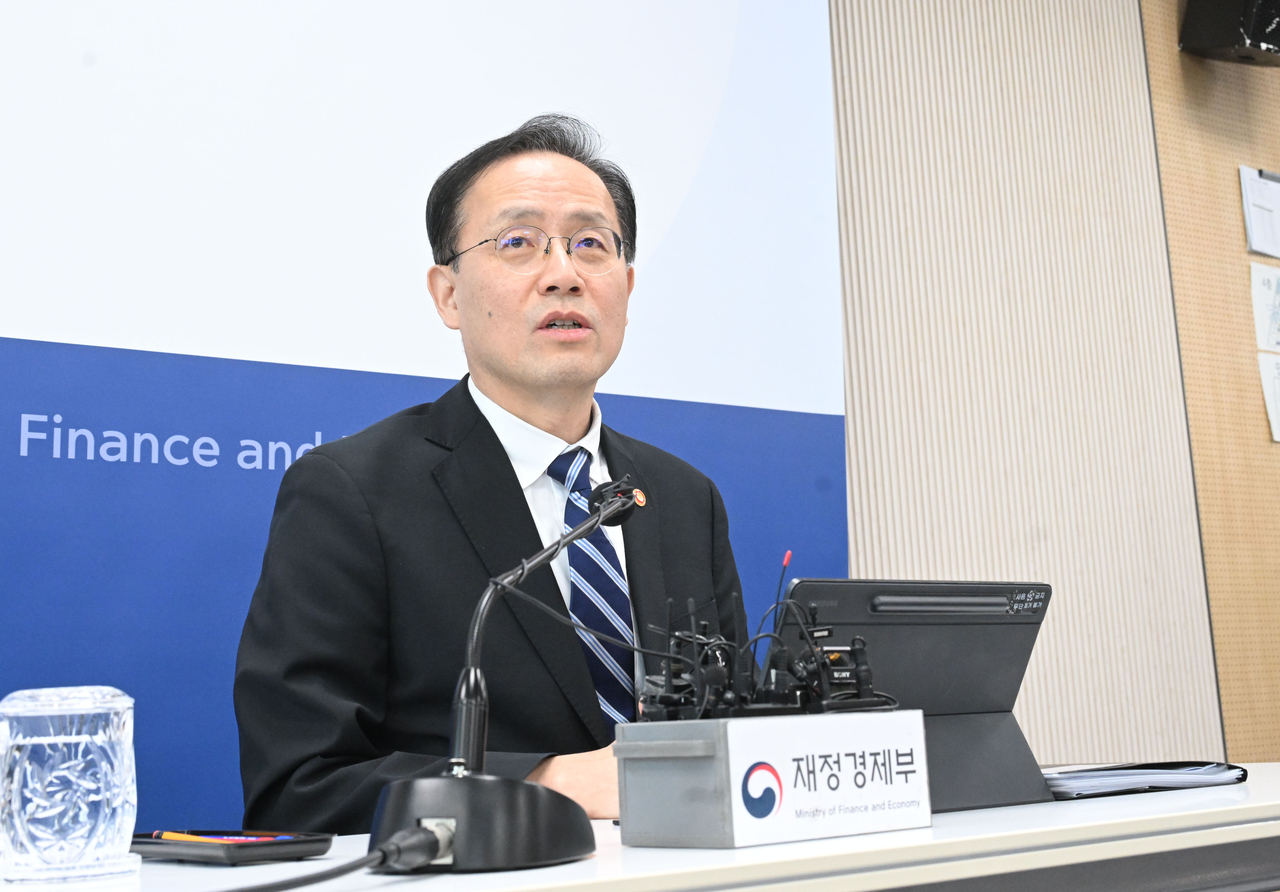
The government decided Sunday to begin preparations to activate the stock market stabilization fund immediately if market conditions warrant, in response to domestic market instability triggered by a sharp drop on US exchanges. If the fund is actually deployed, it would be the first time in 18 years since the 2008 global financial crisis.
Despite the government's market stabilization measures, domestic stocks continued to fall sharply. As of 10 a.m. Monday, the Kospi was trading at 4,706.22, down 163.74 points, or 3.36%, from the previous session. After opening down 2.77%, selling pressure intensified — led by large-cap semiconductor stocks including Samsung Electronics and SK hynix — widening the decline. The NASDAQ Composite and the Philadelphia Semiconductor Index tumbled 5.28% and 10.73%, respectively, on Friday (local time).
"The government has made its commitment to market stability amid stock market volatility clear," Lee said, adding that he expected investor sentiment to improve. However, Lee did not specify when or under what conditions the fund would be activated, saying additional market stabilization measures would be implemented at the right time in accordance with existing contingency plans.
Lee was cautious about imposing additional regulatory measures such as a short-selling ban. Asked whether the government might adopt restrictions similar to those Taiwan had taken if market volatility worsened further, Lee said South Korea's short-selling system already incorporates regulations comparable to Taiwan's strong measures. "South Korea's short-selling regulations are stricter than those of many advanced economies," he said.
"Rather than additional deregulation, we plan to focus more on cracking down on illegal short selling and strengthening surveillance of unfair trading practices by running a special intensive monitoring period of about three months," Lee added.
Lee attributed the unusual widening of domestic market volatility to heightened external uncertainty surrounding the global AI and semiconductor industries and expectations of US interest rate increases. "It is difficult to predict the future trajectory of the stock market," he said.
Despite recent concerns about a slowdown in AI investment, Lee forecast that the global semiconductor industry would maintain solid momentum next year. "I believe AI investment will continue to grow for now," he said, citing the fact that South Korea's two major semiconductor companies have secured substantial order volumes through long-term supply contracts and that memory chip inventories are declining rapidly. The government will nonetheless continue to monitor downside risks surrounding AI investment and factor them into its economic outlook.
On speculation that South Korea might purchase large quantities of US government bonds, Lee drew a clear line. "The foreign exchange authorities are prioritizing the stability and liquidity of reserves while also working to maximize returns," he said. "It is not true that we are buying large amounts of US Treasuries to act as a relief pitcher for the United States."
On the petroleum price cap, Lee said it appeared necessary to maintain the measure for a certain period into next year. He cited continued uncertainty over international oil prices and the situation in the Middle East, as well as the need to consider the burden on ordinary households and small business owners from winter heating and logistics costs. He assessed that the price cap had so far reduced the inflation rate by 0.6 percentage points.
However, Lee acknowledged that keeping the price cap in place for too long was a significant concern. "If conditions improve, we are prepared to lift it at any time," he said. He expected the government to announce its plan for operating the price cap within the year after consultations with related ministries.
Lee also said the government is reviewing a plan to offer capital gains tax benefits to registered rental business operators who sell housing to the public sector, with those properties then continuing to be supplied as rental housing to help stabilize the monthly rent market.
On whether electric vehicles would be included in the domestic production tax credit, Lee said the decision would be made after a comprehensive assessment of factors including enhancing the competitiveness of the EV sector itself and strengthening the industrial ecosystem through cooperation with parts suppliers. On reforming the income tax bracket structure for wage earners, he said the government would take time to carefully review the overall tax burden on workers, deduction levels and changes in taxation across income brackets.
Lee outlined three priorities for next year's economic policy: stabilizing livelihoods, expanding growth drivers and strengthening global competitiveness.
The government plans to flesh out implementation strategies for three major livelihood projects covering jobs, housing and financial services for ordinary citizens, and to incorporate into policy the high-impact initiatives identified through a TF on addressing polarization and a TF focused on protecting wage earners' purchasing power. Alongside this, the government will develop action plans for next year covering three mega-projects and seven SEED initiatives, and will identify policy tasks aimed at boosting the competitiveness of key industries, strengthening the growth ladder for small and medium-sized enterprises, accelerating regionally led growth and advancing the service sector.
"In fiscal policy, we will maintain solid medium- and long-term fiscal soundness while continuing to play an active role in productive investment aimed at easing polarization and nurturing future growth engines," Lee said.
To respond more swiftly to changes in economic conditions, the government will expand the number of economic outlook releases to three times a year starting next year, and will continue efforts to stabilize prices for petroleum products and agricultural, livestock and fishery goods while reducing the cost of living.
Follow-up measures from the newly established Economic Issues Consultative Meeting — set up to strengthen inter-ministry cooperation and policy coordination — will also be released in quick succession. Following the announcement of a plan to strengthen the retirement pension system on Oct. 29, the government is set to release a plan to boost the competitiveness of the electric vehicle industry this week. It is also working on improvements to the refund system for Onuri gift vouchers used at traditional markets and continuing discussions on the direction of the petroleum price cap policy.
On this year's economic growth rate, Lee said growth in the high-3-percent range appeared achievable at the current pace. He also anticipated a rebound in the potential growth rate this year, and said further gains would be possible if the spread of AI transformation across the broader economy drives productivity improvements. He forecast that next year's growth momentum would remain solid as strong exports and investment spill over into domestic demand, while inflation would ease compared with this year.
Lee did express concern, however, about deepening polarization driven by semiconductor-centric growth and the economy's vulnerability to external shocks. "There is a risk that volatility in the semiconductor sector could amplify into volatility across the entire macroeconomy," he said. "We will coldly analyze and monitor domestic and external risk factors and devise a policy mix to support macroeconomic stability and sustainable growth."
y2k@heraldcorp.com
hajun825@heraldcorp.com