Broiler wholesale price falls 35.9% from this year's peak
Supply recovery follows highly pathogenic avian influenza outbreak
Franchise industry cites contract structures, cooking oil and delivery costs
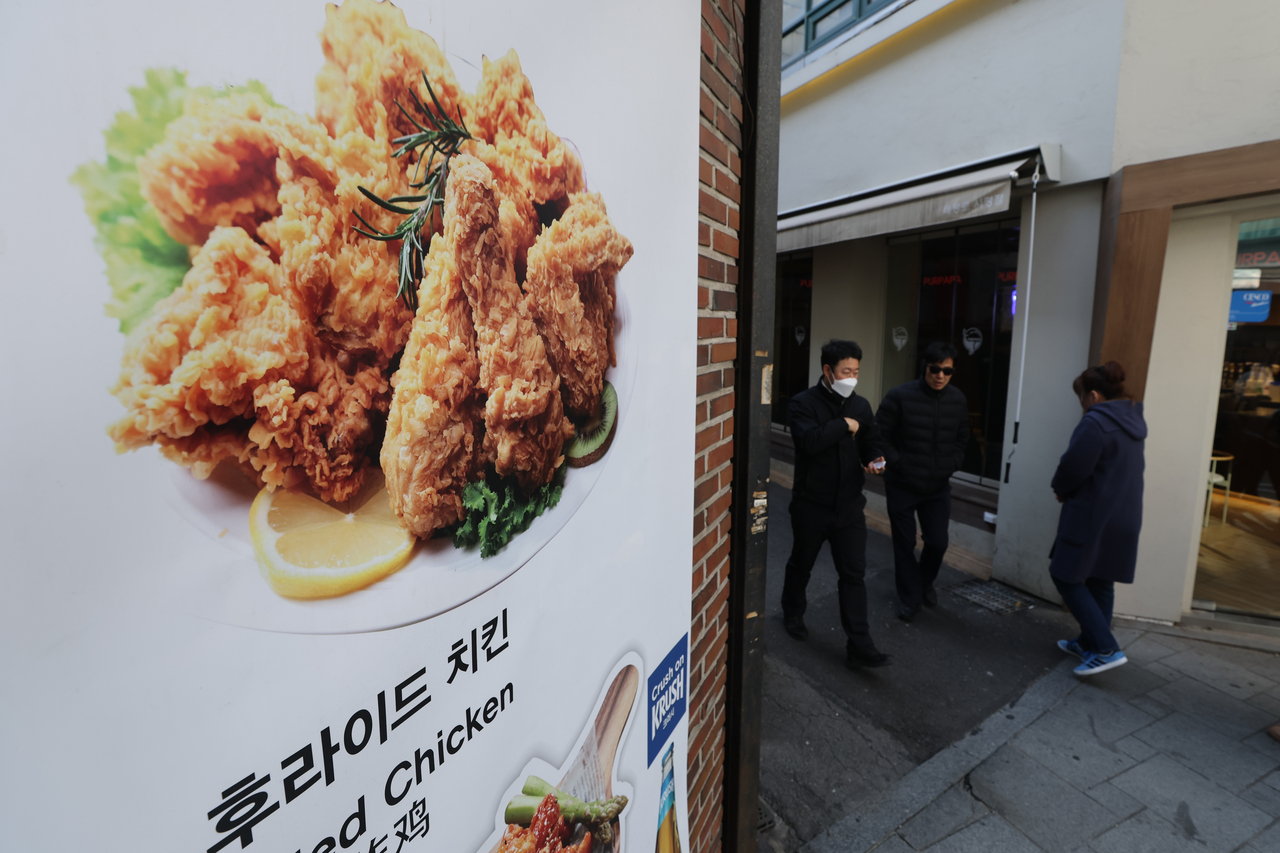
Chicken prices have fallen sharply to their lowest level this year as supply disruptions caused by a highly pathogenic avian influenza outbreak ease. Yet prices at major fried chicken franchise chains remain unchanged, with the industry citing a lag between market price movements and actual procurement costs, as well as persistent pressure from raw materials and labor.
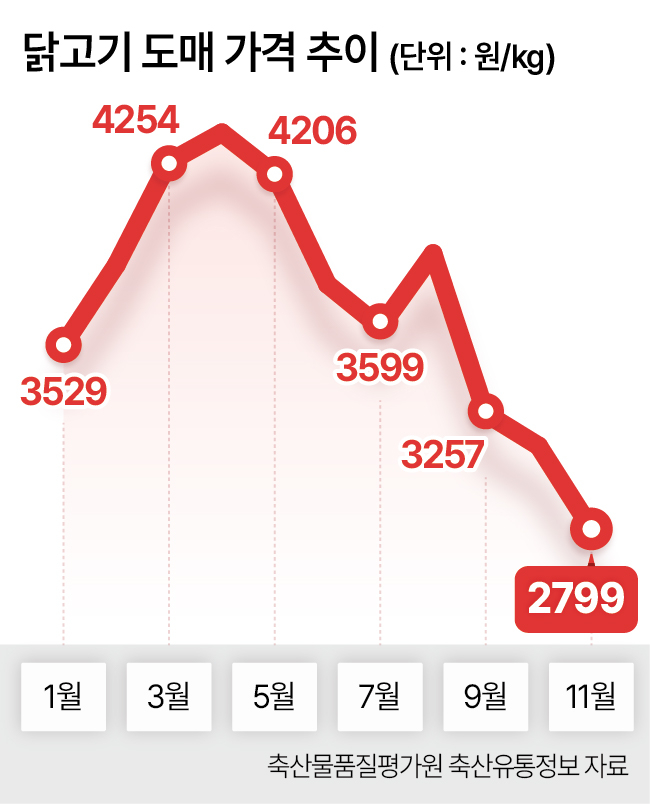
According to data released Tuesday by the Korea Institute for Animal Products Quality Evaluation's livestock distribution information system, the average wholesale price of broiler chickens in November stood at 2,799 won per kilogram — down 13.6 percent from 3,238 won in the same month last year and the lowest monthly figure so far this year. Compared with the year's peak of 4,370 won per kilogram in April, the price has dropped 35.9 percent. The retail price also fell, coming in at 5,451 won per kilogram in November, a 3.5 percent decline from a year earlier and 17.2 percent below the April high of 6,582 won.
Chicken prices climbed in the first half of the year due to supply disruptions caused by highly pathogenic avian influenza. According to the Korea Rural Economic Institute, the spread of the virus from last winter through early this year led to the culling of 806,000 broilers and breeder chickens. The culling of broiler breeder hens — the parent birds that produce meat chickens — was particularly damaging, as it curtailed production and created a supply shortfall.
Conditions improved in the second half of the year, pushing prices lower. The institute estimated that the number of broilers slaughtered in October reached about 71.04 million, up 7.2 percent from the same month last year. It projected that slaughter volumes in November and December would rise by as much as 7.6 percent and 5.8 percent, respectively, compared with the same months a year earlier.
The fried chicken industry, however, says that falling broiler wholesale prices do not translate immediately into lower procurement costs. Franchise headquarters typically sign contracts with chicken suppliers on a fixed-term basis — usually six months to a year — with purchase prices set according to market price ranges. In some cases, even when supply shortages force a franchise to buy at prices above the contracted rate, it continues to supply franchisees at the original contract price.
Slaughtering and processing costs add to the bill. An industry official said chicken meat accounts for roughly 15 to 30 percent of the retail price of a whole fried chicken, but noted that the procurement price reflects far more than the market rate for live birds — it also incorporates slaughter fees, processing labor, and farming costs such as feed and wages.
Cooking oil prices are also running higher than a year ago. According to food industry statistics from the Korea Agro-Fisheries & Food Trade Corp. (aT), canola oil prices in September were up 32.1 percent from the same month last year. Kyochon Chicken, which uses a proprietary canola-based frying oil, raised its frying oil supply price by about 10 percent in April, though the chain agreed to absorb half of that increase at the headquarters level.
Delivery-related costs, including online food delivery platform commissions, add further pressure. A survey of franchise outlets published by the Seoul Metropolitan Government in June last year found that 48.8 percent of total franchisee sales came through delivery platforms. As of October 2024, commissions accounted for 24.0 percent of delivery platform revenue. In the chicken segment specifically, platform commission costs — at 17.5 percent of total operating expenses — exceeded even labor costs, which stood at 15.2 percent.
As cost burdens have grown, dual pricing — charging more on delivery apps than in store — has become widespread. Since last year, a flexible pricing system allowing individual franchisees to set their own menu prices has also gained traction. As a result, even without a headquarters-level price increase, delivery app prices at some outlets already exceed the standard consumer price. At some stores, chicken is being sold for up to 3,000 won more than the official franchise price.
Critics say chicken prices have not come down despite the recent drop in broiler costs. President Lee Jae Myung shared a news article about chicken prices on his X account in September and said he would "take a look at the issue." The Korea Fair Trade Commission subsequently launched an investigation in October into suspected price-fixing among major chicken franchise operators, including bhc, BBQ and Kyochon Chicken.
The industry has pushed back. The three major fried chicken chains have not raised prices for some time — BBQ last adjusted its flagship menu prices in June 2024, bhc in December 2023, and Kyochon Chicken in April 2023. The chains say they also held the line on prices earlier this year when chicken costs surged amid supply instability caused by the avian influenza outbreak.
"Because labor, rent, taxes and other costs all factor in, it is difficult to immediately adjust the selling price of fried chicken just because broiler prices go up or down," an industry official said.

korean@heraldcorp.com