Foreign buyers drop from 1,660 to 1,452 in January–October
Gift recipients rise from 135 to 232, with Americans and Canadians accounting for 75%
Owner-occupancy requirement under foreign land transaction permit zone rules cited as factor
The number of foreigners purchasing collective buildings — apartments, row houses and officetels — in Seoul fell 12.5 percent this year compared with a year earlier, while those receiving such properties as gifts jumped 71.9 percent. Analysts say the pullback in foreign buying reflects the burden of owner-occupancy requirements introduced last year under the foreign land transaction permit zone designation.
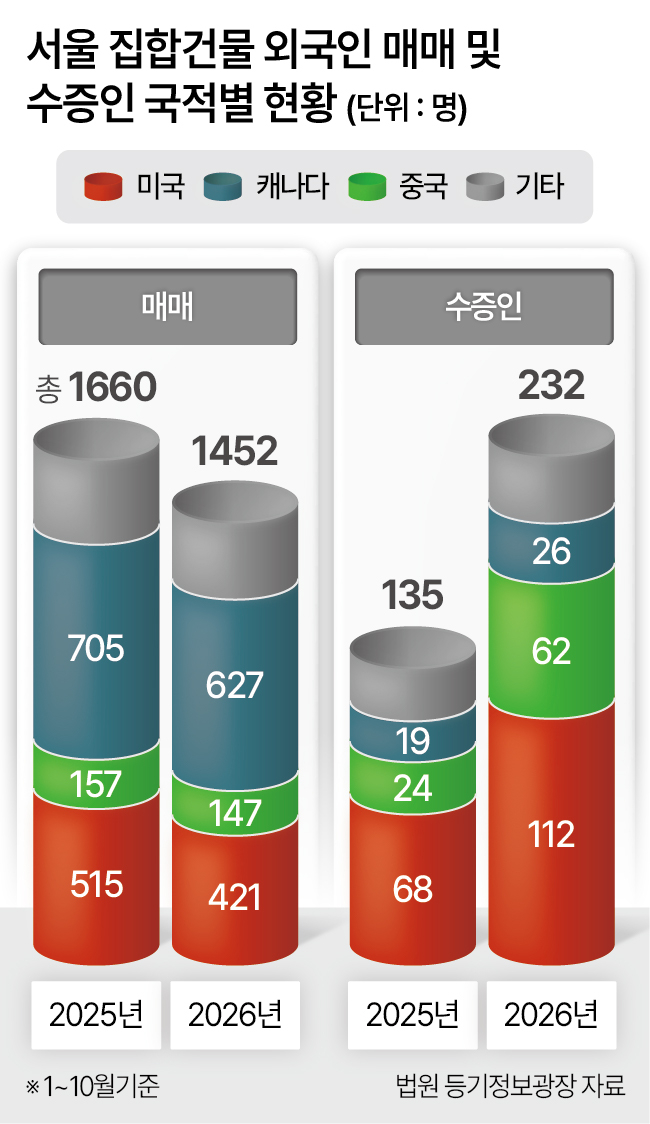
According to the Court Registry Information Plaza, 1,452 foreigners applied for ownership transfer registrations for Seoul collective buildings through purchases in the January–October period this year, down from 1,660 in the same period a year ago. The decline is attributed to regulations that took effect Aug. 26 last year, when all of Seoul, along with parts of Gyeonggi Province and Incheon, was designated a foreign land transaction permit zone. Under the rules, foreigners who obtain permits to purchase housing must move in within four months of the permit date and reside there for two years.
All three nationalities with the highest buyer counts posted declines over the period. Chinese nationals remained the largest group, though their numbers fell 11.1 percent, from 705 to 627, still accounting for 43.2 percent of the total. American nationals saw the steepest drop among the top three, falling 18.3 percent from 515 to 421. Canadian nationals declined 6.4 percent, from 157 to 147.
Meanwhile, the number of foreigners receiving Seoul collective buildings as gifts rose 71.9 percent, from 135 to 232, over the same period. American nationals made up the largest share of gift recipients at 112, or 48.3 percent, followed by Canadians at 62 (26.7 percent) and Chinese nationals at 26 (11.2 percent). Of the American recipients, 55, or 49.1 percent, were concentrated in the three high-end Gangnam districts — Gangnam-gu, Seocho-gu and Songpa-gu — and Yongsan-gu.
The trend mirrors the broader Seoul real estate market. The total number of gift recipients for Seoul collective buildings rose 62 percent over the same period, from 7,708 to 12,522.
The surge in gift transfers is a direct consequence of how the land transaction permit system works. The permit requirement applies only to transactions involving payment. Gifts, which involve no monetary exchange, are exempt from the permit process and therefore do not trigger the owner-occupancy requirement.
Industry insiders say the rise in foreigners receiving Seoul real estate as gifts also reflects cases in which parents living in Seoul have transferred apartments to their children who acquired foreign citizenship through emigration or marriage — a group sometimes referred to in Korea as "black-haired foreigners."
Kim Hyo-seon, a senior real estate specialist at KB Kookmin Bank, said the motivations are varied. "There are cases where assets are transferred to children with foreign citizenship who cannot afford to buy a home amid rising prices, cases where parents gift property in advance to children planning to return to Korea in order to sidestep loan and residency regulations, and cases where multi-property owners are looking to consolidate their holdings," Kim said. "This suggests that wealthy asset holders are acting on the judgment that now is the best time to give, given the current regulatory environment including tax reform."
A real estate consulting specialist said parents currently living in Seoul often grapple with how to transfer an apartment to a child who has acquired foreign citizenship through emigration or marriage. "However, details such as the proportion of apartments involved and the nationality relationships between donors and recipients are limited by available administrative data, and the statistics will need to be supplemented going forward," the specialist added.
Yun Su-min, a real estate specialist at NH NongHyup Bank, said the trend extends beyond housing. "There are also cases where the parent generation, feeling burdened by holding not just homes but also retail units and neighborhood commercial facilities, turns to gifting for tax-saving purposes," Yun said. "Asset holders have likely been wrestling with properties they do not want to sell at a loss but cannot afford to keep."
The number of foreigners receiving Seoul real estate as gifts has been consistently rising. It grew from 98 in 2024 to 170 in 2025, and this year's tally through October has already surpassed last year's full-year figure.
hope@heraldcorp.com