China's 'AI proctor' automatically saves footage when it detects wandering eyes or prolonged head-bowing — 'final judgment stays with humans'
More than 150 flagged as suspects in India's medical entrance exam; the US SAT logs every mouse movement
A technique using a smartphone camera to identify smart glasses by the light leaking from their lenses
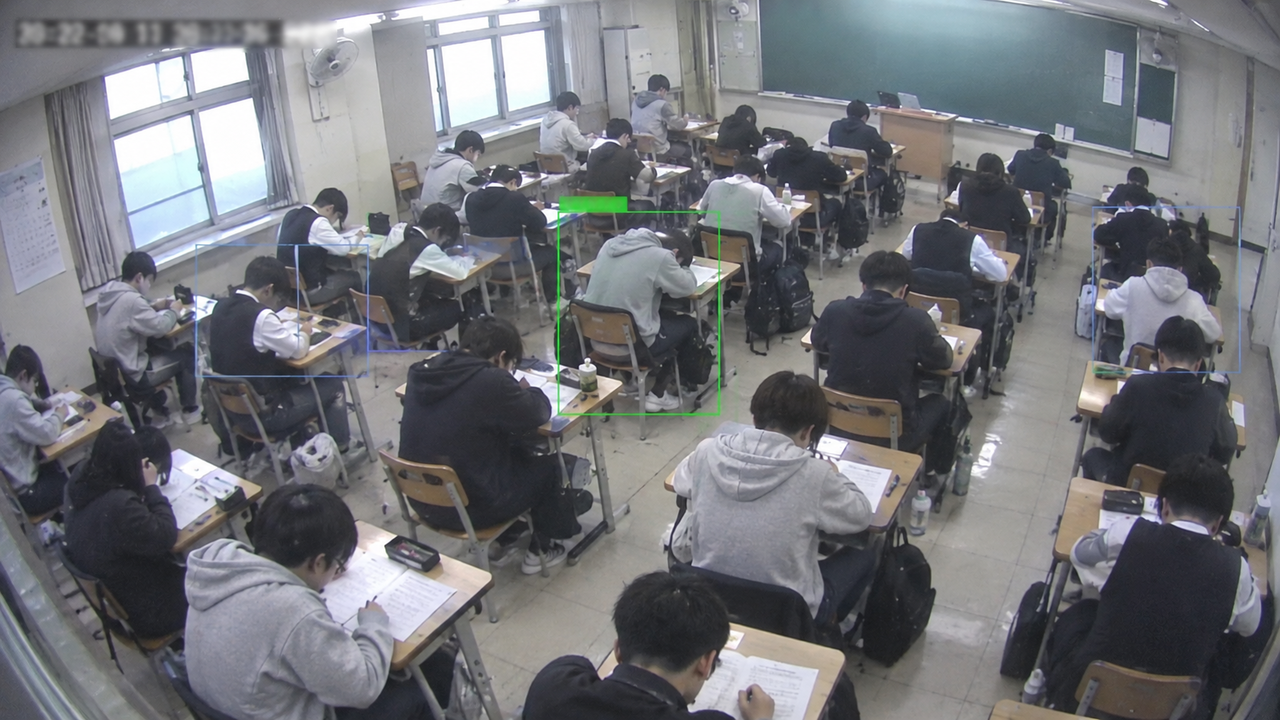
AI systems that flag test-takers for bowing their heads too long or glancing repeatedly to the side — and that monitor the invigilators themselves — are being rapidly deployed at exam venues around the world.
China Mobile, the country's largest telecommunications carrier, partnered with the Ministry of Education's National Education Examinations Authority in 2024 to develop an "AI smart patrol proctoring" system that was deployed across 300,000 exam rooms during this year's gaokao college entrance examination. The system monitored a cumulative total of more than 10 million test-takers.
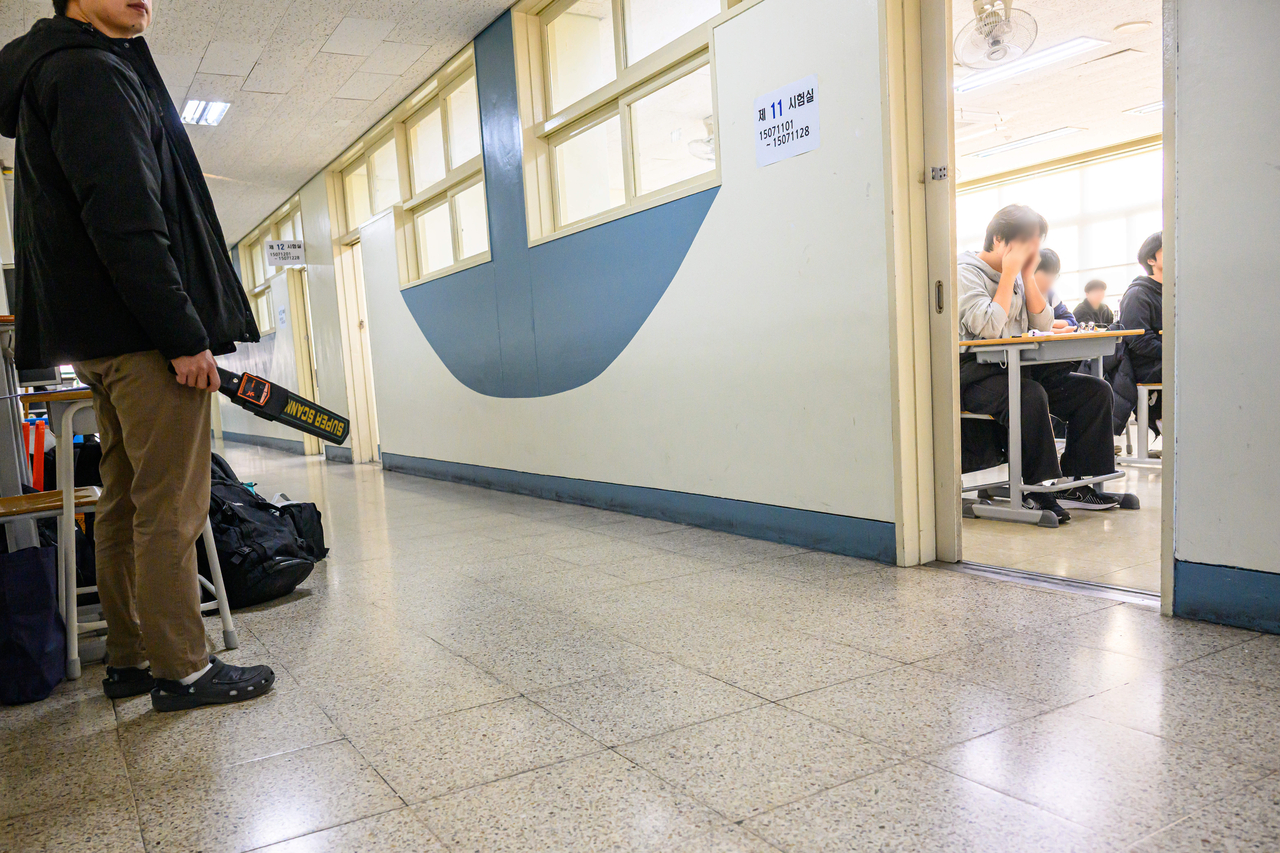
In South Korea, 98 candidates were penalized for cheating during the College Scholastic Ability Test for the 2027 academic year, held Thursday.
According to the Ministry of Education, 49 of them were caught carrying mobile phones after emergency alert messages rang during the exam, and 44 were found in possession of electronic devices. Two test-takers were detected via Wi-Fi signal scanning. Five cases involved candidates caught using smart glasses or miniature cameras during the exam.
Suspicious glances, bowed heads trigger automatic clip saves
China's AI proctoring system operates in two stages. A lightweight AI model rapidly scans footage from exam-room cameras to flag anomalies in a first pass, and a larger AI model then reviews those flagged clips. According to China Science and Technology Daily, the system's accuracy in identifying suspicious behavior is reported to exceed 95 percent.
According to the US-based Chinese-language outlet World Journal, the behaviors the AI targets include frequent sideways glances, prolonged head-bowing and other suspicious movements. When the system detects a suspicious moment, it automatically clips the footage from just before and after the incident and sends it to a patrol platform for review.
Zheng Bilou, an invigilator at an exam venue in Hainan Province, told China National Radio that the AI smart patrol system "captures suspected cheating behavior by test-takers in real time." World Journal reported that some candidates were heard saying they could not even risk sneaking a glance at the ceiling.
According to China National Radio, exam venues in Guangzhou have extended the system's reach beyond test-takers: when the AI detects unusual behavior by an invigilator, it automatically saves the surrounding footage and forwards it to review personnel.
Human invigilators review the AI-flagged footage first, a second invigilator then checks it again, and a chief invigilator makes the final ruling on whether cheating occurred. A China Mobile official said the AI only flags anomalies and has no authority to make final determinations — those decisions rest with on-site and remote invigilators.
130,000 cameras in exam halls, every movement logged
India has also introduced AI proctoring for NEET, its medical school entrance examination.
According to local outlet Patna Press, more than 150 candidates were classified as "suspects" by the AI system during the NEET exam held last May. The system flagged test-takers for making unusual hand gestures or appearing to communicate with other candidates.
According to India's Free Press Journal, when more than 2.2 million candidates sat a NEET re-examination last June, the National Testing Agency installed 138,560 CCTV cameras across approximately 95,000 exam rooms at 5,440 venues, with AI monitoring the sites in real time. Some 51,311 signal jammers were also deployed.
For the computer-based US SAT, surveillance takes place inside the test-taker's own device.
Under the privacy policy of Bluebook, the College Board's official SAT app, candidates taking the SAT outside the United States on weekends using a Windows laptop must grant the College Board administrator-level access to their computer for the duration of the exam.
Every interaction a test-taker has with the exam screen is recorded. The College Board logs where the mouse is positioned, where clicks occur, how long the cursor lingers on any part of the screen and which keys a candidate attempts to press. For some exams administered outside the United States, cursor movements and screen captures are also collected.
With separate consent, the College Board may also collect biometric data — including facial images captured by the laptop's front-facing camera and keystroke dynamics — to help detect cheating.
The College Board's expansion of surveillance was driven in part by a hacking program called "Auto SAT."
According to University Herald, a US higher-education outlet, the program went on sale this past March for $499 and was capable of bypassing Bluebook's screen lock and using AI to facilitate cheating.
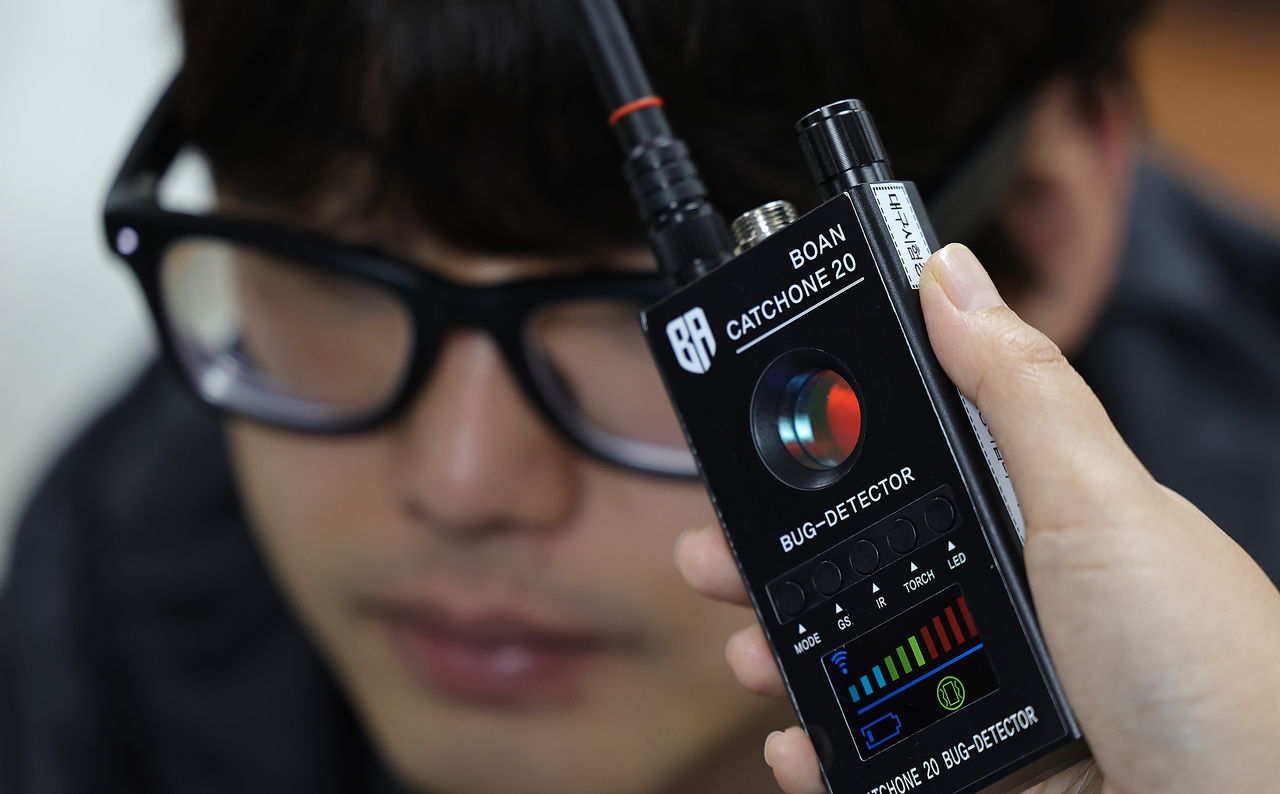
Catching glasses by their leaking light — and their Bluetooth 'name tags'
A research team at Duke University — Harding Ye, Tianyi Hu and Maria Gorlatova — presented a technique for detecting smart glasses using a smartphone camera at HotMobile 2026, a mobile computing workshop held last March.
Smart glasses lenses contain a thin layer called a waveguide, which carries light from a small display in the temple arm to the wearer's eye. The waveguide projects text or answers in front of the wearer's field of vision.
Viewed straight on, the lens looks transparent and indistinguishable from an ordinary lens. But viewed at an angle, light leaks from the display and causes a faint glow around the eye area. When ambient light strikes the microscopic structures inside the lens, it bends and produces a rainbow-like pattern.
When the research team moved a smartphone camera around the glasses while recording, the smart glasses lenses showed light leakage and rainbow patterns that appeared and disappeared depending on the viewing angle, with sudden shifts in brightness.
Ordinary prescription lenses show no significant change in brightness across different viewing angles.
The team said the difference allows examiners to determine whether a candidate is wearing smart glasses without touching the person or asking them to remove the glasses.
The approach does require a person to manually sweep a smartphone around the glasses and capture footage from multiple angles — a practical limitation. To address this, the team also demonstrated a robotic scanning device and a guided app that walks a human operator through the capture process.
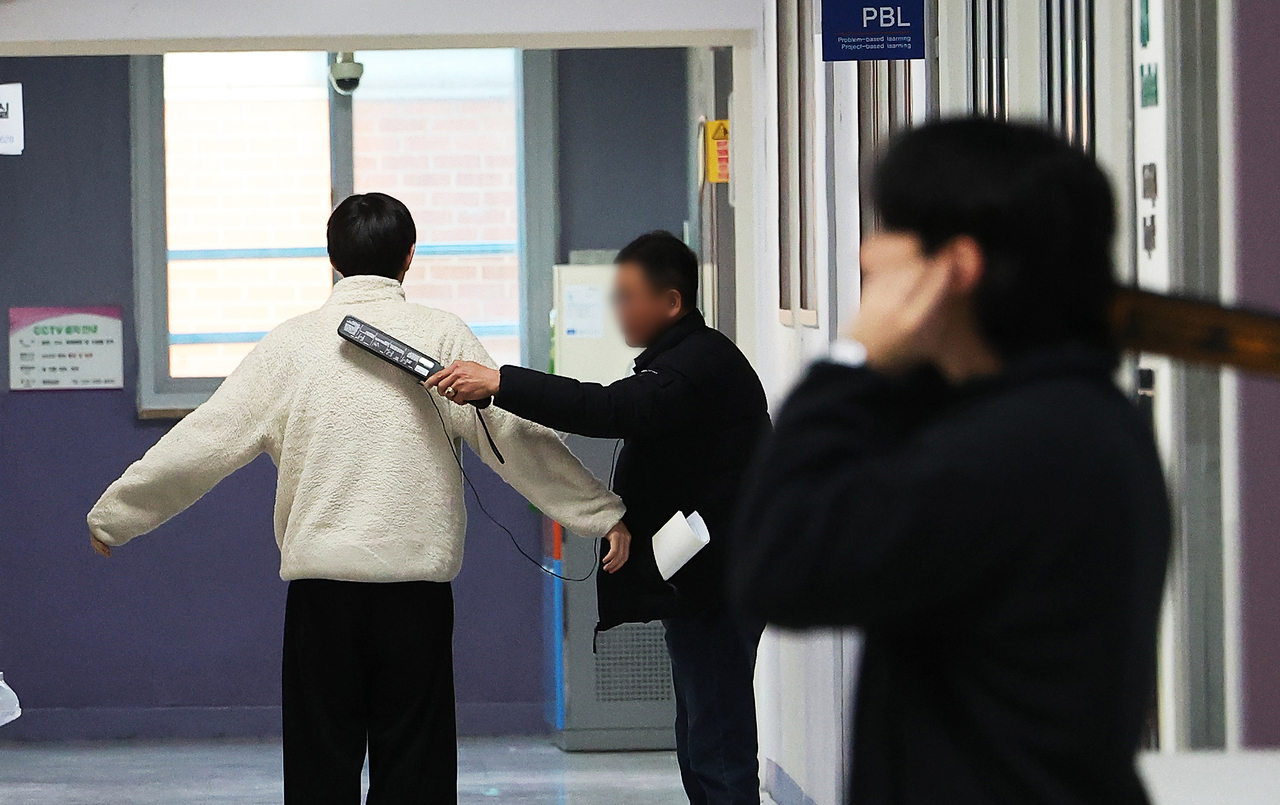
Smart glasses can also be detected via Bluetooth signals. Smart glasses continuously broadcast Bluetooth signals in order to pair with a smartphone. Embedded in those signals is a unique identifier assigned to each manufacturer by the Bluetooth Special Interest Group, the international standards body for the technology.
According to US tech outlet TechCrunch, an Android app called "Nearby Glassies," developed by Yves Janreno, continuously scans for nearby Bluetooth signals and triggers an alert when it detects an identifier matching a known smart glasses manufacturer.
Users can set a detection range based on signal strength, so that alerts fire only for glasses in the immediate vicinity.
According to US tech outlet Engadget, the app offers an effective detection method but can only identify glasses that are actively broadcasting a Bluetooth signal.
Janreno described the app to US outlet 404 Media as "a small act of resistance against surveillance technology."
Thomas Corbin, a researcher at Deakin University's Centre for Research in Assessment and Digital Learning in Australia, warned in the Times Higher Education that "there is in effect no foolproof way to detect these devices" and that "simply believing you can spot them visually is not enough."
dbsdn1110@heraldcorp.com