Toss Insight holds 'Future Finance Forum' on Tuesday
Repayment capacity, not credit history, drives delinquency risk
Data sharing seen narrowing information gaps, intensifying rate competition
FSC vows to streamline data-combination procedures
Borrowers with credit scores just one point apart can have delinquency rates that differ by more than sixfold, new research shows — a finding that underscores how credit assessments built around financial transaction histories alone may fail to capture a borrower's actual repayment capacity and default risk. Analysts say AI and MyData could lower barriers to credit for underserved borrowers while reshaping competition among financial institutions and even altering how monetary policy transmits through the economy.
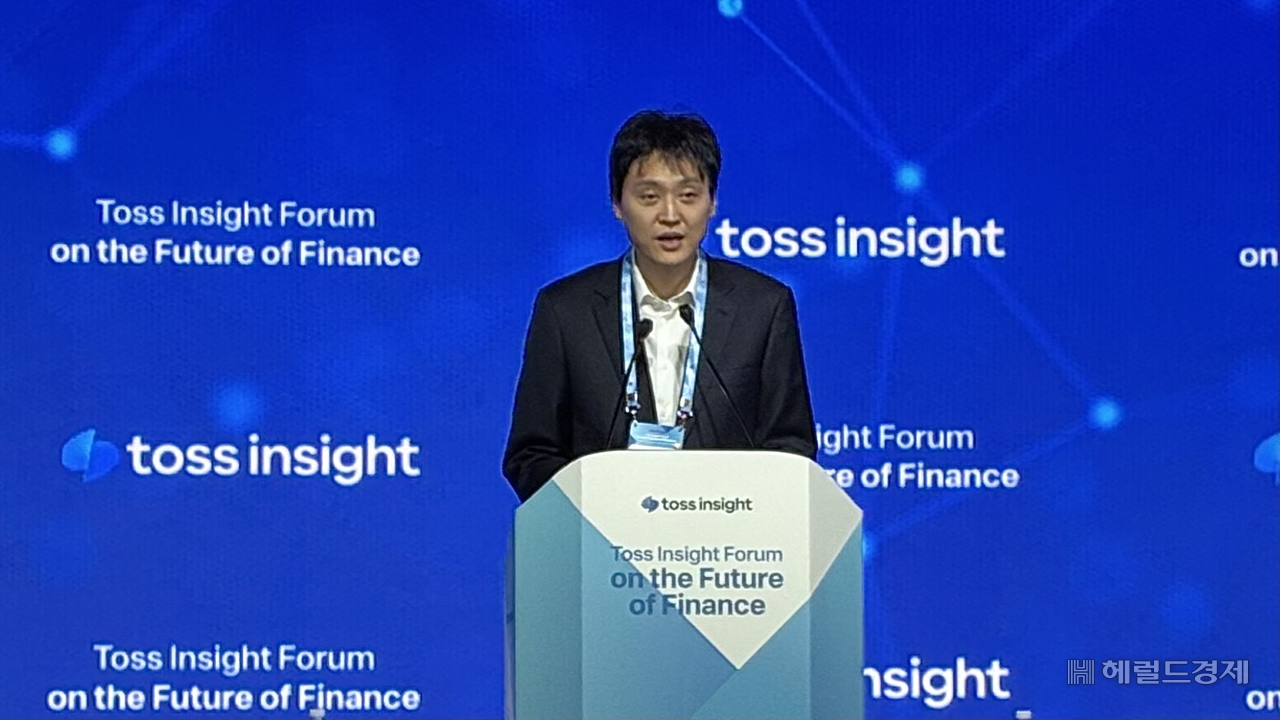
Toss Insight held the Toss Insight Future Finance Forum at the Westin Josun Seoul in Jung-gu, Seoul, on Tuesday, bringing together industry and academic voices to discuss how technological advances are transforming the financial sector and what regulatory changes are needed to keep pace.
Noh Yu-cheol, team leader of Toss Insight's innovative finance research team, said MyData can fill the gaps left by conventional credit scoring. An analysis of borrowers' liquidity positions and credit card billing data found that two groups separated by a single credit score point showed delinquency rates more than six times apart. Even among borrowers with similar repayment capacity, those with shorter financial transaction histories had median credit scores roughly 100 points lower. "Their scores are low simply because they haven't been observed," Noh said.
Data sharing could also narrow the information gap between financial institutions. In one Toss Insight analysis, a card company with a low customer market share could predict overseas payment behavior for only about 3 in 10 of its customers using its own data alone — but when it incorporated data from other card companies, that predictive reach rose to roughly 7 in 10. "Financial institutions will find it increasingly difficult to retain customers on the strength of a long relationship alone," Noh said.
The spread of financial platforms may also change how benchmark interest rate moves feed through to lending rates. Noh said that after the mortgage loan refinancing infrastructure launched in 2024, mortgage rates fell more than corporate lending rates during periods of rate cuts and rose less during periods of rate increases. Price competition among financial institutions, the analysis suggests, can reshape the transmission channels of monetary policy.
If AI agents begin comparing and switching financial products on behalf of customers, bank revenue models could shift as well. Yoo Jae-won, team leader of Toss Insight's digital finance research team, said that as customer mobility increases, lending rates will fall and funding costs will rise, compressing banks' interest margins.
Financial regulators said they plan to reform rules to support broader data use. Kim Jin-hong, director general of the financial industry bureau at the Financial Services Commission, said "data is the most important asset in the AI era" and pledged to promote data combination and simplify procedures related to pseudonymization and synthetic data. Kim also flagged concerns about the so-called 5-5-7 regulation — which sets uniform requirements for the share of IT and information-security staff and budgets at financial firms — but cautioned that "shifting to self-regulation amid a string of IT incidents would require broad social consensus."
Risks from the spread of AI were also raised. Choi Jae-won, a professor in the economics department at Seoul National University, warned that if AI investment decisions and orders converge in one direction, markets could crash sharply. Baek Yeon-ju, a researcher at the Korea Institute of Finance, said clear principles for allocating liability among service providers must be established to address accidents that may occur when AI conducts financial transactions on behalf of consumers.
Former Bank of Korea Governor Lee Chang-yong, who delivered the keynote address, said that even if South Korea has reached advanced-economy standards across financial technology broadly, security remains an exception, and pointed to the limitations of network-separation regulations. His remarks underscored the need to build security frameworks capable of managing risk as AI and cloud adoption expands.
Viva Republica CEO Lee Seung-gun said the industry must harness the potential of AI, data and new payment technologies while managing risks responsibly and building trust. Toss Insight CEO Son Byung-du said AI agents that compare terms across multiple financial institutions and execute transactions on behalf of customers "will emerge before long," and pledged to verify both the promise and the risks of the technology.
snsd@heraldcorp.com