
Last year's heavy snowfall on Gyeongchun Buk-ro prompted the two municipalities to build a joint snow-removal system for their shared border zones; real-time communication channels and brine-spraying drills cut response time by 15 minutes
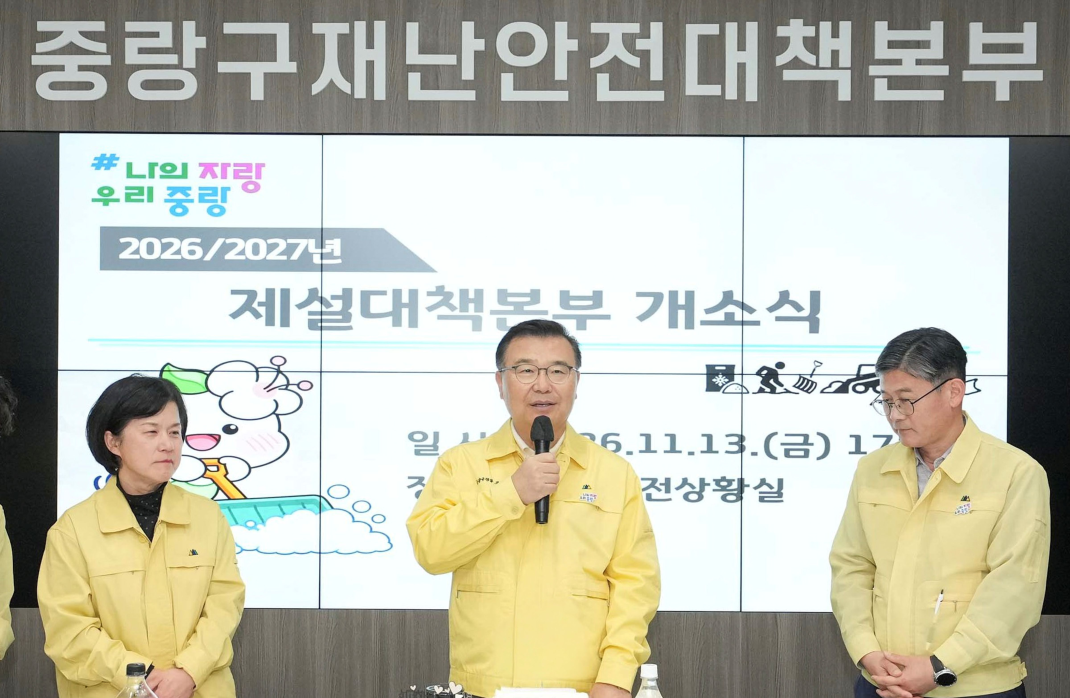
Seoul's Jungnang-gu is building a coordinated snow-removal system with the neighboring city of Guri, bolstering its capacity to handle heavy winter snowfall through field drills and equipment upgrades.
Jungnang-gu said it held a joint meeting with Guri at Guri City Hall on Monday to establish the cooperative snow-removal framework.
The meeting was prompted by a sudden heavy snowfall during the evening rush hour on Dec. 4 last year, which caused severe traffic gridlock along Gyeongchun Buk-ro. The paralysis on roads connecting the two municipalities underscored the need for a joint snow-removal response that crosses administrative boundaries.
The two sides reviewed snow-removal conditions and procedures for key shared stretches — including Mangu-ro to Gyeongchun-ro and Yongmasan-ro to Gyeongchun Buk-ro — and agreed to coordinate pre-treatment timing when snowfall is forecast so that work along border zones begins simultaneously. Should traffic disruptions arise from delayed snow removal or road icing, both sides will immediately share updates and deploy personnel and equipment without delay.
To support this, snow-removal officers from both sides will operate a shared group chat on social media to exchange real-time updates on weather conditions, pre-treatment schedules and equipment deployment. Jungnang-gu will also use its existing coordination channel with the Jungnang Police Station to step up monitoring of ice-prone stretches and traffic conditions.
Field readiness was also put to the test. On Thursday, the district conducted a brine-spraying drill simulating a heavy snowfall scenario at its No. 1 snow-removal forward base in Junghwa-dong and along Jungnangcheon-ro. Two road water trucks and a large wet-salt integrated spreader were deployed to run through the full process from brine loading to on-site application. The drill assumed an emergency mobilization under a Level 3 snow-removal alert, allowing crews to verify appropriate spray volumes, spray widths, and equipment operation and cleaning procedures.
During the snow-removal season running from Nov. 15, 2026 to March 15, 2027, Jungnang-gu will deploy 1,822 snow-removal personnel and 340 pieces of equipment across eight categories. The number of snow-removal vehicles on main arterial roads has been increased from four to six, cutting the average time to complete one round of de-icing agent application from 100 minutes to 85 minutes — a reduction of 15 minutes. The district also plans to continue managing brine storage tanks and inspecting brine injection pumps.
"Reducing traffic disruptions caused by heavy snow requires both swift snow-removal operations and close cooperation between neighboring municipalities," District Mayor Ryu Gyeong-gi said. "We will maintain the joint response framework with Guri and continuously monitor the condition of our snow-removal equipment and personnel to ensure there are no gaps when snowfall hits."
seouldream01@heraldcorp.com





