
Business promotion and unnecessary event costs cut, all projects reviewed from scratch — campaign pledges included; resources secured through rigorous spending restructuring to be channeled into welfare, sports, youth and education
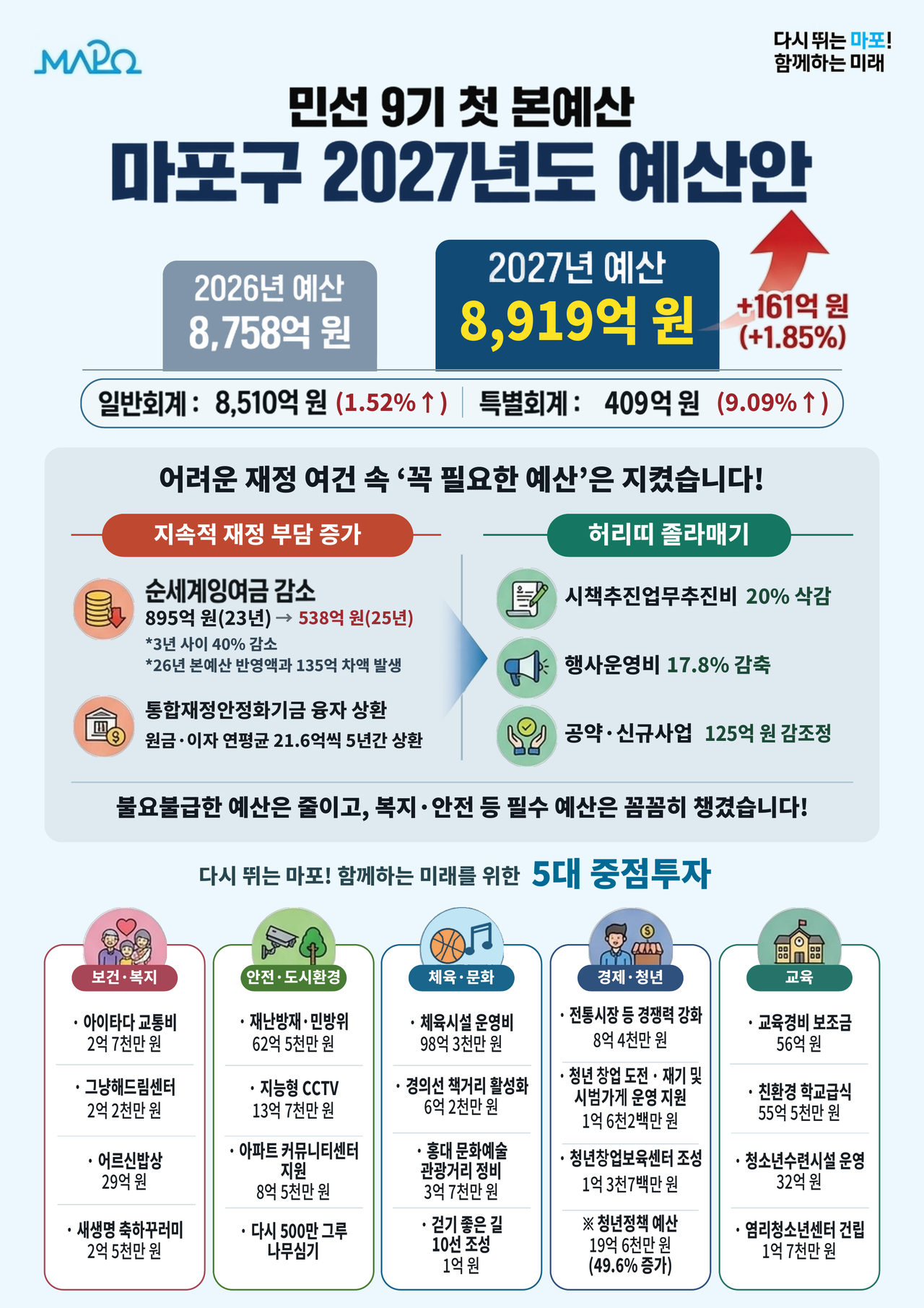
Mapo-gu has submitted its first full budget under the ninth directly elected administration — totaling 891.95 billion won ($662 million) — to the second regular session of the 288th Mapo District Council.
The 2027 budget proposal marks a 1.85 percent increase from this year's 875.77 billion won. The general account rose 1.52 percent to 851.07 billion won, while the special account grew 9.09 percent to 40.88 billion won.
Despite tight fiscal conditions, the budget prioritizes ensuring that spending essential to residents — particularly support for vulnerable groups — is fully reflected without exception.
The fiscal strain is evident in the numbers. The net fiscal surplus carried over from the previous year — funds left unspent under the general account — shrank roughly 40 percent over three years, from 89.5 billion won in 2023 to 53.8 billion won in 2025. Higher budget execution rates and reduced unspent funds meant the actual net surplus from the fiscal year 2025 settlement came in about 13.5 billion won short of the amount factored into this year's base budget.
The shortfall was covered by 2026 general adjustment grants and other sources, which significantly reduced the funds available for next year's budget.
In response, the district reviewed all planned projects from scratch and carried out a rigorous restructuring of expenditures.
Unnecessary events were cut, reducing event operating costs by 731.17 million won — a 17.8 percent drop from this year's base budget. Policy promotion expenses were slashed across the board by 20 percent from departmental requests. Campaign pledges and new projects were reviewed without exception, trimming 12.5 billion won from initial requests and eliminating non-essential projects, while ensuring that spending indispensable to district operations was preserved in full.
Social welfare under the general account was allocated 471.92 billion won — equivalent to 55.5 percent of the total general account and the largest share of any sector — reflecting the district's commitment to protecting residents' livelihoods.
The budget for supporting vulnerable groups, including people with disabilities, was increased 13 percent from this year to 70.92 billion won, with 218 million won set aside for operating a debt-relief support center. For the senior meal program, the district had originally planned to raise its contribution by about 2.2 billion won from this year to 3.9 billion won to reduce reliance on donations, but given the difficult fiscal environment, 2.9 billion won has been allocated in this budget proposal, with the remaining 1 billion won to be reflected in a supplementary budget.
The sports budget, aimed at enriching residents' daily lives, rose 39.4 percent to 15.4 billion won. Of that, 9.83 billion won goes toward operating nine sports facilities, and 539 million won is earmarked for a feasibility study and master plan for a multipurpose cultural and sports center, as part of efforts to promote community sports participation.
The youth policy budget was increased 49.6 percent from this year to 1.96 billion won. For children and teenagers, 5.6 billion won was allocated in education subsidies and 3.19 billion won for operating youth training facilities, supporting young residents as they pursue their goals and grow in Mapo.
To keep Mapo safe and healthy, 6.25 billion won was directed to public order and safety, and 26.29 billion won to public health.
Beyond these areas, the budget distributes funds broadly across sectors closely tied to residents' daily lives, including support for small businesses and neighborhood commercial districts, and improvements to the local transportation environment.
The district said it worked to channel savings from belt-tightening into areas where residents need them most, and plans to maintain sound fiscal management through a dedicated task force that monitors everything from revenue forecasting to budget execution.
Mapo-gu District Mayor Yoo Dong-gyun said the district would manage its budget efficiently to fulfill its commitments to residents despite the difficult fiscal environment, adding that it would make every effort to secure external funding — including national and city government grants — to minimize the burden on the district's own finances and ensure stable progress on necessary projects.
The 2027 budget proposal will be deliberated and approved at the second regular session of the 288th Mapo District Council, which opens Wednesday.
seouldream01@heraldcorp.com





