
Export rights cover Europe, Middle East and parts of Asia
Company says Korean military track record will drive overseas sales
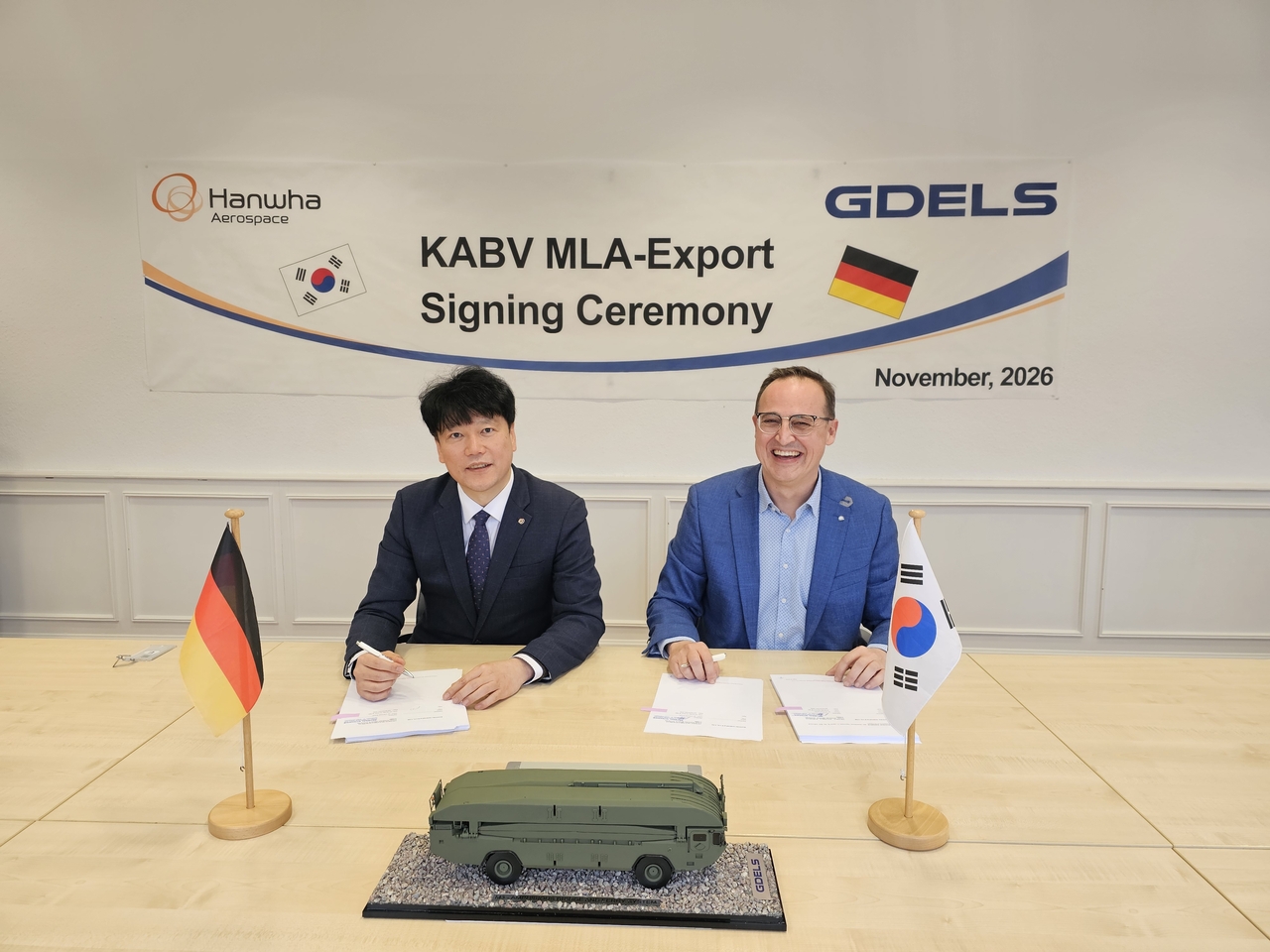
Hanwha Aerospace announced Wednesday that it has secured export rights for the Surong (KM3), a self-propelled amphibious bridging vehicle. It is the first case in which a company that imported the M3 system from an overseas partner and domestically produced it is now pursuing exports of the same platform.
Hanwha Aerospace held a licensed manufacturing agreement (MLA) amendment ceremony with GDELS-BS, the German original equipment manufacturer of the KM3, on Nov. 3 (local time). Among all countries that have imported the M3 amphibious bridging vehicle from GDELS-BS, Hanwha Aerospace is the only one to produce the system domestically and supply it to the South Korean military — and the first to obtain export rights. GDELS-BS is a German subsidiary of GDELS, the European arm of US defense contractor General Dynamics.
The agreement gives Hanwha Aerospace the right to export the KM3 to select countries in Europe, the Middle East and Asia. In export negotiations, the company plans to highlight the KM3's combat-verified performance and a domestic content rate it has raised to 90 percent. Hanwha Aerospace said it intends to pitch its ability to respond quickly to customer requirements and offer performance upgrades and locally tailored configurations.
"This is the result of the South Korean military's stamp of approval organically translating into export potential," a company official said. "By combining the KM3 with our independent K-defense weapon systems such as self-propelled howitzers and armored vehicles, we will be able to drive even stronger export results through competitive package products in overseas markets."
The KM3 is a domestically produced system that enables the army's main combat equipment — including self-propelled howitzers, tanks and armored vehicles — to cross fast-moving rivers. Hanwha Aerospace has been delivering the vehicle to the military since June 2024 and recently completed key validation steps, including field operational testing and a combat-readiness assessment. The company will supply the first production batch through next year, with a second batch scheduled for fielding from 2028. Once the second batch enters service, higher production volumes are expected to improve price competitiveness.
If export deals are concluded, workloads for more than 50 small and medium-sized domestic suppliers are expected to grow, strengthening the supply base for locally made components. There is also expectation that the program could expand into follow-on logistics support, maintenance and additional exports of domestically produced parts.
"Securing these rights has laid the groundwork for us to lead KM3 export efforts," said Park Mae-hun, head of Hanwha Aerospace's LS4 project division. "We will do our utmost to expand our export product lineup, pursue stable follow-on domestic production, maximize national interest, and foster mutual cooperation with our supplier ecosystem."
klee@heraldcorp.com





