
Confirmed abuse cases actually declining
Indiscriminate reports targeting teachers
Social stigma and legal burden mount

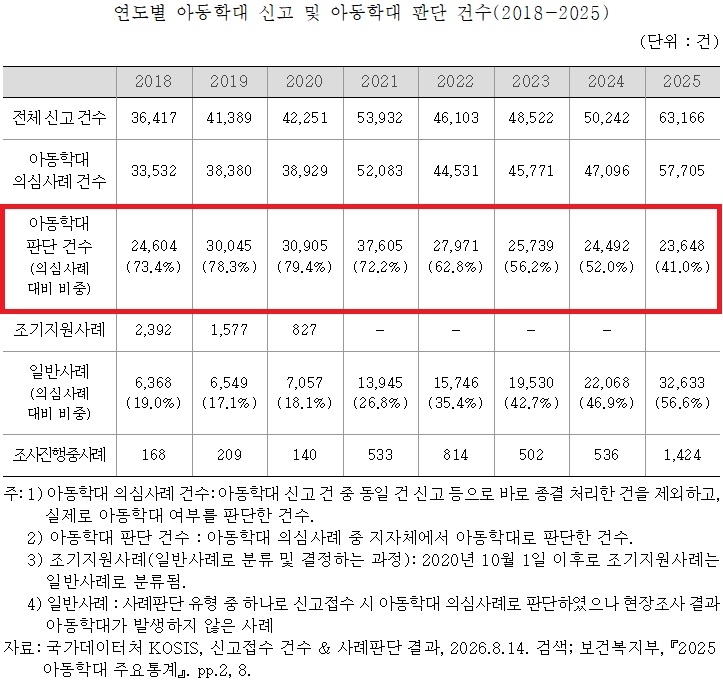
Total child abuse reports have nearly doubled over seven years while the number of cases confirmed as actual abuse has declined, with the fallout from indiscriminate false reports now reaching a serious level, according to a new analysis.
The National Assembly Research Service announced Wednesday that it had published a report titled "Legislative and Policy Responses to Prevent False Child Abuse Reports: A Comparative Review of Major Countries' Legislation."
According to the report, total child abuse reports surged from 36,417 in 2018 to 63,166 in 2025. Over the same period, confirmed abuse cases fell from 24,604 to 23,648. The share of suspected cases ultimately confirmed as abuse plunged from 73.4 percent to 41.0 percent.
Cases classified as "general" — meaning investigations found no abuse had occurred — rose from 6,368 in 2018 to 32,633 in 2025, accounting for 56.6 percent of all suspected cases.
By reporting party, non-mandatory reporters accounted for 83.9 percent of all reports in 2025. Parents filed the most reports at 21,973, followed by children themselves at 17,521 — together making up more than two-thirds of the total.
The surge has created confusion on the ground. Teachers have faced child abuse reports over routine student lifestyle guidance, only to be hit with repeated complaints and malicious civil petitions even after being cleared. In one case, civil servants were dispatched to investigate a traditional folk village field trip after someone filed a report against it.
According to the Korea Federation of Teachers' Associations' 2025 report on teacher rights protection and counseling, 59.2 percent — 74 of 125 consultations related to student guidance — involved child abuse reports.
Since the Child Welfare Act was comprehensively revised in 2000, the response framework has grown more robust, with a shift to a public-led investigation system and the introduction of an immediate separation regime. Yet the absence of a clear legal definition or statistical standard for false reports means accused individuals must navigate lengthy legal proceedings — including non-referral and non-indictment decisions — largely on their own. Experts say additional safeguards at the ground level are urgently needed despite government and legislative efforts.
Rather than harsher penalties, the report proposed a three-stage response grounded in the principle of subsidiarity.
The first stage calls for subdividing general cases into subcategories — Alert, early support, simple misidentification and malicious — and publishing the findings. The second stage involves establishing criteria within Ministry of Health and Welfare guidelines to distinguish false reports and formalizing cooperation with investigative agencies. The third stage proposes amending the Child Abuse Punishment Act to create a specific offense of "false child abuse reporting" and introduce special civil and criminal relief provisions. The report also recommended exempting simple misidentifications and immature judgments by children themselves from liability, to prevent genuine reports from being chilled.
"In a situation where false reports persist and are being exploited, we must gradually build careful and balanced institutional wisdom that preserves the original purpose of the system while providing robust protection for innocent accused individuals from malicious abuse," the report said.
thlee@heraldcorp.com





