
Survey by Korea Population, Health and Welfare Association finds 60.5% worried about developmental delays from premature birth; 54.5% got only 2–4 hours of uninterrupted sleep in first 6 months
Seven in 10 parents of twins or other multiple-birth children say lack of rest and sleep was their greatest hardship during the first year after birth, a new survey shows. More than 60 percent also said they had worried about developmental delays linked to premature birth.
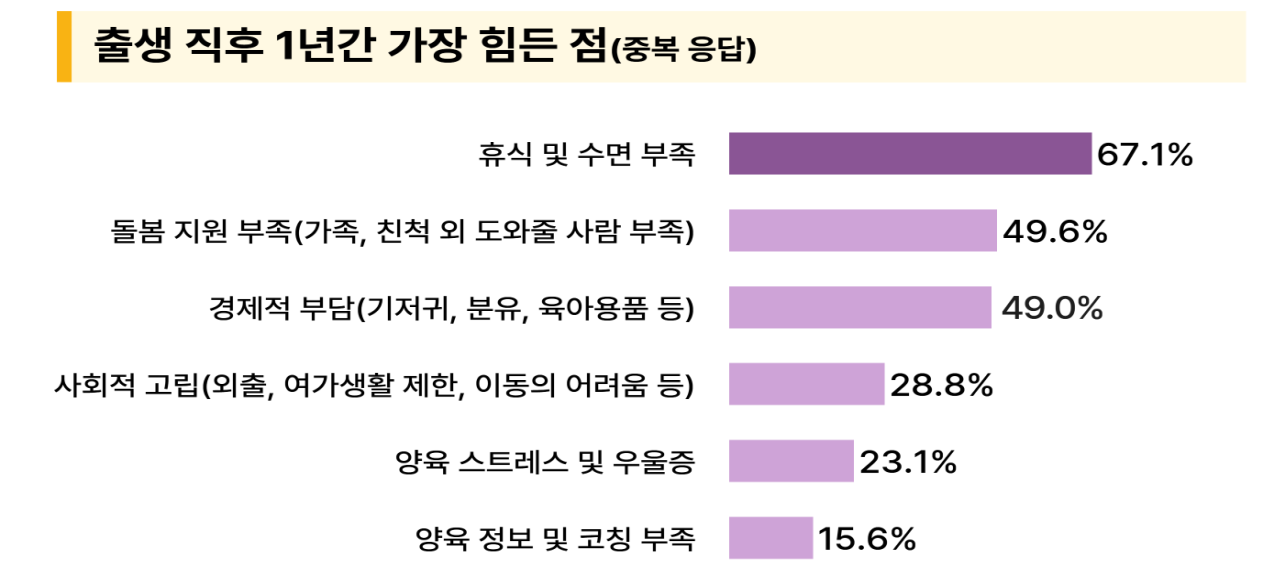
The findings come from a survey on parents' experiences with early support policies for twin pregnancies and child-rearing, released by the Korea Population, Health and Welfare Association ahead of its 2026 Twin Issues Forum on Thursday. Asked to name the hardest aspects of the first year after a multiple birth — with multiple answers allowed — 67.1 percent of respondents cited lack of rest and sleep, placing it first.
That was followed by insufficient caregiving support beyond family and relatives, at 49.6 percent; financial burdens such as the cost of diapers and formula, at 49.0 percent; social isolation due to restricted outings and travel, at 28.8 percent; parenting stress and depression, at 23.1 percent; and a lack of parenting information and coaching, at 15.6 percent.
The severity of sleep deprivation was borne out in detailed sleep-time data.
Within the first six months after a multiple birth, 54.5 percent of respondents said their average daily stretch of uninterrupted sleep was two to four hours, and another 15.8 percent said it was less than two hours. In total, seven in 10 caregivers — 70.3 percent — were getting fewer than four consecutive hours of sleep a day. Only 24.8 percent reported four to six hours.
The elevated risk of premature birth that comes with multiple pregnancies also weighed heavily on parents' minds.
Among respondents, 45.0 percent said their children were born at a gestational age of 32 to fewer than 37 weeks. According to 2025 birth statistics from the Ministry of Statistics, the share of preterm births — defined as fewer than 37 weeks of gestation — was more than 11 times higher for multiple births (73.7 percent) than for single births (6.6 percent). As a result, 60.5 percent of respondents said they had worried about developmental delays in their children stemming from premature birth or related causes.
When asked which period most needed concentrated institutional support — again with multiple answers allowed — 67.1 percent named the period from birth to 12 months, by far the top response. That was followed by 13 to 24 months at 40.6 percent, the full duration of pregnancy at 26.5 percent, and 25 months and beyond at 16.4 percent.
Lee Eun-hwa, a division head at the Korea Population, Health and Welfare Association, said the survey results showed that families with twins face acute difficulties in the first year — from insufficient rest and caregiving support to concerns about developmental delays from premature birth — and proposed that "intensive support be provided through the first 12 months after birth."
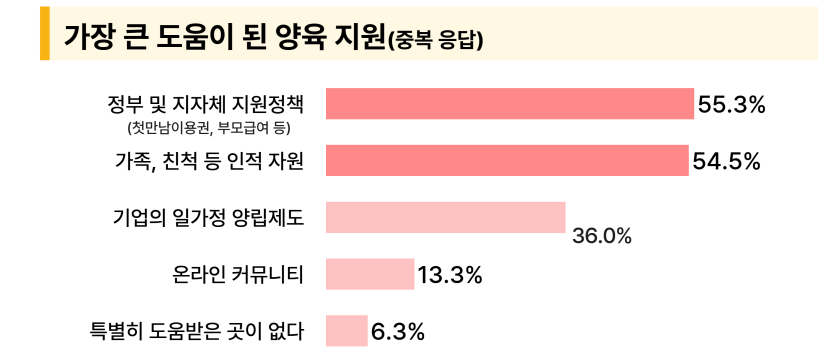
The most helpful forms of parenting support in the first year after birth, with multiple answers allowed, were government and local government support programs — including the first-meeting voucher and parental allowance — at 55.3 percent, and family and relatives at 54.5 percent, both at similarly high levels. Corporate work-life balance programs came next at 36.0 percent, followed by online communities at 13.3 percent.
Meanwhile, multiple births accounted for 6.1 percent of all births in South Korea in 2025, and the rate of higher-order multiple births — triplets or more — reached 0.67 per 1,000 deliveries, the highest in the world among 27 major countries surveyed, where the average was 0.2 per 1,000.
Kim Kyung-sun, president of the Korea Population, Health and Welfare Association, said that while multiple births are increasing due to rising maternal age and the expansion of support for fertility treatments, "the support system remains insufficient relative to the difficulties families with twins face during pregnancy, childbirth and child-rearing." Kim called for "separate, comprehensive and tailored support" specifically for families with multiple births.
thlee@heraldcorp.com





