
Samsung Electronics, SK hynix surrender Tuesday's gains
Philadelphia Semiconductor Index tumbles 8%
AI overinvestment, regulation fears chill sentiment
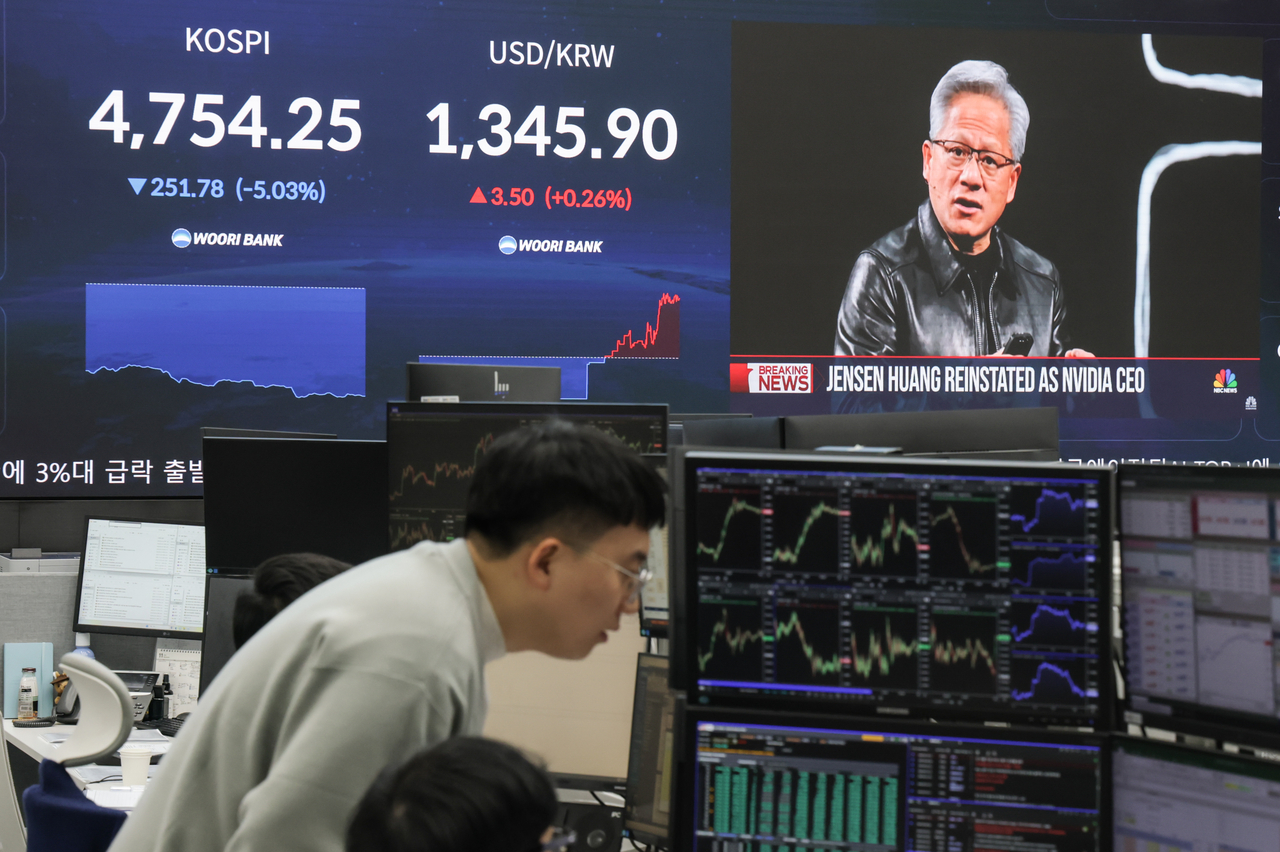
The Kospi, which had been falling for several consecutive sessions, surged more than 6% on Tuesday after news broke that Nvidia CEO Jensen Huang had returned to his post — only to give back nearly all of those gains the very next day, sliding toward the 4,700 level. A sell sidecar was triggered in the early minutes of Wednesday trading.
According to Korea Exchange, the Kospi stood at 4,764.75 as of 9:20 a.m. Wednesday, down 4.82% from Tuesday's close.
The index opened down 3.94% at 4,809.00 and continued to deepen its losses.
On Tuesday, the Kospi had snapped a two-session losing streak, rebounding 6.32% to close at 5,006.03 and barely reclaiming the 5,000 mark. By Wednesday morning, however, it had been pushed back toward 4,700, with volatility widening sharply.
Individual investors were net buyers of 407.1 billion won ($302 million), while foreign and institutional investors were net sellers of 363.2 billion won and 59.3 billion won, respectively.
At 9:08:32 a.m., a swing in the KOSPI 200 futures index triggered a temporary suspension of program sell orders — a sell sidecar — on the main bourse. At the time of activation, the KOSPI 200 futures index stood at 738.20, down 39.90 points, or 5.12%, from the previous session's close.
Wednesday's activation was the 62nd time this year that a sidecar has been triggered on the Kospi market — far surpassing the previous record of 26 activations set during the 2008 global financial crisis.
Samsung Electronics and SK hynix, the two largest stocks on the Kospi by market cap, had risen 6.7% and 6.73%, respectively, on Tuesday, but gave back most of those gains in early Wednesday trading.
Samsung Electronics was trading down 7.23% at 175,700 won, while SK hynix fell 6.74% to 1.08 million won.
Most other large-cap names were also in the red, including Samsung Electronics preferred shares (down 7.13%), SK Square (down 8.11%), LG Energy Solution (down 1.59%), Samsung Electro-Mechanics (down 8.28%) and Hyundai Motor (down 2.18%).
The selloff was driven in part by an 8% drop in the Philadelphia Semiconductor Index overnight in New York, which weighed heavily on chipmaker-heavy domestic markets.
Nvidia shares, which had soared 31.5% on news of Huang's return, closed Tuesday down 5.9% at $55.38 as investors took profits. The company's market cap shrank by roughly $233 billion in a single session.
Market participants noted that despite Huang's return, concerns over excessive AI capital expenditure, stretched valuations and the potential for AI regulation following a midterm election 'blue wave' continued to dampen investor sentiment.
Micron Technology tumbled 11% to close at $629.79. Texas Instruments (down 11.25%), SanDisk (down 11.13%), Marvell (down 9.1%), Arm (down 8.55%) and Western Digital (down 7.84%) also fell sharply.
The Philadelphia Semiconductor Index, which tracks the top 30 chipmakers by market cap, plunged 7.88% to close at 8,832.5.
SK hynix's American depositary receipts also fell 9.9% to $111.98, surrendering roughly 60% of the 20% gain they had posted on Monday in a single session.
Neo-cloud providers — companies that lease AI computing capacity powered by Nvidia chips — also tumbled, with CoreWeave down 11.85%, Nebius down 10.73% and iRen down 11.54%. Anthropic fell 6.54% to $81.91, slipping below its IPO price of $83.
The Kosdaq was down 3.33% at 643.72 at the same time. Individual investors were net buyers of 55.2 billion won, while foreign and institutional investors were net sellers of 50.3 billion won and 6.9 billion won, respectively.
Han Ji-young, a researcher at Kiwoom Securities, said the Kospi's recapture of the 5,000 level on Tuesday had only partially offset last week's steep losses, leaving several hurdles before investor sentiment could fully recover and market flows normalize. "Uncertainties such as the AI circular-financing debate, deteriorating free cash flow at hyperscalers, and concerns about memory chip oversupply after 2028 remain unresolved," Han said. Han added that the key question at this juncture is how much of the extreme pessimism — including doubts about Kospi earnings credibility and arguments that valuations are meaningless — can be unwound as the market works to recover from its sharp decline.

jiyun@heraldcorp.com





