
Construction cost index up 53% while standard building cost rose only 15%
Low purchase price stalls LH public land project ground-breakings
Industry calls for timely reflection of cost increases
The government is moving to update the standard building cost for publicly built rental housing, which has been frozen for more than three years since 2023. The push comes amid growing criticism that project viability has deteriorated and housing supply has been disrupted because the standard building cost has not kept pace with rising material and labor costs. The government plans to examine not only a cost increase but also a possible link to the basic building cost index and whether the standard building cost regime should be retained at all.
According to the Ministry of Land, Infrastructure and Transport's request for proposals for a study on improving the standard building cost for publicly built rental housing, issued Wednesday, the ministry has decided to draw up a revised standard building cost that reflects actual construction expenses and price fluctuations. Based on the study's findings, the ministry plans to prepare a revised official notice and begin consultations with relevant agencies.
The standard building cost serves as the benchmark for calculating the initial rent and deposit on public rental housing, the ceiling on conversion prices for five-year lease-to-own apartments, and the acquisition price of rental units in some reconstruction and redevelopment projects. Unlike the basic building cost — the construction cost benchmark for apartments subject to the price ceiling on new apartments, which is officially announced every March and September — the standard building cost has been revised on an irregular basis.
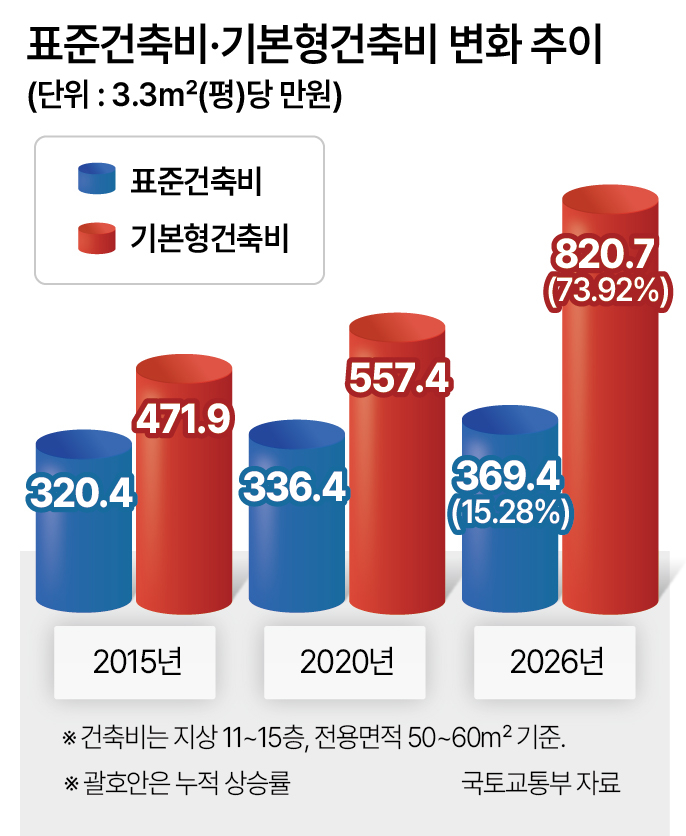
Over the 10 years from 2015 through last year, the construction cost index rose 53.2%, yet the standard building cost climbed only 15.3% — from 970,900 won ($723) per square meter to 1.12 million won. The modest increase reflects the fact that the cost was raised only twice, in 2016 and 2023, partly to ease the housing cost burden on low-income households.
The gap with the basic building cost has also widened. For buildings of 11 to 15 stories with an exclusive use area of 50 to 60 square meters, the standard building cost as a share of the basic building cost fell from 68 percent in 2015 to 60 percent in 2020 and to 45 percent this year. Based on this year's figures, the basic building cost stands at about 8.21 million won per 3.3 square meters, more than double the standard building cost of 3.69 million won.
The ministry said it will also examine whether the standard building cost regime needs to be retained at all, noting that the benchmark for calculating rental housing acquisition prices in reconstruction and redevelopment projects has been shifting toward the basic building cost, and that the standard building cost has seen declining use since the introduction of integrated public rental housing in 2021.
According to the request for proposals, switching the purchase price benchmark for rental housing in redevelopment projects to 80 percent of the basic building cost would produce a price increase of 78 percent compared with the current standard building cost. The study will also analyze how different levels of cost adjustment would affect rents and lease-to-own conversion prices, alongside options for revising the update cycle and linking the standard building cost to the basic building cost.
A ministry official said the specific direction of the overhaul and the scale of any increase "remains to be seen pending the study results." The official added that the ministry would "pursue improvements as quickly as possible after consulting with related ministries, taking into account the impact on consumer prices."
The construction industry argues that the low standard building cost is hampering housing supply. A prime example is Korea Land and Housing Corporation's publicly solicited project for jointly developing public land for rental housing construction, which LH has been running since 2021. Under the scheme, private construction companies receive public land in exchange for LH purchasing a portion of the completed units to use as public rental housing — with the relatively low standard building cost applied to the units sold to LH.
The scheme was structured so that companies bid by proposing the share of units they would provide as rental housing. In the early stages, when competition for public land was fierce, some companies offered to set aside 20 to 30 percent of units as rental housing. As construction costs subsequently surged, sites with higher rental housing ratios have faced mounting profitability pressures, according to industry officials.
The government raised the construction cost benchmark applied to rental housing purchase prices under the scheme from 100 percent to 110 percent of the standard building cost in April last year, but industry voices say the gap with actual construction costs remains wide. In all, 20 public land sites in the greater Seoul area were supplied through this method between 2021 and 2024 — including Namyangju Jinjeop 2, Bucheon Daejang and Yeokgok, Incheon Gyeyang-gu, and Siheung Geomo and Hajung — with a total planned construction volume of 12,784 units. Some sites have yet to break ground despite becoming available for use, citing the burden of construction costs.
The industry is calling for the standard building cost to be linked to the basic building cost so that construction cost changes can be reflected in a timely manner.
A Korea Housing Builders Association official said, "The basic building cost is officially announced every March and September, so construction cost increases are reflected on time, but because the standard building cost is announced irregularly, the gap has grown far too wide." The official added that sites that committed to providing 20 to 30 percent of units as rental housing "are bearing considerable losses."
The official also said that while there had long been concern that raising the standard building cost would increase housing expenses for low-income residents without homes, "the supply system has recently shifted toward integrated public rental housing, which sets rents based on surrounding market prices, so the impact of updating the standard building cost on ordinary residents' housing costs is smaller than it used to be."
Park Hap-su, an adjunct professor at Konkuk University's Graduate School of Real Estate, said the widening gap between the standard building cost and the basic building cost is discouraging construction companies from participating in projects at a time when public rental housing quality also needs to improve. "Because the existing construction cost has been set far too low, there is a need to bring it in line with the basic building cost level rather than simply reflecting inflation," Park said.
Park added that "in public housing projects involving private participation, setting construction costs too low reduces builder participation and ultimately diminishes the effect of expanding housing supply."
quq@heraldcorp.com





