
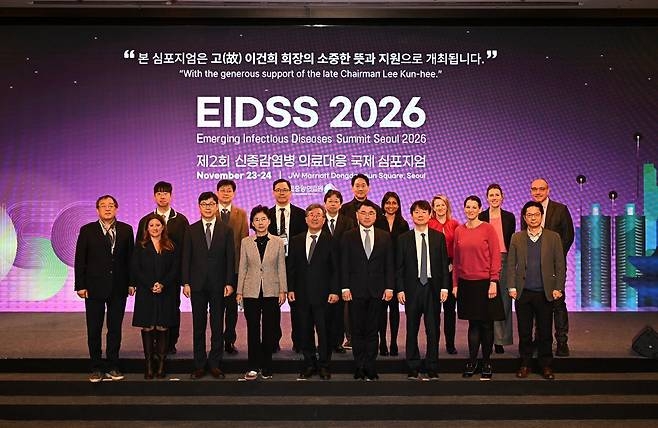
A symposium launched with a donation from the family of the late Samsung Chairman Lee Kun-hee brought together experts this year to discuss building an integrated national and regional medical response system for infectious disease emergencies.
The National Medical Center said it held the 2nd International Symposium on Medical Response to Emerging Infectious Diseases at the JW Marriott Dongdaemun Square in Jongno-gu, Seoul, from Monday to Tuesday. The event, held for the second time following its inaugural edition in 2024, drew about 300 participants, including medical professionals specializing in infectious diseases from home and abroad, as well as government and related agency officials.
The symposium was organized as part of a program to help South Korea overcome infectious diseases, funded by a 700 billion won ($520 million) donation that Lee's family made to the National Medical Center in April 2021. The family said the decision to donate honored Lee's conviction that "improving human health and quality of life is a corporate mission."
Of the total donation, 500 billion won is being directed toward the construction of the Central Infectious Disease Specialty Hospital, which will be South Korea's first dedicated infectious disease hospital. The project has completed its final design phase and is currently undergoing a design adequacy review by the Public Procurement Service, with ground-breaking targeted for next year.
The remaining 200 billion won is being used to expand infectious disease research infrastructure and fund research. Drawing on those resources, the National Medical Center and the Korea National Institute of Infectious Diseases have carried out 17 infectious disease research projects, including one on essential medical care under pandemic scenarios.
kty@heraldcorp.com





