
Union converts Thursday-Friday action into mass rallies, citing risk to hospitalized patients
Government must revise fund plan by Dec. 8 or face full strike and patient transfers
16.12 billion won shortfall this year; 3.6 billion won needed just to follow government's own guidelines
Agency earned 'A' in management review but lacks funds to pay performance bonuses
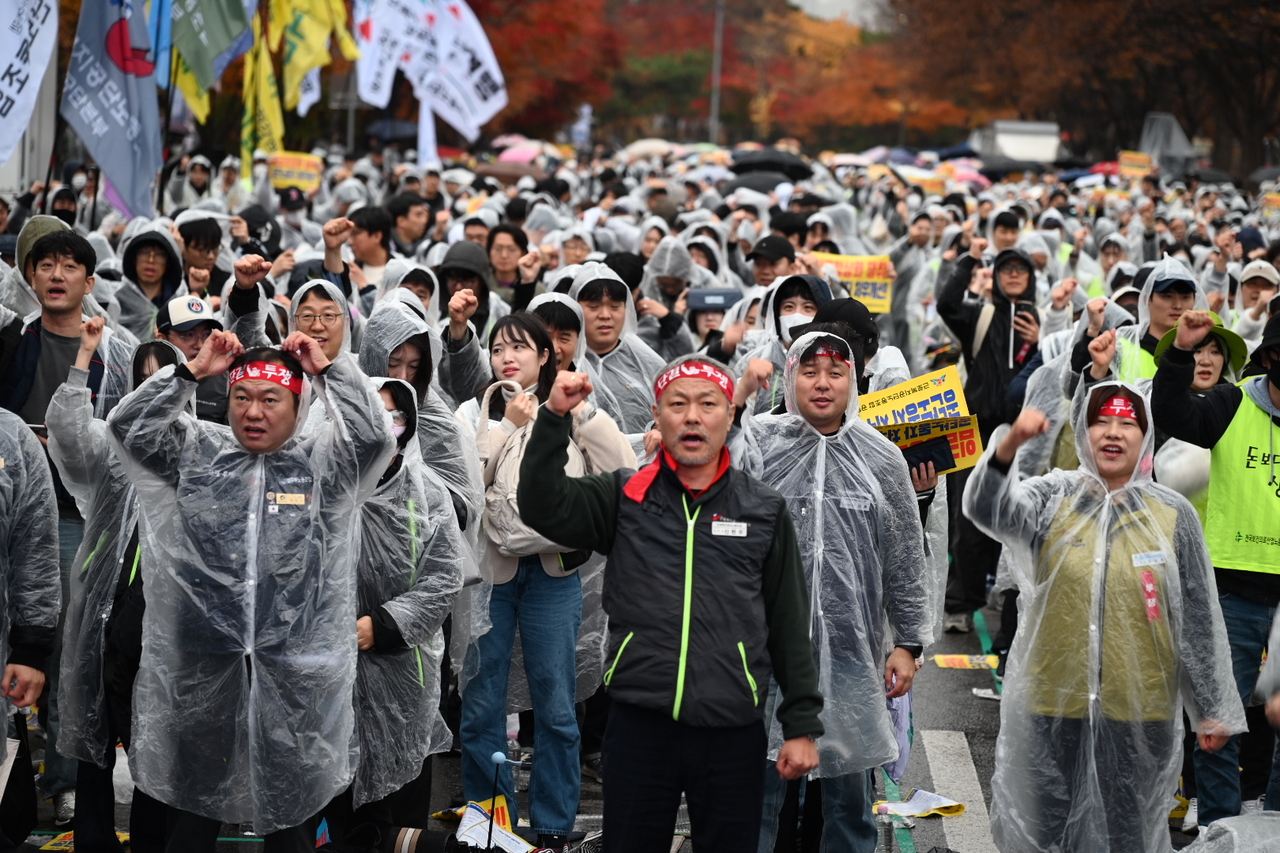
The labor union of the Korea Workers' Compensation and Welfare Service, which had planned a full strike of 8,000 workers Thursday, has decided to postpone the action out of concern for patients hospitalized at industrial accident hospitals. Instead, the union will hold mass rallies Thursday and Friday to build momentum for a general strike. It has set Dec. 8 as a hard deadline: if the government does not revise its fund management plan by then, the union will launch a full strike and transfer all inpatients at its industrial accident hospitals to other medical facilities.
The move follows the National Assembly's standing committee vote to increase the agency's personnel budget for next year, while the government has yet to take concrete steps to cover this year's shortfall of 16.12 billion won ($12 million).
The union's joint struggle committee held a meeting Tuesday and finalized the revised action schedule. The decision to hold off on an immediate strike reflects the burden that transferring hospitalized patients would place on those individuals, and gives the government additional time to revise the fund management plan.
Han Hyeon-ju, secretary general of the Korea Workers' Compensation and Welfare Service union, said in a phone interview Wednesday that "both the Ministry of Planning and Budget and the National Assembly are said to be moving, but nothing has actually been decided." Han added that the committee decided Tuesday to hold general assemblies in the form of mass rallies Thursday and Friday, and that if the fund plan is not revised by Dec. 8, the union will proceed with patient transfers.
Han said the union expects to launch a full strike from Dec. 8, demanding a revision to this year's fund management plan rather than waiting for next year's budget to be reflected. Even if the National Assembly finalizes an increase in next year's budget, Han said a strike would be hard to avoid unless funding for this year's shortfall is secured separately.
Next year's 6.4 billion won budget increase still leaves 16.1 billion won gap this year
The joint struggle committee had previously held two rallies outside the National Assembly in Yeouido, Seoul — on Nov. 12 and Nov. 17 — drawing a combined attendance of 5,000 people. A strike authorization vote passed with 94.93 percent support.
The union's core demand is the normalization of personnel costs for staff positions the government itself approved. When the Industrial Accident Compensation Insurance Act was revised in 2008, the agency added 71 positions to staff newly established occupational disease adjudication and industrial accident review committees — but the personnel costs for those positions were never incorporated into the agency's total wage budget. According to the union, the agency has covered those costs out of existing funds for 18 years, accumulating a total of 98.5 billion won.
The National Assembly's Climate, Energy, Environment and Labor Committee approved a 6.43 billion won increase in personnel costs for those positions Friday, as part of its review of next year's Ministry of Employment and Labor budget. However, the budget must still clear the National Assembly's Budget and Accounts Committee and other final approval steps, and resolving this year's shortfall would require a separate revision to the fund management plan by the Ministry of Planning and Budget.
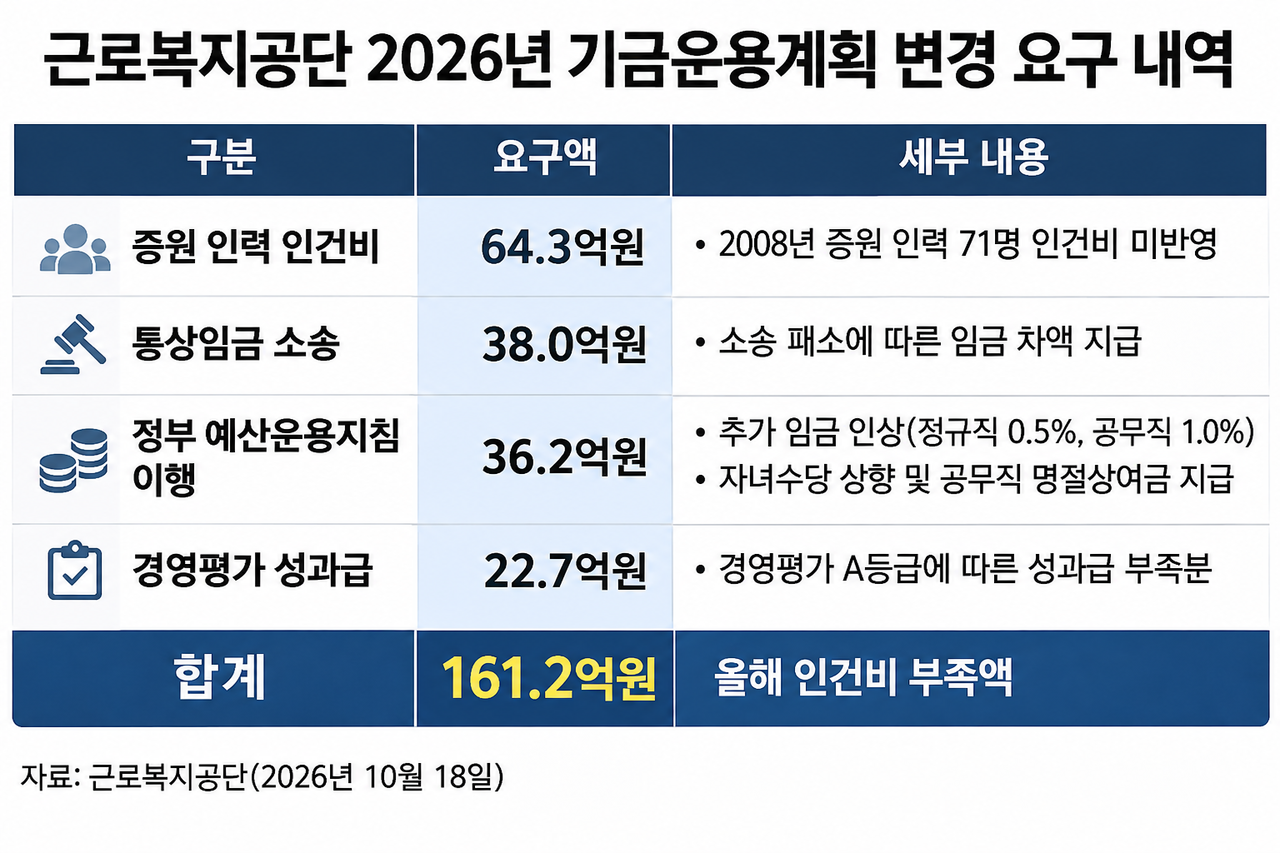
According to a document obtained by The Herald Business — the agency's "Request for Cooperation on Revision of the 2026 Fund Management Plan" — the total additional personnel funding the agency needs to secure this year is 16.12 billion won. The breakdown includes 6.43 billion won in unpaid personnel costs for the 2008 positions, 3.8 billion won in additional payments stemming from a lost lawsuit over ordinary wages, 3.62 billion won needed to implement the government's own public institution budget guidelines, and 2.27 billion won in shortfalls for management performance bonuses.
Notably, the agency lacks even the funds needed to carry out the government's own wage guidelines. The government this year allowed public institutions with wages below the average to raise pay by an additional 0.5 percent for regular employees and 1.0 percent for public service workers. Implementing that policy would cost the agency 1.67 billion won. An additional 1.95 billion won is needed to raise child allowances for employees and pay holiday bonuses to public service workers.
The agency received an "A" rating in last year's public institution management evaluation, yet it is still 2.27 billion won short of the funds needed to pay the resulting performance bonuses. The personnel budget shortfall has effectively blocked both the government-mandated pay improvements and the performance bonuses tied to the government's own evaluation results.
Labor minister cites 'extraordinary measures,' but patient transfers loom
The government has acknowledged the agency's poor working conditions and staff attrition. Employment and Labor Minister Kim Young-hoon told the National Assembly's Budget and Accounts Committee on Nov. 10 that extraordinary measures were needed to improve conditions for agency employees. Planning and Budget Minister Park Hong-keun also said he would hold additional consultations with related ministries.
Despite those statements, the union said no concrete decision on revising this year's fund management plan had been reached as of Wednesday — the day before the originally planned strike.
The agency had requested a 37.01 billion won increase in next year's budget, but the government's initial proposal reflected only 1.69 billion won, or 4.6 percent of the request. Over the past five years, the agency's total requests for additional funding reached 115.57 billion won, of which only 3.98 billion won, or 3.4 percent, was actually approved.
According to settlement data from the public institution management information system released last year, the average annual compensation for Korea Workers' Compensation and Welfare Service employees — excluding physicians — was 62.69 million won, which is 13.77 million won less than the figure at the National Pension Service. The agency ranked 79th out of 88 comparable public enterprises and quasi-governmental institutions. The rate of employees leaving within five years of joining reached 27 percent.
At the same time, the government continues to expand the policy tasks it assigns to the agency, including broadening industrial accident insurance coverage, shortening processing times for accident claims, restructuring employment insurance on an income basis, and expanding the retirement pension business.
If a full strike materializes on Dec. 8, disruptions could spread beyond the processing and payment of industrial accident insurance benefits and employment insurance services to the treatment and rehabilitation of injured workers. The situation points to a broader problem: rigid public-sector personnel cost management has forced the agency to cover 18 years' worth of government-approved staffing costs from existing funds, and left it unable to implement the government's own pay improvement guidelines — a failure that now threatens to create a gap in medical services for industrial accident patients.
fact0514@heraldcorp.com





