
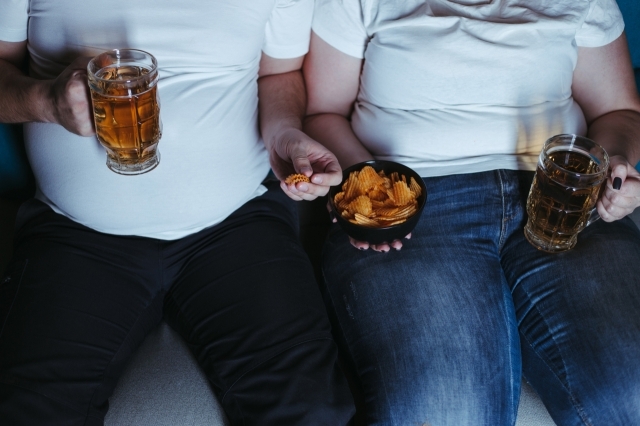
People who watch more mukbang — online eating broadcasts — tend to consume more sugary snacks, a new study has found. While awareness of mukbang's impact on health is growing, only about half of respondents said they support regulating it.
Seoul National University's Health Culture Project released the results Wednesday of a survey on media exposure and health policy awareness, conducted by Korea Research. The survey examined how often people encounter four types of media content — food advertisements, mukbang, alcohol advertisements and smoking scenes — and how they perceive the health effects of and policies around each.
The survey was conducted online using a nationally representative panel of 1,022 adults aged 20 and older from Sept. 4 to Sept. 18. The sample was stratified by region, gender and age, with a margin of error of plus or minus 3.1 percentage points at the 95 percent confidence level.
Food advertisements were the most frequently encountered content in the past week, cited by 79.9 percent of respondents, followed by mukbang at 69.4 percent, alcohol advertisements at 52.1 percent and smoking scenes at 33.6 percent. Some 71.4 percent of respondents said mukbang influences their health habits, compared with 68.9 percent for food advertisements. In total, 78.3 percent said at least one of the two types of content affects their health habits.
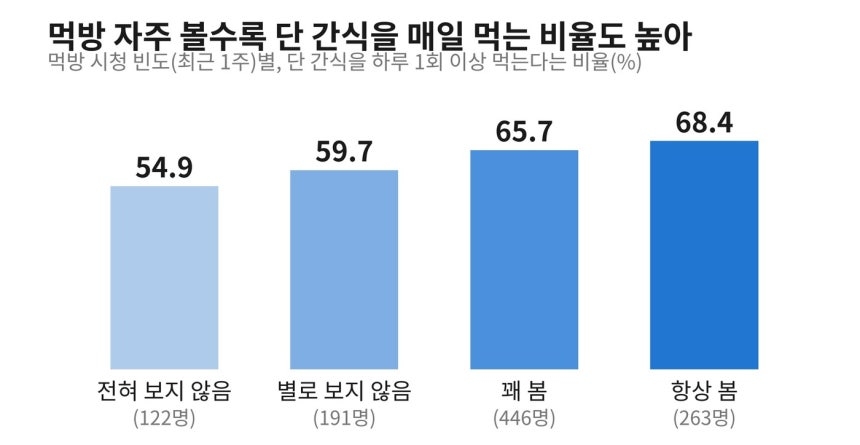
A correlation was also observed between mukbang viewing frequency and sugary snack consumption. Among respondents who had not watched any mukbang in the past week, 54.9 percent said they ate sugary snacks at least once a day. That figure rose to 59.7 percent among those who rarely watched mukbang, 65.7 percent among frequent viewers and 68.4 percent among those who watched it constantly. The pattern suggests heavier mukbang viewers tend to eat more sugary snacks. However, the survey shows only an association between the two phenomena and does not establish that watching mukbang directly causes increased sugary snack consumption.
Despite widespread awareness of media's health effects, respondents were comparatively cautious about regulation. Support for regulating smoking scenes stood at 78.1 percent and for alcohol advertisements at 72 percent, but support for mukbang regulation was limited to 53 percent and for food advertisement regulation to 49.6 percent.
Particularly striking was the generational divide over mukbang regulation. Support among respondents in their 20s reached only 30.4 percent, and 33.5 percent among those in their 30s, but rose to 62 percent among those aged 40 and older — indicating that while people across age groups recognize mukbang as health-influencing content, attitudes toward the need for regulation differ sharply by generation.
Attitudes toward regulating mukbang and food advertisements have changed little compared with eight years ago. A 2018 survey by a research team led by Seoul National University Professor Yoon Young-ho found support for mukbang regulation at 51.9 percent and for food advertisement regulation at 44.1 percent. In the current survey, those figures edged up to 53 percent and 49.6 percent, respectively, still hovering around the halfway mark. Differences in support for regulation by household income were also minimal.
Support for health-friendly policies was higher among those who said they felt the influence of media on their eating habits. Overall, 71.9 percent of respondents backed the introduction of a so-called sugar levy — a surcharge on beverages and other products with high sugar content. Among those who said they felt the influence of mukbang and food advertisements, support reached 75.9 percent, some 18.2 percentage points higher than among those who did not (57.7 percent).
Some 63.6 percent of respondents also supported introducing a "clean health label" certification for establishments selling healthier food options. Support among those who felt media's influence on their diet reached 68.3 percent, compared with 46.8 percent among those who did not — a gap of 21.5 percentage points. Differences in policy support based on frequency of food advertisement exposure or household income, however, were not significant.
Choi Go-eun, a researcher at the project, said the survey "is meaningful in showing that when consumers become aware of the influence of mukbang and food advertisements — which have already become part of our daily eating lifestyle — their support for and sensitivity to health policies increases on their own."
Professor Yoon recommended exploring the introduction of warning labels on mukbang and food advertisements to help consumers quickly and easily recognize their potential harms. Yoon also proposed extending the clean health label certification to restaurants, cafes, convenience stores and bakeries that offer healthier menu options.
123@heraldcorp.com





