
10 billion won earmarked for two matcha processing facilities
Tea output to rise 22% by 2031
Contract farming, cooperative cultivation to secure market access for growers
The South Korean government is seizing on the global matcha craze as a new growth opportunity for the domestic tea industry, pledging 10 billion won ($7.44 million) for dedicated matcha processing facilities and a contract farming system linking growers with food companies. The goal is to lift tea exports to $35 million by 2031.
The Ministry of Agriculture, Food and Rural Affairs unveiled the plan Wednesday as part of its second five-year basic plan for the tea industry, covering 2027 to 2031.
South Korea's tea sector has been weakening under the strain of an aging farming population and labor shortages. The number of tea-growing households fell 21.2 percent, from 3,406 in 2017 to 2,683 in 2024, while cultivated area shrank 16.4 percent over the same period, from 3,050 hectares to 2,551 hectares.
Demand for matcha, however, is surging at home and abroad. The global matcha market is projected to grow from $5.1 billion last year to $8.9 billion by 2033. South Korea's green tea exports also jumped 45.5 percent, from $5.95 million in 2024 to $8.66 million last year.
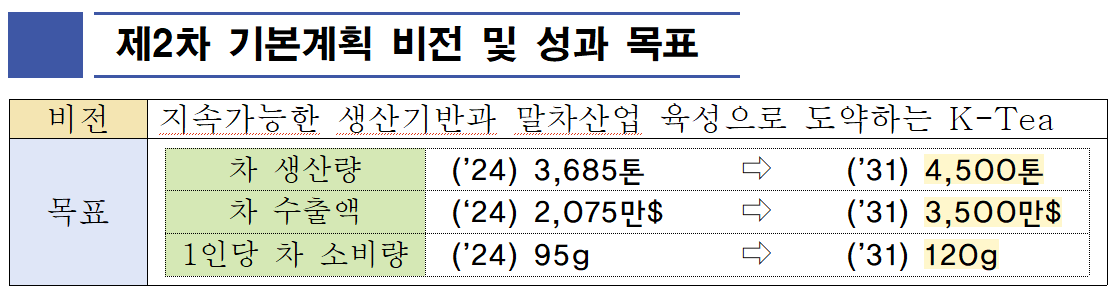
The ministry aims to keep tea cultivation area above 2,500 hectares through 2031 while raising output from 3,685 metric tons in 2024 to 4,500 metric tons. Tea exports are targeted to grow 68.7 percent, from $20.75 million to $35 million, and per capita annual tea consumption is set to rise from 95 grams to 120 grams.
At the heart of the plan is expanding matcha production and processing capacity. Over the next two years, the government will invest a total of 10 billion won to build dedicated matcha processing lines at two major tea-producing regions. The facilities will cover steaming, drying, sorting and low-temperature fine grinding, with the aim of raising annual domestic matcha output from about 650 metric tons to roughly 800 metric tons.
The plan also introduces a contract production system between growers and processing or end-use companies. Under the arrangement, output volumes, quality standards, delivery schedules and purchase terms are agreed in advance, giving farmers a stable sales channel while ensuring companies receive a consistent supply of raw material. A pilot program is set to run from 2027 to 2028 before a gradual rollout.
The ministry will establish industry standards covering the definition of matcha, its color and particle size by intended use, while tightening safety inspections and origin management. Exporters will receive support for obtaining international certifications, attending overseas trade fairs and identifying overseas buyers. In one or two high-potential markets, the government will pilot local hubs combining tasting events and export consultations.
To shore up the shrinking cultivation base, the government will promote cooperative farming and mechanization. Starting next year, a pilot cooperative farming program worth about 3 billion won will help organize growers around demand-side companies and support joint execution of key farm tasks — fertilizing, pruning, shading and harvesting.
Ride-on farm machinery will be developed and distributed for flat terrain, while compact, lightweight equipment will be introduced for hillside plots. The annual supply of high-quality seedlings suited to mechanized harvesting and climate change will expand from 40,000 to 60,000 plants. Young farmers will be offered rental tea fields, on-site training and courses in cultivation and tea processing to lower the barriers to entering the industry.
The ministry will also support product development targeting the growing demand among people in their 20s and 30s for matcha lattes, desserts and ready-to-drink tea beverages. Tasting events and pop-up stores are planned at airports and university districts, and tourism and experience programs in major tea-producing areas — including Boseong, Hadong and Jeju — will be developed to boost consumption of domestically grown tea.
Agriculture Minister Song Mi-ryeong said the plan is designed to "maintain a stable tea production base and translate the growth potential of high-value products such as matcha into higher farm incomes and expanded exports." Song added that the ministry would "concentrate its policy efforts so that Korean tea becomes part of everyday life for our people and K-Tea gains recognition in global markets."
adastra@heraldcorp.com





